Kansas City
A recovery is a rigging problem, not a strength contest. The angle, the anchor and the sequence are what decide whether the unit comes out undamaged.
Winch-outs & recovery in Kansas CityTitan Tow & Repair performs winch-outs and accident recovery 24/7 across Kansas City and northwest Missouri. We pull trucks out of ditches, medians, soft shoulders and docks, upright rolled tractors and trailers, and handle jackknifed units and shifted loads using rated rigging and WreckMaster-certified operators.
Bad rigging wrecks loads and hurts people. Recovery is the part of this job where training is the whole difference.
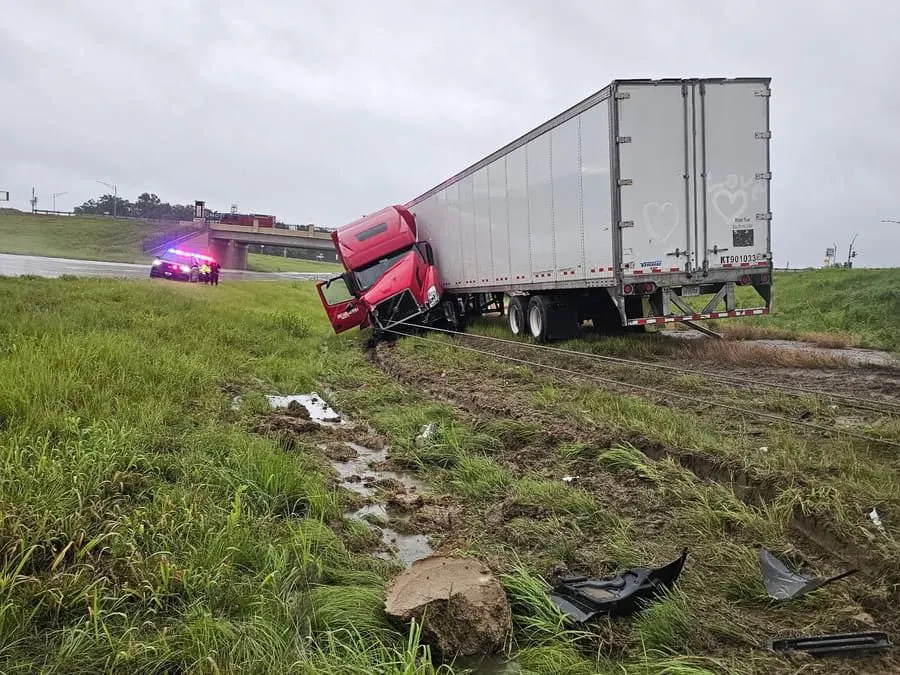
If it is on this list, say so on the phone and the right unit is dispatched the first time.
| Service | Winch-outs & recovery |
|---|---|
| Available | 24 hours a day, every day — nights, weekends and holidays |
| Dispatched from | 2751 Liberty Landing Rd., Liberty, MO 64068 |
| Coverage | Kansas City metro and northwest Missouri, roughly a 60-mile radius, in Missouri and Kansas |
| Typical arrival | About 20–45 minutes across the metro, traffic and weather depending |
| Phone | (816) 888-8732 |
Get clear of live lanes if you can, triangles out, and tell us exactly where you are.
Rigging points, angles and load condition get decided before anything moves.
Once it is on the pavement we tell you whether it drives, gets repaired, or gets towed.
Every city we cover gets the same service from the same yard. Pick yours for local detail — corridors, drive time and what tends to go wrong there.
After a Semi Rollover: What Happens, Step by Step — What follows a tractor-trailer rollover: scene safety, fluids and cargo, how the truck is uprighted, the paperwork carriers need, and what drives cost.
What a Winch-Out or Recovery Actually Costs — What you are really paying for in a recovery — assessment, rigging, equipment class, operators and scene time — and what the invoice should itemize.
Semi Stuck in Mud, Snow or Soft Ground? Stop Digging — Why spinning a drive axle buries a loaded truck deeper, what a winch-out actually involves, and what to tell dispatch so the right rigging comes out.
Winch-Out vs Recovery: What Is the Difference? — A winch-out and a full recovery are different jobs with different equipment and different costs. Here is how to tell which one you are looking at.
Rotator or Wrecker: Which Heavy Tow Truck Does It Need? — What a rotator does that a standard heavy wrecker cannot, when a scene genuinely needs one, and why most heavy tows and recoveries do not.
What Happens to Your Load When the Truck Breaks Down — The three ways freight keeps moving after a breakdown — tow the combination, swap the tractor or hold the trailer — who decides, and what the paperwork needs.
What Does a Heavy-Duty Tow Cost in Kansas City? — Why heavy-duty tows are quoted per job, every factor that moves the number, what an itemized invoice should show, and what to ask before you agree.
More general questions — pricing, insurance, response times — are answered on the FAQ page.
A recovery is a rigging problem, not a strength contest. The angle, the anchor and the sequence are what decide whether the unit comes out undamaged.
Winch-outs & recovery in Kansas CityA loaded tractor-trailer is not a bigger car. It needs a rated wrecker, a rated operator and a plan before anything gets hooked. That is what we send.
Read about heavy-duty towingOur service truck carries the parts and the tools. Faster for your driver, cheaper for your office, and the load keeps moving.
Read about mobile truck repairMost trailer faults do not stop a trailer moving. They stop it being legal to move, which is worse — the load sits while the paperwork says it cannot go anywhere.
Read about trailer repairFleets do not need a hero, they need a truck that turns up and paperwork that reconciles. We do both.
Read about fleet & commercial towingBoth. Cars, pickups and vans that have slid off into mud, snow or a ditch get pulled out with the same care and the appropriate equipment — a rated line on proper attachment points, not a chain around whatever looks solid. The physics are gentler than a loaded semi but the mistakes are the same: pulling from the wrong point or the wrong angle bends things. Tell us what the vehicle is, how far off it went and what it is sitting in, and the right truck comes out.
The pull itself is usually the short part — most of the time on scene goes into assessing and rigging, because the pull only goes well if the setup did. A straightforward slide-off can be back on the pavement quickly; a loaded unit deep in soft ground takes as long as doing it without damage takes. We give you an honest window on the phone once we know how deep, what surface and whether it is loaded, and we would rather quote the realistic version than the flattering one.
Often no. A straightforward winch-out gets a lot of units back on the pavement with no damage and no recovery bill. What moves a job from winch-out to recovery is usually the angle and the ground rather than the distance off the pavement — a unit that has sunk at the drive axles, gone below grade, or come to rest against something needs rigging rather than a straight pull. Send us a photo if you can and we will tell you which truck and how long before we roll.
WreckMaster is the recovery industry’s training and certification program for rigging, load handling and recovery planning. It matters because a recovery is a calculation before it is a pull: the anchor, the angle and the sequence decide whether the unit comes out intact. An unrated pull on the wrong angle can fold a trailer, shift or ruin a load, part a line under tension, or injure the people standing on the shoulder watching it. Certification is the reason we plan a job before anything is hooked.
Yes. We work alongside law enforcement, fire and DOT on highway scenes and follow their direction on lane closures, clearance times and the order things get moved in. On a live scene the agency in charge sets the priorities and we work to them: casualties and traffic flow come before the vehicle, and a recovery sometimes waits for an investigation to finish. If you are a driver at a scene like that, tell us which agency is on it and who is directing the clearance.