A truck has rolled over. Here is what happens next, in order.
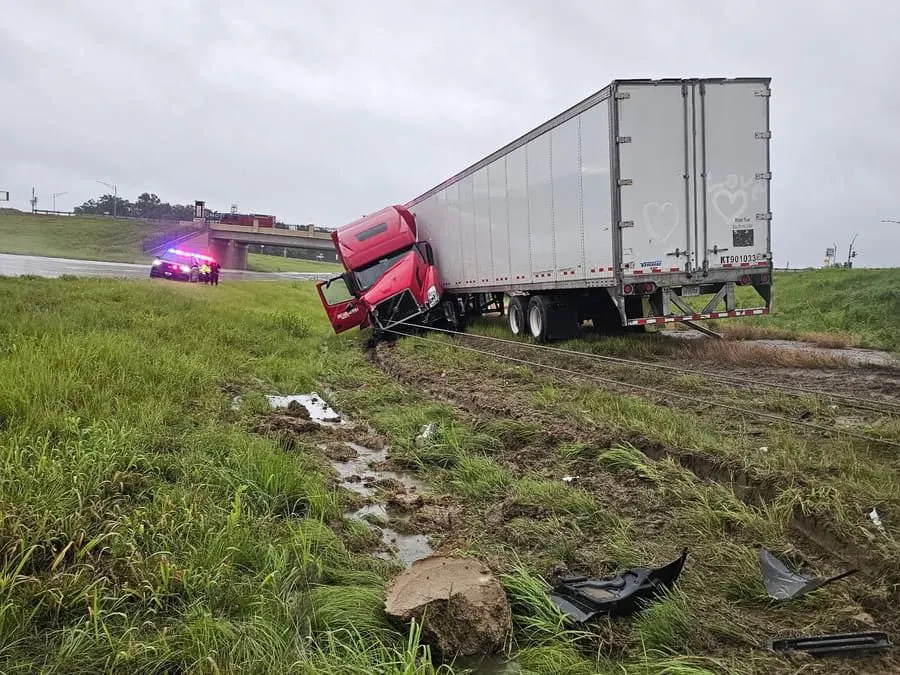
After a rollover, people and the scene come first: emergency services, traffic control, and any leaking fuel or hazardous cargo. Recovery is then planned around the load, deciding whether it can stay in the trailer or has to come out, before the truck is uprighted and towed. Carriers should document the scene and notify their insurer and safety department early.
First: people, then the scene
The first minutes after a rollover have nothing to do with the truck. If anyone is hurt or trapped, or the truck is in a traffic lane, call 911 before anything else. If the truck is carrying placarded hazardous materials, tell the dispatcher that immediately and give the placard numbers if you can read them safely, because it changes who responds and how close anyone should get. Do not climb onto or into an overturned truck except to escape a fire.
Once emergency services arrive, the responding agency controls the scene. Its priorities are the injured, the safety of everyone working around the wreck, and eventually reopening the road. The driver's job at that point is to stay safe, answer questions, and get word to the carrier. Depending on injuries, towing and whether a citation is issued, federal rules can require the driver to take post-accident drug and alcohol tests within set time limits, so the carrier's safety department needs to hear about the crash quickly rather than at the end of the day.
Fluids and cargo before anything moves
An overturned tractor almost always leaks something. Diesel from ruptured fuel tanks, engine oil, coolant and hydraulic fluid can all end up on the pavement or the ground beside it. Before any recovery equipment starts pulling, leaks are stopped or contained as far as they safely can be, because dragging a leaking truck spreads the spill and a large spill can require an environmental cleanup that takes longer than the recovery itself.
The cargo gets the same attention. Is the trailer intact, or has the load broken through the walls or the roof? Is it perishable, fragile, heavy and concentrated, or liquid in a tank? The shipper or the load's owner should hear about the crash early, because their instructions about the freight — whether it can be salvaged, where it should go, who is authorized to handle it — shape the recovery plan.
Planning the upright around the load
The central decision in most rollover recoveries is whether the truck is uprighted with the load still aboard or after some or all of it has been removed. There is no single rule; it depends on the situation, and a competent recovery crew will explain why they have chosen what they have.
- The weight and how it sits. A trailer lying on its side puts enormous strain on its structure when it is rolled back up. A heavy or shifted load can tear the trailer apart during the upright, or spill out as it comes up.
- The condition of the trailer. A trailer whose walls or roof have split can no longer contain its load, so the load may have to come out before anything else happens.
- The type of cargo. Liquids in a tank, livestock, refrigerated food and high-value freight each carry their own handling requirements and their own people who have to be consulted.
- The ground and the space. Soft ground, a slope, a ditch or a narrow roadway limit where equipment can stand and which way the truck can safely be rolled.
- Transloading. When the load has to come out, it is usually moved into another trailer at the scene, which adds equipment, labor and time but can save both the freight and the trailer.
How a rolled truck is actually uprighted
On most rollovers the tractor and trailer are dealt with separately, and uprighting is a controlled pull rather than a lift. Heavy wreckers are positioned and anchored, and rigging is attached to strong points on the frame and axles, never to body panels that would simply tear away. The truck is then rolled back up slowly with winch cables running through snatch blocks, while a second, holding line controls it on the way over so that it comes down onto its wheels instead of slamming onto the far side.
Some scenes call for different methods. Recovery air cushions can be used to raise a unit gently from underneath, and a truck lying down an embankment, against a barrier or somewhere a wrecker cannot line up to pull it may need to be lifted rather than rolled. Our post on rotators versus wreckers explains when a lift is the better tool.
Once it is back on its wheels
An uprighted truck is not a drivable truck. Rollovers commonly damage frames, axles, the fifth wheel, fuel tanks, the air system and the steering, and much of that damage is not visible from the outside. After the upright, the crew checks for new leaks, secures anything loose or hanging, and prepares the tractor and trailer to be towed, usually to a yard or a repair facility where they can be inspected properly and where the insurer's adjuster can see them.
Nobody should drive a truck away from a rollover scene, however intact it looks. The same applies to the trailer: even an empty trailer that rolled and came back up needs its running gear, brakes and structure checked before it carries anything again.
The paperwork carriers should start at the scene
Claims and disputes after a rollover are settled by what was recorded on the day. Whoever is at the scene for the carrier should start this list as early as it is safe to.
- Photographs of the truck, the trailer and the load from every side, before and after the upright, including the seal if it is still intact.
- The name of the responding law enforcement agency and the report or case number.
- The bill of lading, the seal number and the trailer and tractor unit numbers.
- The names of the recovery company and any cleanup or transload companies involved, and who authorized them.
- Key times: when the crash happened, when help was called, when equipment arrived and when the road reopened.
- Where the truck and the trailer were taken, and who to contact to arrange their release.
- The insurance claim number once it has been opened.
What drives the cost of a rollover recovery
Rollover recoveries are priced on the time the job takes, the equipment used, the number of people working, and anything extra the scene requires, such as transloading the cargo, containing and cleaning up spilled fluids, or storing the truck afterwards. A light, empty trailer that rolled onto flat ground is a very different job from a loaded tractor-trailer down an embankment with a fuel spill, and the invoice reflects that. Ask for an itemized invoice that separates those parts, and see what a winch-out or recovery costs for how the pricing works. For who usually ends up paying, read who pays when a truck breaks down.
We run rollover and uprighting work across Kansas City and northwest Missouri with WreckMaster-certified operators, and we work with law enforcement on scene control and lane closures. Describe the scene as precisely as you can when you call — where the truck is lying, whether it is loaded and with what, and whether anything is leaking — and see our winch-out and recovery page for the rest of the recovery work we take on.
Related reading
Semi Stuck in Mud, Snow or Soft Ground? Stop Digging — Stop spinning the wheels.
Winch-Out vs Recovery: What Is the Difference? — A winch-out pulls an otherwise undamaged vehicle back onto the pavement — off a soft shoulder, out of mud or a shallow ditch — and is usually a single truck and a straight pull.
What a Winch-Out or Recovery Actually Costs — Winch-outs and recoveries are priced per job because the work varies more than any other call in towing.
What this covers
Winch-outs & recovery
Bad rigging wrecks loads and hurts people. Recovery is the part of this job where training is the whole difference.
Winch-outs & recovery detailsHeavy-duty towing
A loaded tractor-trailer is not a bigger car. It needs a rated wrecker, a rated operator and a plan before anything gets hooked. That is what we send.
Heavy-duty towing detailsIn a specific city: Heavy-duty towing in Kansas City, Missouri · Heavy-duty towing in Liberty, Missouri · Winch-outs and truck recovery in Kansas City, Missouri