
Heavy-duty towing
A loaded tractor-trailer is not a bigger car. It needs a rated wrecker, a rated operator and a plan before anything gets hooked. That is what we send.
Read about heavy-duty towingTitan Tow & Repair handles fleet and commercial towing across Kansas City and northwest Missouri for box trucks, straight trucks, cargo vans, service vehicles and company cars. We tow to your shop, your yard or ours, work with fleet accounts and insurers, and send invoices with the vehicle, driver, location and time already on them.
Fleets do not need a hero, they need a truck that turns up and paperwork that reconciles. We do both.
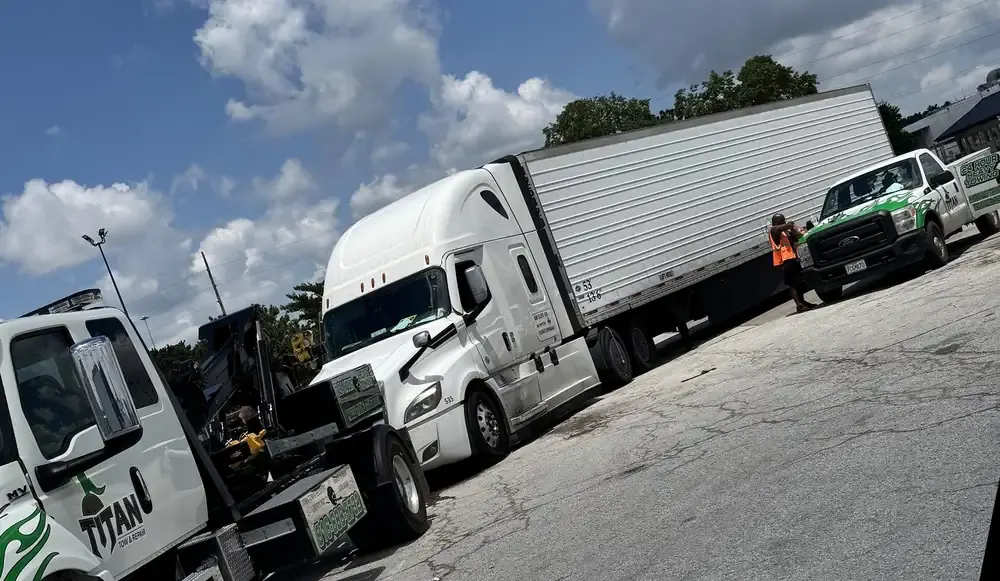
If it is on this list, say so on the phone and the right unit is dispatched the first time.
| Service | Fleet & commercial towing |
|---|---|
| Available | 24 hours a day, every day — nights, weekends and holidays |
| Dispatched from | 2751 Liberty Landing Rd., Liberty, MO 64068 |
| Coverage | Kansas City metro and northwest Missouri, roughly a 60-mile radius, in Missouri and Kansas |
| Typical arrival | About 20–45 minutes across the metro, traffic and weather depending |
| Phone | (816) 888-8732 |
Call us with your billing contact and vehicle list. After that a dispatch is one phone call.
Tell us the unit, the location and the destination shop.
Time, location, driver and destination on the invoice, so nothing bounces back from accounts.
Every city we cover gets the same service from the same yard. Pick yours for local detail — corridors, drive time and what tends to go wrong there.
Who Pays When a Semi Breaks Down: Driver, Carrier, Insurer? — Who normally pays a breakdown bill for a company driver, an owner-operator, a leased-on truck, a rental or a warranty unit — and who authorizes the work.
How to Choose a Heavy-Duty Towing Company — What to verify before a breakdown — insurance, recovery certification, owned equipment and real dispatch — plus the warning signs of a predatory operator.
Semi Won't Start: Jump Start, Batteries or Starter? — How to tell a battery from a connection, a starter or a fuel problem on a semi, how to jump a truck safely, and what a mobile call fixes on the spot.
Air Leak on a Semi: Roadside Fix or Tow? — Where air leaks actually happen on a semi, what the gauges are telling you, which faults a service truck fixes on the shoulder, and which ones need a shop.
More general questions — pricing, insurance, response times — are answered on the FAQ page.
A loaded tractor-trailer is not a bigger car. It needs a rated wrecker, a rated operator and a plan before anything gets hooked. That is what we send.
Read about heavy-duty towingOur service truck carries the parts and the tools. Faster for your driver, cheaper for your office, and the load keeps moving.
Read about mobile truck repairMost trailer faults do not stop a trailer moving. They stop it being legal to move, which is worse — the load sits while the paperwork says it cannot go anywhere.
Read about trailer repairBad rigging wrecks loads and hurts people. Recovery is the part of this job where training is the whole difference.
Read about winch-outs & recoveryYes. Call (816) 888-8732 and ask for an account. We take your billing contact and vehicle list once, and after that dispatching a truck is a single phone call with the unit number — no card at the roadside and no driver trying to authorize a job he has no authority to authorize. Invoices carry the vehicle, driver, location, time and destination, which is normally what an office needs to reconcile the charge against a run.
Yes, and most fleets prefer it. Tell us the destination when you call and the vehicle goes straight there rather than through our yard, which is both faster and cheaper than a two-stage move. Our Liberty yard is available if you need somewhere to hold a unit — overnight, over a weekend, or until a decision gets made about it — and it can be collected from there at any hour without a delivery charge on top.
Often, yes — we run wreckers, flatbeds and a service truck from one yard, so two units down in the metro is a normal day rather than a crisis. What we will not do is promise unlimited capacity: if a storm has half the metro calling at once, we tell you where you are in the queue instead of telling everyone they are first. For fleets that is usually the more useful answer — dispatch can plan around an honest hour, not around a promise that slips.
That is what they are built for. Every fleet invoice carries the unit, driver, location, time, destination and the nature of the work — the fields a claims adjuster or a safety department actually needs to close a file, and the reason offices stop chasing us for reconstructed receipts. If your carrier or insurer needs a specific format or reference on the paperwork, tell us at account setup and it goes on every invoice automatically after that.
We work with insurers and provide the documentation claims departments ask for: vehicle, driver, location, time, destination and the nature of the work. Direct billing depends on the carrier and on the policy, so tell us who the insurer is when you call and we will confirm rather than guess. Where a carrier will not bill direct, we invoice you and give you paperwork in the form the claim needs, which usually settles faster than a reconstructed receipt.