You just had a minor collision in your truck. Here is what to do, in order.
Stop, turn on your hazard flashers and put out warning triangles within 10 minutes. Check for injuries and call 911 if anyone is hurt or the road is blocked. Move the vehicles out of traffic only when it is safe and state law allows. Exchange information, photograph everything, stick to facts rather than fault, call your carrier at once, and inspect the truck before it moves again.
Stop, and make the truck impossible to miss
However small the contact seemed, stop. A clipped mirror in a truck stop, a trailer that touched a car while turning, or a nudge in slow traffic is still a collision, and leaving before you have exchanged information can turn a minor incident into a serious legal problem. Stop as close to the scene as you safely can without creating a second hazard.
Then protect the scene. Under 49 CFR 392.22, when a commercial truck is stopped on the traveled part of a highway or the shoulder, the hazard flashers go on immediately and stay on until the warning devices are out, and the triangles go out as soon as possible and in any case within 10 minutes. On a divided highway all three go behind the truck, at about 10, 100 and 200 feet. Put on a high-visibility vest before you step out, get out on the side away from traffic if you can, and do not walk in a live lane to place a triangle.
Check on people, then call 911
Once traffic is warned, check on the people involved. Do not move an injured person unless there is an immediate danger such as fire. Call 911 if anyone is hurt or complains of pain, if lanes are blocked, if fuel or cargo is leaking, or if the other driver is hostile or appears impaired.
Give the dispatcher your location, how many vehicles are involved and whether anyone is hurt. If a placarded load is leaking, say so first, keep people back and stay upwind.
Moving the vehicles out of traffic: Missouri and Kansas
A damaged car and a stopped tractor-trailer sitting in live lanes invite a second, worse crash. Both states in the Kansas City area expect drivers to clear the roadway after a minor crash when it can be done safely, but the conditions are worded differently, and the responding officer's instructions always come first. This is general information, not legal advice.
Before moving anything, take a few quick photos of where the vehicles came to rest, if you can do so without standing in traffic. Then only move a vehicle that can be driven safely. A truck leaking fuel, with a torn air line, damaged steering or a trailer that will not track should stay where it is until it has been checked. Here is how each state puts it:
- Missouri. RSMo 304.151 says that, except for a crash involving injury or death, a driver whose vehicle obstructs the regular flow of traffic on a state highway must make every reasonable effort to move it, or have it moved, so it does not block traffic. MoDOT promotes this as its Steer It, Clear It law.
- Kansas. K.S.A. 8-15,107 says that, except for a crash involving death or apparent injury, or the transportation of hazardous material, a driver whose vehicle obstructs traffic on an interstate, a U.S. highway or a multilane or divided road must make every reasonable effort to move it, when that can be done safely, does not require towing, and the vehicle can run under its own power without further damage or endangering anyone.
- When not to move. Someone is hurt, the load is hazardous material, the truck is not safe to drive, or police have told you to leave the vehicles in place.
Exchange details and photograph everything
Your carrier and its insurer will build their file from what you collect in the next few minutes, so gather it while everyone is still there. Missouri's leaving-the-scene statute, RSMo 577.060, expects a driver to give their name, address, vehicle registration or license number and driver's license number to the other party or a law enforcement officer, and Kansas law, in K.S.A. 8-1604, requires similar information along with the insurance company and policy number on request. Collect and record:
- The other driver. Name, address, phone number, driver's license number, and the vehicle's plate, make, model and color.
- Their insurance. The insurance company and policy number, photographed from the card if possible.
- The officer. The officer's name, agency and the report or case number, if police respond.
- Witnesses. Names and phone numbers of anyone who saw it and is willing to be contacted.
- Wide photos. The whole scene from several angles, including lane markings, signs, signals, skid marks and debris, taken from safe positions.
- Close photos. The damage to every vehicle, the other vehicle's plate, and your truck and trailer, including the unit numbers.
- The conditions. Time, weather, lighting and road surface, noted while you remember them. Your truck's camera footage, if it has one, should be preserved according to your carrier's policy.
Stick to facts, not fault
Be polite, cooperate with the police and answer their questions truthfully, but do not decide fault out loud. "I'm sorry, I didn't see you" can be read as an admission even when it is meant as courtesy, and nobody at the scene yet knows everything that happened. Stick to what you saw and did.
Do not argue with the other driver, and do not agree to settle the damage privately, which can conflict with your carrier's policy and complicate the claim. Our post on whether commercial truck insurance covers towing explains how claims come into it. For liability questions, ask the carrier's safety department, its insurer or a lawyer.
Call your carrier before you drive another mile
Notify your carrier's safety department or dispatch as soon as the scene is safe, and before you continue the trip. Even a minor collision can trigger federal obligations that the carrier, not the driver, is responsible for deciding and carrying out, and some of them run on a clock measured in hours. Our post on fleet paperwork after a breakdown covers the office side of that. These rules are worth understanding:
- Post-accident drug and alcohol testing. Under 49 CFR 382.303, the employer must test after a crash involving a fatality, and after a crash where the driver receives a citation for a moving violation and someone is treated for an injury away from the scene or a vehicle has disabling damage requiring a tow. The rule sets time limits, which is why you must stay reachable. Whether your crash requires a test is your carrier's safety department's decision.
- Whether it is a recordable accident. Under 49 CFR 390.5, an accident means a crash involving a fatality, an injury treated immediately away from the scene, or a vehicle with disabling damage that has to be towed away. Damage such as a broken headlamp or taillight, or a flat tire with no other damage, does not count as disabling damage. Many minor collisions therefore do not meet the definition, but the carrier makes that call.
- The accident register. Under 49 CFR 390.15, carriers keep a register of those accidents for three years, with copies of reports required by states, other governments or insurers.
- State police reports. Reporting thresholds vary by state. In Kansas, K.S.A. 8-1604 requires a driver to report a crash by the quickest available means when no officer is present and someone is injured or killed or property damage is $1,000 or more. Missouri has its own requirements, so ask the responding agency or your carrier what applies.
Walk around the truck before it moves
A collision that barely dented a car can still leave a truck unsafe to drive. Before pulling away, walk around the whole rig from positions away from traffic, without crawling under it on the shoulder. Look at:
- Tires and wheels. Cuts or bulges in the sidewalls, loose or missing lug nuts, and bent rims on the side that made contact.
- Steering and front end. A bumper or fender pushed into a tire.
- Air and electrical lines. Glad hands, air lines and the electrical cord between tractor and trailer, which a sideswipe can tear.
- Fuel tanks and leaks. Dents, cracks or drips, and any fluid under the truck.
- Lights and mirrors. Broken lamps, damaged reflective tape and mirrors knocked out of position.
- The trailer and load. Damaged doors, panels or rear impact guard, and any sign the load has shifted.
When the answer is a tow or a recovery
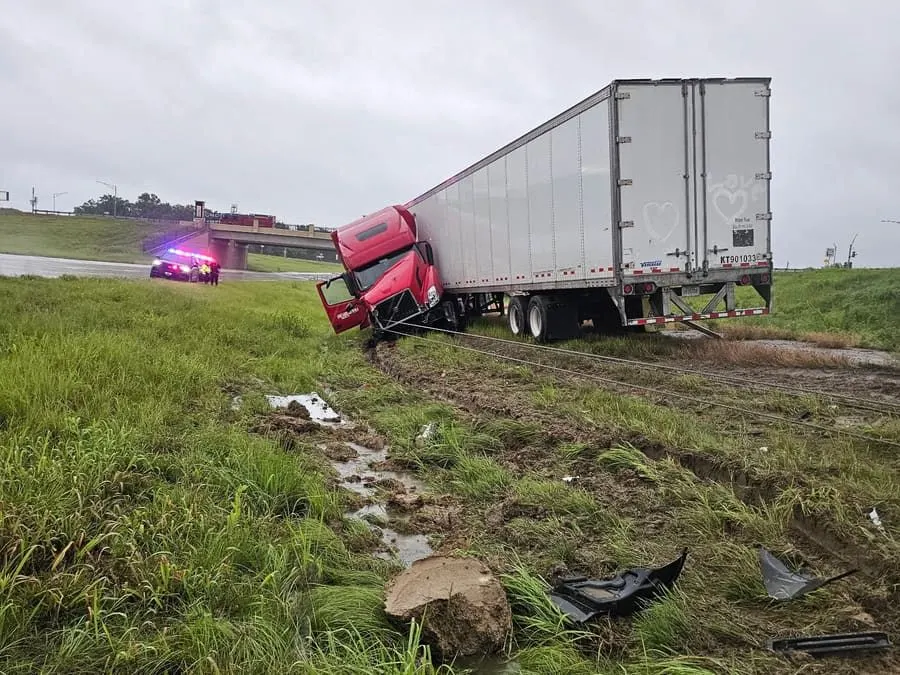
Some collisions leave a truck that should not be driven, even if nobody was hurt. If the truck will not build or hold air, is leaking fuel, has a steering or suspension part bent, a tire cut through, or a trailer that no longer tracks straight, it needs a repair on scene or a tow. If it slid off the pavement, into a median or a ditch, or folded at the fifth wheel, it needs a winch-out or a recovery before it goes anywhere. Our post on jackknifed semis covers that last case.
When you call, the details in our guide to what to tell dispatch for a heavy tow will get the right truck sent the first time. Our heavy-duty towing and winch-out and recovery crews work to the direction of police on a scene, and we can move a damaged unit to your shop, a dealer or our Liberty yard. We do not replace your carrier's safety department or insurer on any of the decisions above.
Sources
- 49 CFR 392.22, Emergency signals; stopped commercial motor vehicles
- 49 CFR 382.303, Post-accident testing
- 49 CFR 390.5, Definitions
- 49 CFR 390.15, Assistance in investigations and special studies
Related reading
Semi Broke Down on a Bridge or Overpass: What to Do — If the truck can safely roll, get it off the bridge before stopping.
Semi Broke Down in a Construction Zone: What to Do — If the truck can still move safely, keep going until you clear the work zone.
Where to Place Warning Triangles When a Semi Breaks Down — Turn on your hazard flashers immediately, then place three warning triangles as soon as possible and within 10 minutes.
What this covers
Heavy-duty towing
A loaded tractor-trailer is not a bigger car. It needs a rated wrecker, a rated operator and a plan before anything gets hooked. That is what we send.
Heavy-duty towing detailsWinch-outs & recovery
Bad rigging wrecks loads and hurts people. Recovery is the part of this job where training is the whole difference.
Winch-outs & recovery detailsIn a specific city: 24 hour semi truck towing and heavy-duty wrecker service in Kansas City, Missouri: big rigs, tractor-trailers and semi trailers · Heavy-duty towing and wrecker service in Liberty, Missouri · Winch-outs and truck recovery in Kansas City, Missouri · Wrecker service: heavy-duty, semi, semi trailer and commercial truck towing in Kansas City, Kansas · Heavy wrecker service and semi towing in Saint Joseph, Missouri · 24/7 semi and heavy-duty towing in Oak Grove, Missouri · Heavy-duty and semi towing in Topeka, Kansas · Winch-outs and emergency accident recovery in Saint Joseph, Missouri · Heavy-duty wrecker service in Lee’s Summit, MO: semi truck towing, medium-duty towing and accident recovery
Towing near you: Towing and tow trucks in Kansas City, MO · Tow truck service in Kansas City, KS · Towing in Liberty, MO · Towing in Lee’s Summit, MO