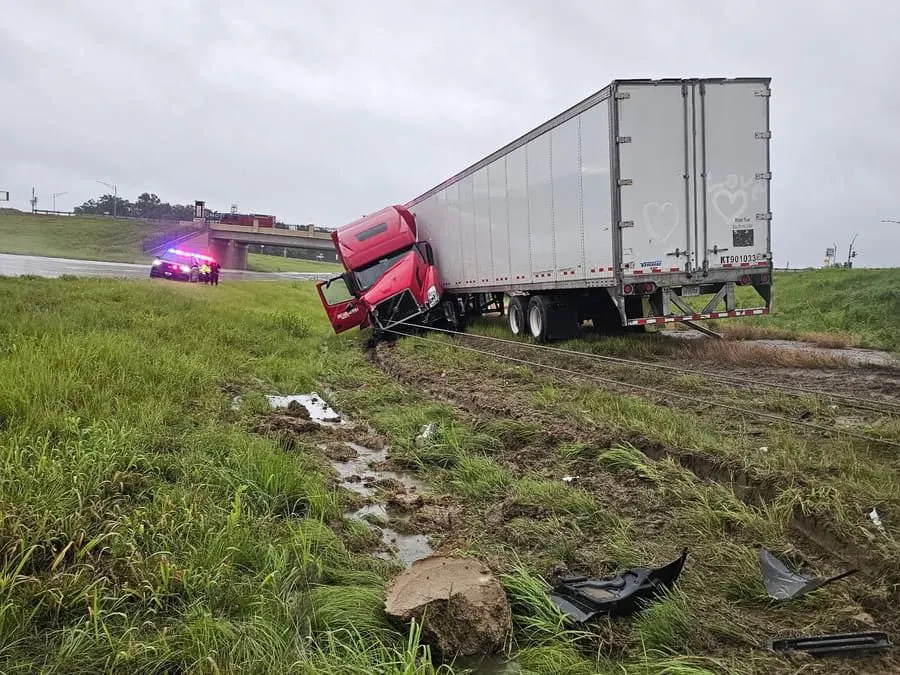
Semi stuck in mud or snow? The next five minutes decide how bad this gets.
Stop spinning the wheels. A loaded drive axle digs itself down faster than anything else on the truck, and every attempt turns a winch-out into an excavation. Set the brakes, look at what the truck is sitting on, and call with three facts: how deep, what surface, and whether the trailer is loaded. Those three decide the rigging.
Why a loaded rig sinks and a pickup does not
It is a question of how much weight sits on how little ground. Federal limits on the Interstate System under 23 CFR 658.17 allow 80,000 pounds gross, 20,000 pounds on a single axle and 34,000 pounds on a tandem. That tandem load is carried by eight tires, each pressing on a contact patch not much bigger than a sheet of paper. A pickup spreads a fraction of that over four.
Soft ground holds weight through a crust — a dried surface, a frozen layer, a mat of grass roots, a few inches of gravel. The crust is what a pickup drives across all summer. Break it, and what is underneath carries the load instead, and saturated clay or river-bottom silt carries almost nothing. A truck does not sink gradually; it sits on top of the surface until the surface fails, and then it is axle-deep.
Drive tires make it worse by design. Their tread is cut to bite and clear, not to float, so under power they are extremely good at removing the material in front of them — exactly what you do not want once the truck has stopped moving forward.
Everything that makes it worse
A car can sometimes be rocked free because it is light and its tires are small. Eighty thousand pounds behaves differently, and most of the damage on these jobs is done in the twenty minutes before anyone picks up the phone.
- Spinning. A spinning dual pair cuts through the crust and augers down into whatever is underneath. Two or three determined attempts can put a tractor frame-down on ground that was axle-deep when you started, and a frame sitting on the ground removes the option of pulling the truck out on its own wheels.
- Rocking. Shuttling between gears packs the ground under the tires into a polished trough with a wall at each end. The truck now has to climb out of a hole it built.
- Steering while stuck. Turned steer tires plow rather than roll, and a steer axle pushed sideways into soft ground gives the recovery one more direction to fight.
- A trailer folding into the pull. If the tractor moves and the trailer does not, the two start to fold. A combination that has begun to jackknife cannot be pulled straight back in one line and has to be brought around in stages, which is rigging rather than winching.
- Dumping the suspension. Lowering the air bags to change the weight on an axle also lowers the frame toward the ground, which on soft surfaces risks setting the frame down.
- Another truck with a chain. A snatch pull from a passing rig is the single most dangerous improvisation on this list. Chains are not rated for shock loading, tow hooks are not recovery points, and a parted line under tension is the failure mode that hurts people.
What to do before you call
- Stop at the first sign. The moment forward progress stops and the tach still climbs, you are digging. Everything from here should be deliberate.
- Set the brakes and get out on the safe side. If any part of the unit is near a live lane, get hazard flashers on and warning devices out to the distances in 49 CFR 392.22, which differ between an undivided road and a divided highway. Where to place warning triangles covers both patterns.
- Walk all the axles, not just the one you felt go. A tractor stuck at the drives with a trailer still on firm ground is a different job from a combination that slid in together.
- Read the ground. Mud, snow, ice under snow, or a shoulder that collapsed. Each one pulls differently and rigs differently. Say what you can see rather than what you assume is underneath.
- Measure the depth against something. Tread, sidewall, hub, axle, frame. Those five words are worth more than any adjective.
- Take photos if you can do it safely. One picture from behind and one from the side carry the angle, the depth and where a truck could be positioned.
- Do not crawl under the unit. Not to look, not to attach anything. Ground that is soft enough to swallow a tire is soft enough to move under a truck.
How a winch-out is rigged and anchored
A winch-out is controlled force applied in a planned direction. The wrecker is positioned where the pull line runs as close as it can to the direction the casualty is able to travel, and then it is anchored — braced against firm ground, sometimes tied back to a second point when the surface will not hold it. If the recovery truck slides, the pull has only moved the problem.
The attachment on the truck goes onto points built to take the load: frame rails, tow eyes, rated recovery points. Not axle housings, not air tanks, not steering components, not a bumper. Where the line cannot run straight at the casualty, snatch blocks redirect it or double it, trading speed for pulling force, and that is why a recovery sometimes involves more rope than you expected for a pull that lasts thirty seconds.
The load comes on gradually, with everyone clear of the line and out of the snapback path. Sometimes the tractor is driven gently in gear as the line takes tension, so the tires help rather than dig; sometimes it is pulled dead. Which one depends on whether the tires still have anything to bite on.
Ground conditions, and why the plan is built around them
The recovery truck has to stand somewhere, and that somewhere is often within a few feet of the ground that just defeated an 80,000-pound vehicle. That single fact drives more of the plan than the casualty's position does.
Frozen ground is a good surface that stops being one when the sun comes out, which is why the same slide-off is a different job at seven in the morning and at two in the afternoon. Snow hides what it sits on: powder over gravel pulls one way, powder over glaze ice pulls another. Standing water means the depth cannot be seen and has to be assumed to be worse.
This is also where a job quietly changes category. A unit that slid in and is sitting level is a pull. A unit that has sunk to the frame, gone below grade, or folded against its trailer needs planning, staging and often a second truck, and that is a recovery. The difference between a winch-out and a recovery sets out where that line falls and why it changes the bill.
The three facts that decide the rigging
The person on the phone will ask what feels like too many questions. The questions are the plan being made: loaded or empty changes the force required, nose-in or slid-sideways changes the direction, and the ground decides where a truck can set up. Three answers carry most of that, and what a winch-out costs turns on the same three.
- How deep. "Just the tire tread" and "up to the axle" are different trucks and different bills. Frame-down is a different job again.
- What surface. Mud, snow, ice, gravel over clay, standing water — and whether the shoulder itself gave way, which means the edge will keep giving way.
- Loaded or empty, and with what. Weight sets the force. A load that can shift sets the sequence, because nothing gets dragged sideways under a trailer whose freight is no longer where it was secured.
- Useful extras. Where the unit sits relative to the traffic lanes, whether it still builds and holds air, whether anything is already broken, and whether an agency is on scene directing the clearance.
What to look at once it is back on the pavement
A truck that has been winched out of deep mud or a ditch deserves a walk-around before it runs a load. Most of the time it is fine. A five-minute check here beats finding a mud-packed brake chamber at the next hard stop, and the roadside is the right place to find it rather than the next scale.
- Air lines, valves and glad hands. Dragged through mud, they pick up grit that ends up inside the system.
- Brake components. Clay packed around chambers, slack adjusters and drums keeps heat in and stops parts moving as they should. A wheel end that runs hot afterward is covered in dragging trailer brakes and hot hubs.
- Lights and wiring on the underside. Harnesses get torn and connectors fill with water. A lamp that works now may not after it dries out and corrodes.
- Tires and wheels. Sidewall cuts from whatever was under the mud, and rocks wedged between duals.
- The radiator and charge air cooler. Packed fins from thrown mud show up later as a cooling problem, not now.
- Steering and suspension. Anything bent, torn or hanging that was not before.
- Why it went in. If a steer blowout or a dragging brake put the truck off the road, the winch-out is step one and the tow or roadside repair is step two. Better to plan both than to discover the second after the first truck has left.
Sources
Related reading
After a Semi Rollover: What Happens, Step by Step — After a rollover, people and the scene come first: emergency services, traffic control, and any leaking fuel or hazardous cargo.
Winch-Out vs Recovery: What Is the Difference? — A winch-out pulls an upright, undamaged vehicle back onto the pavement from a soft shoulder, mud or a shallow ditch, usually with one truck and a straight pull.
Jackknifed Semi: Why It Happens and How It Is Recovered — A jackknife happens when the tractor and trailer fold at the fifth wheel, usually because wheels lock or lose traction under braking, often on a slick road, in a curve or with a light trailer.
What this covers
Winch-outs & recovery
Bad rigging wrecks loads and hurts people. Recovery is the part of this job where training is the whole difference.
Winch-outs & recovery detailsHeavy-duty towing
A loaded tractor-trailer is not a bigger car. It needs a rated wrecker, a rated operator and a plan before anything gets hooked. That is what we send.
Heavy-duty towing detailsIn a specific city: 24 hour semi truck towing and heavy-duty wrecker service in Kansas City, Missouri: big rigs, tractor-trailers and semi trailers · Heavy-duty towing and wrecker service in Liberty, Missouri · Winch-outs and truck recovery in Kansas City, Missouri · Wrecker service: heavy-duty, semi, semi trailer and commercial truck towing in Kansas City, Kansas · Heavy wrecker service and semi towing in Saint Joseph, Missouri · 24/7 semi and heavy-duty towing in Oak Grove, Missouri · Heavy-duty and semi towing in Topeka, Kansas · Winch-outs and emergency accident recovery in Saint Joseph, Missouri · Heavy-duty wrecker service in Lee’s Summit, MO: semi truck towing, medium-duty towing and accident recovery
Towing near you: Towing and tow trucks in Kansas City, MO · Tow truck service in Kansas City, KS · Towing in Liberty, MO · Towing in Lee’s Summit, MO