Kansas City
Kansas City is a freight city before it is anything else, and a heavy call here is usually an interstate call in traffic. Where the unit sits decides everything about how it comes out.
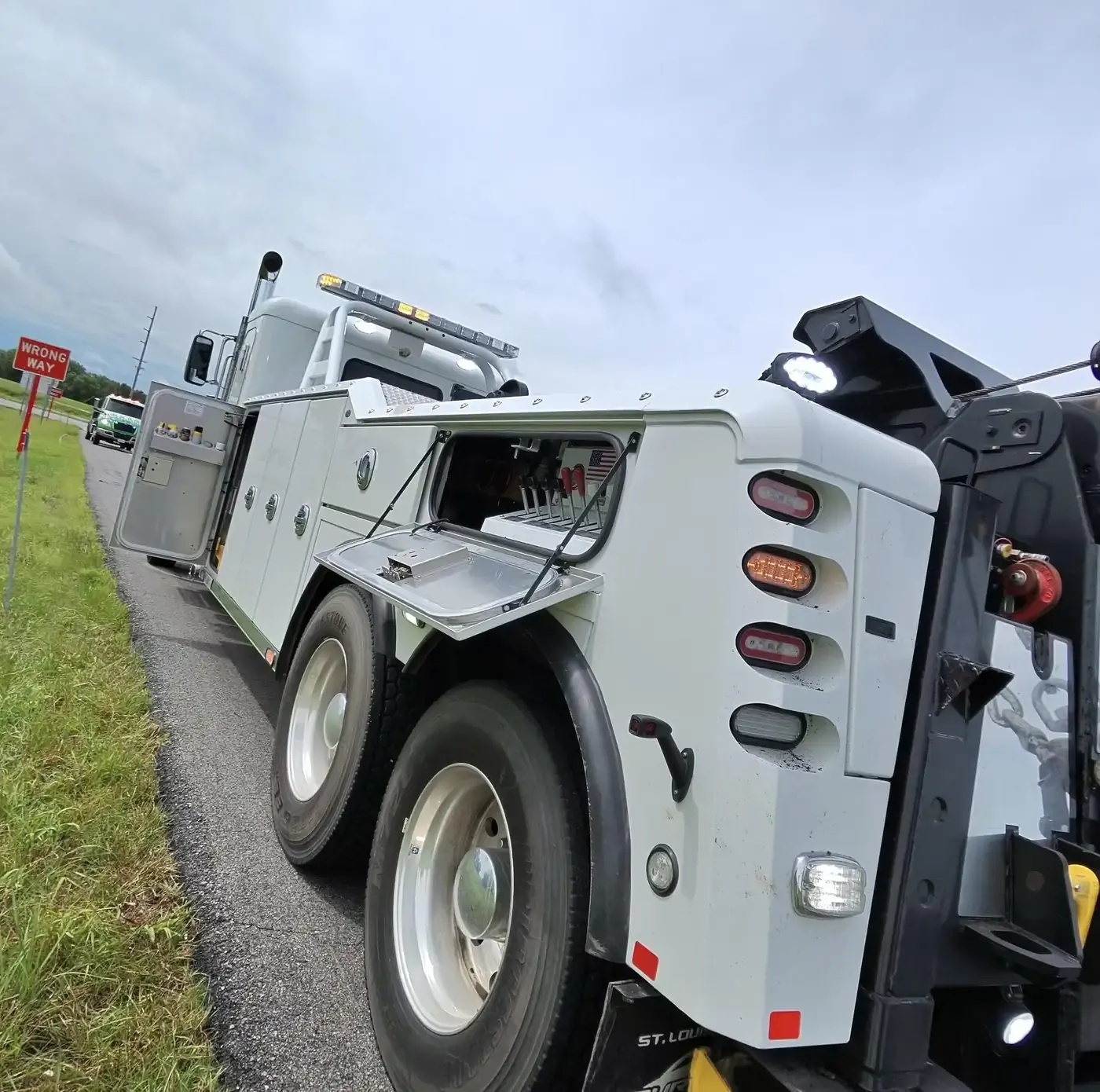
Heavy-duty towing in Kansas CityTitan Tow & Repair provides 24/7 heavy-duty towing across Kansas City and northwest Missouri, on both the Missouri and Kansas sides of the metro, from our yard in Liberty, MO. We tow semi tractors, loaded trailers, box trucks, buses, hot shots and equipment with a heavy wrecker and WreckMaster-certified operators, and we recover units that are stuck, jackknifed or rolled.
A loaded tractor-trailer is not a bigger car. It needs a rated wrecker, a rated operator and a plan before anything gets hooked. That is what we send.
If it is on this list, say so on the phone and the right unit is dispatched the first time.
| Service | Heavy-duty towing |
|---|---|
| Available | 24 hours a day, every day — nights, weekends and holidays |
| Dispatched from | 2751 Liberty Landing Rd., Liberty, MO 64068 |
| Coverage | Kansas City metro and northwest Missouri, roughly a 60-mile radius, in Missouri and Kansas |
| Typical arrival | About 20–45 minutes across the metro, traffic and weather depending |
| Phone | (816) 888-8732 |
Tractor and trailer type, what it is loaded with, and where it sits. Highway and mile marker if you have them.
You get told which unit is coming and how far out it is before you agree to anything.
To your shop, your yard, a dealer or ours at 2751 Liberty Landing Rd. in Liberty.
Every city we cover gets the same service from the same yard. Pick yours for local detail — corridors, drive time and what tends to go wrong there.
Where to Place Warning Triangles When a Semi Breaks Down — The federal placement rule for semi truck warning triangles, at 10, 100 and 200 feet, plus hills, curves and night, and how to set them out safely.
Rotator or Wrecker: Which Heavy Tow Truck Does It Need? — What a rotator does that a standard heavy wrecker cannot, when a scene genuinely needs one, and why most heavy tows and recoveries do not.
Can a Trailer Be Towed Without Its Tractor? — Yes, and often it should be. How a semi-trailer is moved without its original tractor, what has to work first, and who has to authorize it.
Hot Shot Truck Broke Down: Who Actually Tows It? — Why a hot shot with a loaded gooseneck falls between rollbacks and heavy wreckers, what to tell dispatch, and how truck and trailer each get moved.
How a Semi Actually Gets Towed, Start to Finish — The walk-around, the drive shaft, the air lines and the lift: what a heavy wrecker operator actually does before a semi moves an inch.
What Happens to Your Load When the Truck Breaks Down — The three ways freight keeps moving after a breakdown — tow the combination, swap the tractor or hold the trailer — who decides, and what the paperwork needs.
What Does a Heavy-Duty Tow Cost in Kansas City? — Why heavy-duty tows are quoted per job, every factor that moves the number, what an itemized invoice should show, and what to ask before you agree.
After a Semi Rollover: What Happens, Step by Step — What follows a tractor-trailer rollover: scene safety, fluids and cargo, how the truck is uprighted, the paperwork carriers need, and what drives cost.
More general questions — pricing, insurance, response times — are answered on the FAQ page.
Kansas City is a freight city before it is anything else, and a heavy call here is usually an interstate call in traffic. Where the unit sits decides everything about how it comes out.
Heavy-duty towing in Kansas CityThis is home. The yard is inside the city, so a Liberty call does not start with a drive — and a vehicle can be dropped to us or collected at any hour without a delivery charge on top.
Heavy-duty towing in LibertyOur service truck carries the parts and the tools. Faster for your driver, cheaper for your office, and the load keeps moving.
Read about mobile truck repairMost trailer faults do not stop a trailer moving. They stop it being legal to move, which is worse — the load sits while the paperwork says it cannot go anywhere.
Read about trailer repairFleets do not need a hero, they need a truck that turns up and paperwork that reconciles. We do both.
Read about fleet & commercial towingBad rigging wrecks loads and hurts people. Recovery is the part of this job where training is the whole difference.
Read about winch-outs & recoveryHeavy-duty towing is priced per job, not off a flat menu, because it depends on the truck we have to send, how far it runs, whether the unit is loaded and whether recovery work is needed. Call (816) 888-8732 and we will quote your job before we roll.
Usually yes. A loaded trailer can normally be towed as-is if the freight is secure and the trailer is roadworthy. If the load has shifted or the trailer is damaged, we will tell you on scene whether it has to be transferred first.
Yes. We handle winch-outs, uprighting, jackknifed tractors and load-shift recovery with WreckMaster-certified operators and rated rigging. Recovery is a separate skill from towing and we staff it that way — a tow is about moving a unit that is already sitting right, and a recovery is about getting it there without adding damage. The two things that decide the plan are how the unit is lying and whether it is loaded, so tell us both when you call, and send a photo if it is safe to take one.
In everyday use, yes — a wrecker is the truck, and "wrecker service" is what people in this part of Missouri usually call towing. The distinction that actually matters is not the word but the class of truck. A light-duty wrecker or a flatbed handles cars and pickups; a semi tractor, a loaded trailer or a bus needs a heavy wrecker with the boom rating and the rigging to lift it. We run both, so you do not need to know which one you want before you call — describe the vehicle and where it is sitting, and we will send the truck that can actually move it.
From our Liberty yard we are typically 20 to 45 minutes from most of the Kansas City metro and the I-35, I-29 and I-70 corridors, traffic and weather depending. We give you a real ETA on the phone rather than a guess.
Yes — that is most of what we do. The yard sits in Liberty minutes from I-35, and we run the metro loop and the freight corridors that cross it around the clock: I-35, I-70, I-435, I-635, I-29 and US-71, every day including holidays. A person answers the phone at any hour, not a service taking messages, and dispatch starts while you are still describing the truck. Tell us the highway and mile marker first — on an interstate call that is the detail that matters most.
Yes. The state line runs through the middle of this metro and freight does not stop at it, so neither do we — Kansas City, Kansas and the Kansas side are inside our normal 60-mile working radius from the Liberty yard, the same as the Missouri side. That takes in the interstates that cross over: I-70, I-435, I-635 and the run west toward Bonner Springs. Tell us the highway and which side of the line you are sitting on when you call, because on a metro job that decides the approach more than the mileage does.
Yes. Hot shots sit in an awkward gap — heavier and longer than a pickup, lighter than a class 8 tractor — and plenty of companies are set up for one end or the other but not the middle. We run both ends out of one yard, so a dually with a gooseneck or a flatbed rig gets the truck that actually suits it rather than whatever happens to be free. Tell us the trailer length and whether it is loaded; on a hot shot those two answers usually decide which unit comes out.
Yes. Buses and coaches are heavy-wrecker work and we handle them the same way as tractors — school buses, transit and motorcoaches included. RVs and campers split by size: larger motorhomes go on the heavy side, while smaller RVs, campers and towables ride the light-duty flatbeds out of the same yard. Either way it is one phone number, and telling us the length and rough weight is what lets us send the right truck the first time.