Winch-out or recovery? The difference, and why it changes the bill
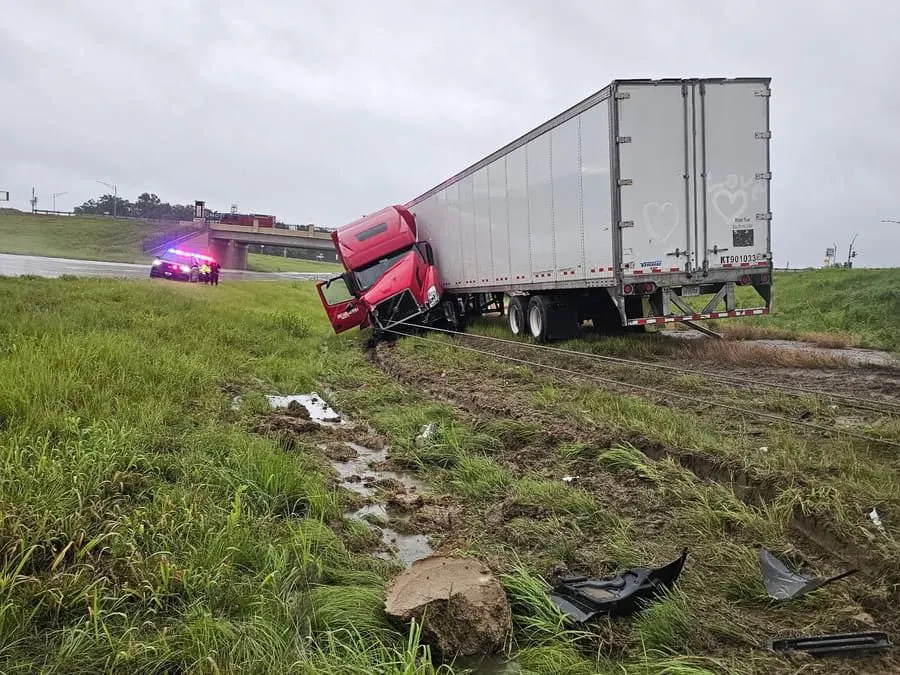
A winch-out pulls an otherwise undamaged vehicle back onto the pavement — off a soft shoulder, out of mud or a shallow ditch — and is usually a single truck and a straight pull. A recovery is what happens when the unit is rolled, jackknifed, stacked or the load has shifted, and it needs rigging, planning and often multiple trucks.
What each word actually means
A winch-out is a pull. The unit is upright, on all its wheels, essentially undamaged, and the only thing wrong is that the ground will not give the tires anything to push against: a soft shoulder that gave way under a drive axle, mud, snow over ice, a shallow ditch. One rated truck, an anchor it will not slide off, a line, and a path the casualty can roll along. Back on pavement, it usually drives away.
A recovery is everything that has to happen before a pull is even possible. The unit is on its side, folded against itself, below grade, wedged against a barrier, or the freight has moved inside the trailer. The work is planning, stabilizing, rigging and sequencing, and the order matters, because the wrong first move can make the second impossible. A recovery usually ends in a tow rather than a drive-away. Our winch-out and recovery page covers both ends of that range.
The two words get used loosely, and some operators bill everything as a recovery because it reads bigger on an invoice. The distinction above is the honest one, and it is the one your paperwork should reflect.
What moves a job from one to the other
It is rarely the distance off the pavement that decides it. Six things do, and any one of them on its own can turn what sounded like a straight pull into a planned recovery.
- The ground. Firm gravel pulls very differently from saturated clay or river-bottom silt. A unit that has sunk rather than slid has to be eased out along a path that exists, not dragged through ground that closed around the tires. Ground that swallowed a loaded tractor will also try to swallow the wrecker.
- The angle. A unit sitting nose-in and square to the road, with a wrecker able to line up behind it, is the easy version. A unit that came to rest sideways, or a tractor and trailer folded against each other, cannot be pulled in the direction you want it to go. It has to be brought around first, in stages, which is rigging rather than winching.
- The weight, and where it sits. A tractor-trailer can run at 80,000 pounds gross on the Interstate System under 23 CFR 658.17, and where that weight sits matters as much as the number. A loaded trailer with its tandems buried is a different calculation from a bobtail tractor with one drive axle over the edge.
- Whether the unit is upright and undamaged. On its wheels and straight is a winch-out. On its side, with the fifth wheel torn, the frame bent or a suspension collapsed, it has to be uprighted or supported before anything pulls, and uprighting is recovery work by definition.
- Whether the load is still secure. 49 CFR 393.100 requires cargo to be contained, immobilized or secured so it cannot shift enough to affect the vehicle's stability, or leak, spill or fall from it. When a load has already moved, the center of gravity is somewhere nobody planned for, and the freight gets stabilized, re-secured or transferred before the unit moves at all.
- What it is up against, and who is running the scene. A guardrail, a culvert, a sign structure or another vehicle all change the sequence. So does an agency: law enforcement, fire or DOT set the clearance priorities and the order things get moved in.
Equipment and hands: the winch-out version
A winch-out is one rated truck used properly: a heavy wrecker with a winch rated for the pull, rated straps and chains, snatch blocks to change the direction of the line or to double it, and an anchor — usually the wrecker itself, braced where it will not be dragged. The attachment on the casualty goes on points built to take the load, not on axle components or whatever happens to be reachable.
One operator can run a straightforward winch-out. Two are common on a highway, because the second pair of hands watches traffic while the first is rigging. Before any of that, the scene gets protected: hazard flashers immediately, and warning devices placed within ten minutes of stopping, at the distances in 49 CFR 392.22, which differ between an undivided road and a divided highway. Our post on where to place warning triangles walks through both patterns.
If your truck is stuck rather than damaged, what to do when a semi is stuck in mud or snow covers the first few minutes, and those minutes usually decide which of these two jobs you end up buying.
Equipment and hands: the recovery version
A recovery starts with a plan made standing still: where the rigging points are, what angle each line runs at, what the load is doing, what the casualty will do as it comes over, what moves first, and where every person stands while it happens. That planning is the job. The pull itself is often the shortest part of the afternoon.
It usually takes more than one truck — a second wrecker to hold or to pull from another angle, cribbing and pads to give a lift something solid to sit on, and enough operators that nobody is doing two things at once inside a load path. This is where WreckMaster certification earns its keep. An unrated pull at the wrong angle folds a trailer that was otherwise repairable, drops a load across a live lane, or parts a line under tension — the failure mode that hurts people standing on the shoulder.
One honest limit: we run heavy wreckers out of our Liberty yard and we do not run a rotator, so a scene that genuinely needs a boom lifting off the side of the truck, over a barrier or down an embankment, is one we would rather flag on the phone than discover on arrival. Rotator or wrecker explains where that line falls, and it is further out than most people assume.
What the customer sees on the invoice
Both are quoted per job rather than off a flat rate card, because both depend on which truck has to go, how long it takes and what has to be rigged. The shape of the bill is what differs, and knowing that shape in advance stops most arguments later. What a winch-out or recovery costs goes through the inputs in detail.
A winch-out is usually a short invoice: the truck, the time on scene including the rigging, and the mileage. A recovery is a longer one, and the extra lines are extra work — a second unit, more operators, more hours, recovery equipment, and very often a tow afterward.
- Ask for it itemized. Equipment, labor by unit, time on scene, mileage and anything consumed. A recovery bill that is one number with no breakdown is not a bill you can check.
- Expect rigging time to be billed. Ten minutes of setup that makes a thirty-second pull work is the job being done right, not padding.
- Expect the tow to be a separate line. Getting a unit back onto the pavement and moving it to a shop are two services, and they should read as two on the invoice.
The questions that tell us which one it is on the phone
Everything the dispatcher asks is the plan being built before anyone rolls, not an attempt to talk the price up. Say "I do not know" rather than guessing, because a guess sends the wrong truck.
- Is it upright, on all its wheels? This one question separates the two jobs most of the time.
- How far off the pavement, and how deep? Tread-deep and axle-deep are different trucks. Frame-down is a different job again.
- What is it sitting in? Mud, snow, ice under snow, gravel over clay, standing water. Say what you can see rather than what you assume is underneath.
- Loaded or empty, and with what? Weight sets the force. A load that can move sets the sequence.
- Is it against anything, and do the wheels still turn? A guardrail, a tree or another vehicle changes the direction everything has to travel in, and a unit that cannot roll has to be lifted or skated rather than pulled.
- Is an agency on scene, and is anyone hurt? Injuries and traffic come before the vehicle, always, and the agency in charge sets the order of work.
- Can you take a photo safely? One photo carries the angle, the ground, the drop and where a truck can be put, all at once.
When a job changes shape halfway through
Plenty of jobs start as one and turn into the other, and it goes both ways. A unit sitting at an angle in a ditch might come out on a single line, or might need stabilizing and a second truck once the operator can see how the weight is really sitting. What should never change is the conversation: if we quote a winch-out and arrive to find a recovery, you hear that before anything is hooked. If it goes the other way, the bill goes down.
If the unit left the road because something broke — a steer blowout, a dragging brake, a steering fault — say so when you call. Then the pull is step one and the heavy tow or roadside repair is step two, and both get planned at once.
Related reading
Semi Stuck in Mud, Snow or Soft Ground? Stop Digging — Stop spinning the wheels.
After a Semi Rollover: What Happens, Step by Step — After a rollover, people and the scene come first: emergency services, traffic control, and any leaking fuel or hazardous cargo.
What a Winch-Out or Recovery Actually Costs — Winch-outs and recoveries are priced per job because the work varies more than any other call in towing.
What this covers
Winch-outs & recovery
Bad rigging wrecks loads and hurts people. Recovery is the part of this job where training is the whole difference.
Winch-outs & recovery detailsHeavy-duty towing
A loaded tractor-trailer is not a bigger car. It needs a rated wrecker, a rated operator and a plan before anything gets hooked. That is what we send.
Heavy-duty towing detailsIn a specific city: Heavy-duty towing in Kansas City, Missouri · Heavy-duty towing in Liberty, Missouri · Winch-outs and truck recovery in Kansas City, Missouri