Moving a broken dump truck or a job-site machine: what tows it, what carries it, and what cannot
A dump truck is towed by a heavy wrecker like any heavy truck: driveline disconnected if the drive wheels roll, air supplied to release the spring brakes, and a lift from rated points. The load and the bed come first, and nobody goes under a raised bed. Skid steers, lifts and containers ride a rollback. Large machines need a lowboy and an equipment hauler, which we do not run.
A dump truck is a heavy tow with two extra questions
Mechanically, a dump truck is a heavy straight truck, and it gets towed like one. The operator walks around it first, disconnects the driveline before any drive wheel rolls, supplies air so the spring brakes release, and lifts from rated points on the frame or axle rather than from a bumper. Our post on how a semi gets towed explains each of those steps, and nearly all of it applies here.
What makes a dump truck different is the body on its back. Before anything is hooked, two questions need answers: what is in the bed, and where is the bed? An empty dump truck with its body down is an ordinary heavy tow. A loaded one, or one stuck with its body in the air, is a different job, and it starts with the load and the body rather than the hook.
Loaded or empty changes the plan
A loaded dump body puts a lot of weight up high and mostly over the rear axles. That weight decides which wrecker can take the truck, how it is lifted and whether it should travel loaded at all. Material that shifts, like wet fill, or material that hardens as it cools, like hot asphalt, adds its own problems the longer the truck sits.
Often the simplest answer is to empty the truck first, if the hoist still works and there is a safe, lawful place to put the load. On a job site, that usually means where the load was headed anyway. When the hoist does not work, the load generally has to come out with the contractor's own loader or excavator before the truck moves. Tell dispatch how full the body is and with what, because that answer shapes everything that follows.
When the body is stuck in the air
Never go under a raised dump body, and never reach into the gap between the body and the frame, however steady it looks. A raised body is held up by its hoist, and if the hydraulics give way it comes down with nothing to stop it. Do not drive with the body up, either. A raised body can strike a bridge, a sign or an overhead line, and a loaded body in the air makes the truck much easier to tip over on uneven ground.
OSHA's construction rules speak to this directly. Under 29 CFR 1926.600, dump bodies must be fully lowered or blocked when they are being repaired or are not in use. Under 29 CFR 1926.601, a truck with a dump body must have a permanently attached support that locks in place to prevent accidental lowering during maintenance or inspection. That support is for trained people doing planned work, not a reason for anyone to climb under a failed hoist.
What happens next depends on why the body is up:
- A hoist or hydraulic fault. A problem in the hoist, its hydraulic lines or its controls can leave a body stuck up, or let it creep down. Hoist and hydraulic repairs are work for a truck body or hydraulics specialist, and we do not claim them. The body has to be lowered or properly supported before the truck is towed.
- Material hung up in the body. Sticky, frozen or packed material that will not slide out can leave a raised body loaded and top-heavy. Clearing it is a job for the contractor's equipment, worked from outside the body, never for someone climbing in.
- Contact with a power line. Treat the whole truck as energized. Stay in the cab unless fire forces you out, keep everyone else away and call 911. OSHA's power line training rules for crane operators make the same two points: stay inside the cab except in an emergency such as fire or explosion, and never touch the machine and the ground at the same time.
Drive axles, air brakes and lift axles
Once the body is down, a dump truck tows much like any heavy straight truck, but a few details change the setup. Tell dispatch about each of them, because they decide how the truck is lifted and what the operator has to disconnect or air up first:
- Drive axles. Whether the truck drives through one rear axle or two, the driveline has to be disconnected before driven wheels roll on a tow. If the front axle is driven as well, say so, because whichever driven axle stays on the road needs the same treatment.
- Air brakes. On a dump truck with air brakes, the spring parking brakes stay applied without air. The wrecker supplies air to release them, or the operator cages them where a fault means the air will not hold.
- Lift axles. Tell us whether the truck has lift axles, sometimes called drop or pusher axles, and whether they are up or down, since they affect how the truck sits on the tow.
- What failed. A truck that has lost air, a battery or a coolant hose may not need a tow at all. Those can be roadside repairs, so describe the fault as well as the truck.
- Where it is sitting. A truck on a haul road, in a pit or on fresh fill may be on ground that will not carry a wrecker, which makes it a recovery question before it is a tow.
What a rollback can carry
Smaller equipment does not need a wrecker at all. A rollback flatbed tilts its deck, winches the machine up and carries it with nothing rolling on the road, the same way it carries a car. Our post on choosing a flatbed or a wrecker covers that difference for cars and pickups. For equipment, what matters is weight, size and how the machine is tied down.
Federal cargo securement rules cover that last part. Under 49 CFR 393.130, a machine on wheels or tracks weighing 10,000 pounds or more has to travel with accessory equipment, such as a hydraulic shovel, completely lowered and secured, with articulated machines restrained so they cannot articulate, and with at least four tiedowns holding it against sideways, forward, rearward and vertical movement. Lighter machines can be secured the same way or under the general securement rules. The equipment our rollbacks carry includes:
- Skid steers. Running or dead, with the bucket or attachment lowered to the deck. Tell us whether it runs on tires or tracks.
- Lifts. Lifts that have broken down on a site or need moving between sites. Give us the make, model and weight from the data plate so we can confirm it suits the deck.
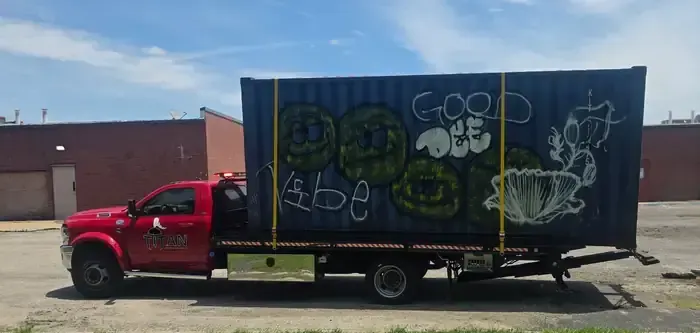
- Containers. Shipping and storage containers moved on the deck, empty or loaded, within the truck's rating.
- Yard machinery. Smaller machines that work around yards and lots and need moving to a shop, a dealer or another site.
When a machine needs a lowboy instead
Excavators, dozers, larger loaders and similar machines are too heavy, too wide or too tall for a rollback. They travel on a lowboy, a trailer with a deck dropped close to the ground, pulled by a tractor and run by an equipment hauler that does that work every day. We do not run lowboys and we do not haul large equipment. If what you describe sounds like lowboy work, we will say so on the phone, so you can call a hauler instead of waiting for a truck that cannot carry it.
Size limits are part of the reason. Missouri and Kansas both cap vehicle width, including the load, at 8 feet 6 inches. Kansas caps height at 14 feet, and Missouri allows 14 feet on the interstate system and its designated routes but 13 feet 6 inches on its other highways. A move over the legal limits needs an oversize or overweight permit, issued in Missouri by MoDOT Motor Carrier Services and in Kansas through KDOT's K-TRIPS system, and the hauler arranges it.
Some machines need a lift rather than a haul, such as one that has gone down an embankment. Our post on rotators and wreckers explains when a lift is the right tool. We do not run a rotator either, and we will tell you when a job needs one.
A machine stuck on the job site is a winch-out
A dump truck bogged down on soft fill, a machine sunk in a wet cut, or a loaded truck that slid off a haul road is not a tow yet. It is winch-out work: a rated wrecker anchored on firm ground, lines rigged to proper attachment points, and the pull brought on gradually along a path the machine can actually travel. Whether a wrecker can do it depends on the machine's weight and on ground firm enough to set up on. The winch-out and recovery page covers that work.
The same rules apply as for a stuck semi, and our post on a truck stuck in mud or snow explains them. Stop spinning wheels or tracks once progress stops, because every attempt digs deeper. Do not chain another machine to it and pull, because an improvised pull from the wrong point or angle bends frames and snaps rigging. Keep people well clear of any line under load.
Details that decide which truck comes out
Dump trucks and equipment are part of the heavy-duty towing we run across Kansas City, northwest Missouri and northeast Kansas, and these calls go faster when the first conversation covers the points below. Photos of the machine and the ground help more than any description.
- What it is. Dump truck, skid steer, lift, container or other machine, with make, model and weight from the data plate if you can read it safely.
- Loaded or empty. For a dump truck, how full the body is and with what.
- Where the body is. Down, partly up or fully raised, and whether anything is close to overhead lines.
- What failed. Engine, air, brakes, hydraulics, a tire, or nothing if it is simply stuck.
- Where it sits. Road, haul road, pit or fill, and how soft the ground is between the machine and a firm surface.
- Access and destination. The site address, the gate and a contact, plus where the machine is going and who is authorizing the move.
Sources
- 29 CFR 1926.600, Equipment
- 29 CFR 1926.601, Motor vehicles
- 49 CFR 393.130, Specific securement requirements for heavy vehicles, equipment, and machinery
Related reading
Rotator vs Wrecker: Which Heavy Tow Truck Does It Need? — Most heavy tows and recoveries do not need a rotator.
Where Semis Can and Can't Drive in Kansas City — Semis may use Kansas City's interstates and state highways at legal size and weight: 102 inches wide and 80,000 pounds gross on the interstate.
How a Bus or Motorcoach Gets Towed Safely — A bus is towed by a heavy wrecker, but not the way a semi is.
What this covers
Heavy-duty towing
A loaded tractor-trailer is not a bigger car. It needs a rated wrecker, a rated operator and a plan before anything gets hooked. That is what we send.
Heavy-duty towing detailsIn a specific city: Wrecker service: heavy-duty, big rig, semi and semi trailer towing in Kansas City, Missouri · Heavy-duty towing in Liberty, Missouri · Wrecker service: heavy-duty, semi, semi trailer and commercial truck towing in Kansas City, Kansas · Heavy wrecker service and semi towing in Saint Joseph, Missouri · 24/7 semi and heavy-duty towing in Oak Grove, Missouri · Heavy-duty and semi towing in Topeka, Kansas · Heavy-duty wrecker service in Lee’s Summit, MO: semi truck towing, medium-duty towing and accident recovery