
Where semis can and can't drive in Kansas City: posted streets, hazmat routes and size and weight limits
Semis may run Kansas City's interstates and state highways at legal size and weight: 102 inches wide, 80,000 pounds gross on the interstate, and 14 feet high in Kansas and on Missouri interstates. Off the highway, both cities sign streets against trucks. Kansas City, Missouri bars trucks from posted parks-board boulevards and posted no-truck streets, Kansas City, Kansas bars vehicles registered above 12,000 pounds from posted streets, and local deliveries may enter at the nearest point.
What decides where a semi can go in Kansas City
Three layers of law apply at once, and which ones depend on which side of the state line the truck is on. State statute sets the legal size and weight of a vehicle and who issues permits to exceed them. The city code adds streets where trucks are banned, weight limits on particular streets and bridges, and its own permit for oversize moves on city streets. Federal rules decide where a placarded hazardous materials load may be routed.
Kansas City, Missouri is governed by the Revised Statutes of Missouri and Chapter 70 of the city's Code of Ordinances. Kansas City, Kansas is governed by the Kansas Statutes Annotated and Chapter 35 of the Unified Government of Wyandotte County/Kansas City, Kansas code. The rules are similar in shape and different in the numbers, so this post keeps them apart and cites each one.
Can semis drive on Kansas City, Missouri's boulevards and parkways?
Not where the road is posted. Sec. 70-902 of the city code says no truck may enter any park, street, highway or park road under the control of the board of parks and recreation commissioners that is posted with signs indicating trucks are prohibited. The only trucks excepted outright are those repairing or building a park, street, highway or park road under the board's authority.
The authority behind those signs sits in Chapter 53. Under Sec. 53-2, the city council, on the parks board's recommendation, may regulate the kind and character of vehicles on boulevards and parkways and may exclude heavy traffic or any kind of vehicle used for commercial purposes from boulevards, parkways and parks. The code does not list the boulevards in these sections; the posted signs are what give notice, so read the signs at each entrance.
- Who counts as a truck. Under Sec. 70-902(c), every motor vehicle designed, used or maintained primarily to carry property, or that displays a truck registration plate, except one rated by its manufacturer at 7,000 pounds gross vehicle weight or less that carries no business advertising. A maker's or dealer's name on the vehicle is not advertising.
- Deliveries and service calls. A truck serving or delivering to a location that abuts the boulevard, or inside a park, may enter at the nearest point to that location, but may not go farther than the nearest point of exit (Sec. 70-902(b)).
- Other no-truck streets. Separately, the director of public works can prohibit trucks on other streets by regulation once signs are up (Sec. 70-916). Trucks may still deliver, pick up or provide services there, entering at the intersection nearest the destination and going no farther than the next intersection. The schedule of those streets is kept in the offices of the director of records and the director.
- Size and load limits on specific streets. The director may also post size restrictions after an engineering and traffic investigation (Sec. 70-917) and load restrictions on streets, bridges and viaducts (Sec. 70-915).
Can a Missouri city close every street to trucks?
No. RSMo 304.120.2(4) lets a Missouri municipality limit certain designated streets and boulevards to passenger vehicles, but every municipality must allow at least one route, with lawful traffic movement and access from both directions, for commercial motor vehicles to reach the state highway system. Under 304.120.5, no ordinance may deny commercial motor vehicles the use of all routes in the municipality, and route there includes any state road, county road, street, avenue, boulevard or parkway.
The same subdivision adds that a commercial vehicle using a route the city designated for it, in compliance with the city's ordinances, is not a nuisance or evidence of one. In practice, that means the posted boulevards are off limits, and a lawful way to reach the highway still exists.
What are the truck restrictions in Kansas City, Kansas?
Kansas City, Kansas uses a registered-weight test. Sec. 35-879 of the Unified Government code bars any vehicle with a registered gross weight classification over 12M, or 12,000 pounds, from a street the traffic engineer has designated and posted with signs indicating that trucks are prohibited. Registered gross weight means the weight the vehicle should be registered for in the jurisdiction that licenses it.
- Exempt vehicles. Recreational vehicles, buses and other vehicles used mainly to carry passengers; vehicles owned by the Unified Government and the Board of Public Utilities; and trash trucks with enclosed packer bodies (Sec. 35-879(c), (d)).
- Deliveries and work. Vehicles carrying goods to or from a location on the posted street, and vehicles doing repair or construction work on or next to it, including utility vehicles, may enter at the point nearest the location and leave at the point nearest the location (Sec. 35-879(e)).
- Posted load limits win. A load limit sign on a street, bridge or culvert takes precedence over the 12,000-pound rule (Sec. 35-879(f)). Under Sec. 35-892, a posted weight limit binds every vehicle unless its excess-weight permit names that street or bridge, and a sign showing three vehicle silhouettes sets one limit for a truck with two or more axles, one for a tractor-semitrailer with three or more axles, and one for longer combinations with four or more axles.
What Kansas state law lets the city do
K.S.A. 8-1912(c) lets a Kansas city or county prohibit trucks or other commercial vehicles, or limit their weight or size, on designated highways, with signs posted. Premises next to a restricted street may still be served, and the restriction may not apply to a street that is a connecting link of the state highway system unless the secretary of transportation has approved a satisfactory alternate route. Under 8-1912(a), a local authority may also close a road or cut its weight limit for up to 90 days a year when deterioration, rain, snow or other climatic conditions would otherwise seriously damage it, but only once signs are up at each end.
What a Kansas city may not do is rewrite the statewide limits. K.S.A. 8-1901(a) makes the size and weight limits in article 19 lawful throughout the state and says local authorities have no power to alter them except where that article grants it.
How do legal size and weight limits compare in Missouri and Kansas?
These are the statewide limits without a permit, as the statutes read on the publication date. Each state's figures apply only in that state.
| Missouri (RSMo) | Kansas (K.S.A.) | |
|---|---|---|
| Width, including load | 102 inches (304.170.1) | 8 1/2 feet (8-1902(a)) |
| Height, including load | 14 feet on the interstate and designated routes, 13 1/2 feet on other highways (304.170.2) | 14 feet (8-1904(a)) |
| Single truck length | 45 feet (304.170.3) | 45 feet; does not apply to a truck tractor (8-1904(b), (d)) |
| Semitrailer length | 53 feet (304.170.5) | 59 1/2 feet (8-1904(d)) |
| Each trailer in a double | 28 feet on the interstate, 28 1/2 if in lawful use on Dec. 1, 1982 (304.170.6) | 28 1/2 feet (8-1904(d)) |
| One axle | 20,000 pounds (304.180.1) | 20,000 pounds, 10,000 per wheel (8-1908) |
| Tandem axle | 34,000 pounds (304.180.1) | 34,000 pounds (8-1908(e)) |
| Gross weight | Axle-spacing table tops out at 80,000 pounds (304.180.3) | No more than 80,000 pounds on the interstate (8-1909(a)(2)); axle-spacing table elsewhere |
The details behind the table
Missouri's width limit excludes clearance lights, rearview mirrors and other accessories that law requires (304.170.1). A tractor and semitrailer is held to 60 feet overall on Missouri highways generally; on the interstate the statute caps the semitrailer at 53 feet rather than the overall length, and the highways and transportation commission may designate other routes for those combinations (304.170.5, 304.170.11). Off the interstate, RSMo 304.180.6 allows up to 2,000 pounds over the single-axle, tandem and gross limits, but total gross weight still may not exceed 80,000 pounds. A carrier of general freight over regular routes is also held to the steering axle's manufacturer rating, never more than 12,000 pounds (304.180.1).
Kansas counts axles more finely. K.S.A. 8-1908 defines a tandem as axles 40 to 96 inches apart, a triple as more than 96 and up to 132 inches, and a quad as more than 120 and up to 150 inches, and an axle whose wheels are lifted off the road is not counted when figuring the legal axle or gross weight. Two consecutive tandems may carry 34,000 pounds each if the first and last axles are at least 36 feet apart, a rule both states share (304.180.3; 8-1909(a)).
Kansas City, Missouri's traffic code also carries its own figures. It sets 102 inches of width (Sec. 70-903), a 13-foot-6-inch height limit with 15 feet allowed for a motor vehicle operating only within the city, two miles of it or its commercial zone (Sec. 70-905), and lower limits on city-maintained bridges: 18,000 pounds on one axle and 32,000 on a tandem (Secs. 70-909(a), 70-910(a)), with a reduced gross-weight table for those bridges unless a bridge is signed for higher limits (Sec. 70-911(b), (c)). A Missouri bridge on the state system can carry posted weight and speed limits of its own (RSMo 304.180.4).
Who issues oversize and overweight permits in the Kansas City area?
In Missouri, RSMo 304.200 has the chief engineer of the Missouri Department of Transportation issue special permits for vehicles exceeding the width, length, height and weight limits, for a single trip or a set period, and each permit names the highways and bridges it may use. MoDOT Motor Carrier Services takes those applications only through its online MoDOT Carrier Express system. Under 304.200.4, the officer in charge of a city's streets may issue permits for its own streets. Kansas City, Missouri's code gives permit authority on city streets to the director, defined in Sec. 70-1 as the director of public works (Sec. 70-913(a)), and Sec. 70-913(e) bars moving any vehicle, equipment or load over the legal limits on a city street without the director approving the route and the time of the move.
In Kansas, K.S.A. 8-1911 lets the secretary of transportation permit moves on state highways and local authorities on their own roads. The secretary keeps jurisdiction over state highways, city streets designated as connecting links and the interstate even inside a city (8-1911(g)). In Kansas City, Kansas, the Unified Government engineer issues permits for its streets, height and width permits are single-trip only, and each permit prohibits stopping on any city street except in an emergency (Sec. 35-889). K.S.A. 8-1914 also allows permits for combinations running between a Kansas Turnpike toll booth and a truck terminal, within ten miles of the booth, or twenty miles at the turnpike's northeastern end.
- Carry the permit. Both Kansas law and the Kansas City, Missouri code require the permit to ride in the vehicle and be open to inspection by police (8-1911(e); Sec. 70-913(d)).
- Kansas hours. A permitted load over legal width or length may not run from 30 minutes after sunset to 30 minutes before sunrise, in visibility under half a mile, or on ice, snow pack or drifting snow. An overweight-only load may run around the clock except on ice, snow pack or drifting snow (8-1911(m)).
- Kansas signs. An oversize load under permit carries an OVERSIZE LOAD sign at least seven feet long and 18 inches high, with red flags on all four corners; an overweight-only load does not carry the sign (8-1911(l)).
- Missouri holidays. MoDOT does not allow oversize or overweight loads on Missouri highways during set holiday periods under 7 CSR 10-25.020(1)(I). For the rest of 2026 it lists Thanksgiving, November 25 through 27; Christmas, December 24 through 28; and New Year's, December 31 through January 4, 2027.
Where can hazmat loads go through Kansas City?
Routing for placarded hazardous materials is federal law first. Under 49 CFR 397.67(a), a carrier hauling non-radioactive hazardous materials in placarded quantities must follow any routing designation a state has made, and 397.69(a) treats a city's designation as the state's. Where no designation applies, 397.67(b) requires routes that avoid heavily populated areas, places where crowds gather, tunnels, narrow streets and alleys, unless there is no practicable alternative, a reasonable deviation is needed to reach a terminal, a loading point, food, fuel, repairs, rest or a safe haven, or an emergency detour or a police officer requires another route. Operating convenience is not a reason (397.67(c)).
A state or city route designation takes effect only once it is published in FMCSA's National Hazardous Materials Route Registry (49 CFR 397.73(c)), so the registry, not a local rumor, is the list to check before routing a placarded load through the metro. Loads of highway-route-controlled quantities of radioactive material are held to preferred routes, and an Interstate bypass or beltway around a city is used instead of a route through it unless the state has designated an alternative (397.101(b)). Kansas City, Missouri's own hazmat article requires containers and vehicles to meet federal construction, labeling and placarding rules (Sec. 34-442); the city code sections read for this post do not designate routes. And 49 CFR 397.3 requires every vehicle carrying hazardous materials to be driven and parked in line with local law.
What happens when a truck breaks down where it isn't allowed?
A truck that quits on a posted boulevard, or a load that is over legal size when it fails, still has to come off the road, and the tow truck doing it is a vehicle subject to the same streets and limits. Here is what the sections read for this post say about that moment.
- Missouri size limits. The length, width and height limits in RSMo 304.170 do not apply to towing for repair purposes vehicles that have become disabled upon the highways (304.170.13(1)(b)). The weight section, 304.180, contains no matching exception.
- Kansas permits. The rule that a permit is valid only when the power unit is registered for the full gross weight does not apply to a wrecker or tow truck registered under Kansas law (K.S.A. 8-1911(c)).
- The connection. In Kansas, the drawbar or towbar must be strong enough to pull, stop and hold the towed weight, with a safety hitch in addition, and a chain, rope or cable connection must carry a white flag at least 12 inches square (8-1907). Kansas City, Missouri sets the same flag rule and limits the drawbar to 15 feet between vehicles, apart from loads that cannot be taken apart (Sec. 70-908).
- Posted streets. Both cities let trucks providing services or doing work at a location on a posted street enter at the nearest point and leave by the nearest exit (KCMO Sec. 70-902(b), 70-916; UG Sec. 35-879(e)). Posted load limits on a street or bridge still apply to every vehicle (UG Sec. 35-879(f), 35-892).
- Hazmat on the shoulder. A vehicle carrying hazardous materials other than Division 1.1, 1.2 or 1.3 explosives that sits on a public street or highway shoulder must be attended by its driver, meaning on the vehicle, awake and not in the sleeper berth, or within 100 feet with it in unobstructed view (49 CFR 397.5(c), (d)).
- Damage. In Kansas City, Missouri, a driver who damages a street or structure through illegal operation, or while running overweight under a permit, is liable for the damage, jointly with the owner if the owner allowed the use (Sec. 70-914).
General information, and where Titan Tow & Repair fits
This is general information, not legal advice. It summarizes the sections listed below as they read on the publication date; the statute, regulation or ordinance text controls, posted signs control on the street in front of you, and a permit office or a lawyer is the right call for a specific move.
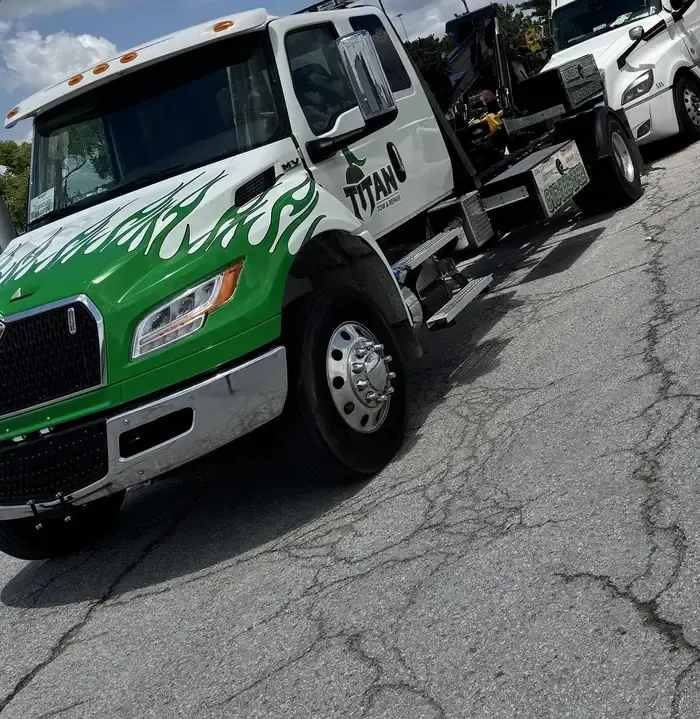
Titan Tow & Repair dispatches heavy-duty wreckers from Liberty for semis, trailers and box trucks across the Kansas City area on both sides of the state line. When you call, tell dispatch the street you are on, any no-truck or weight-limit signs you can see, and whether the load is over legal size or placarded, because that decides how the truck is rigged and the route it leaves by. Our post on how a semi gets towed walks through the job, what a heavy tow costs covers the bill, and heavy-duty towing covers the service. Call (816) 888-8732, any hour.
Sources
- RSMo 304.120, Municipal regulations (streets and boulevards limited to passenger vehicles; commercial vehicle routes)
- RSMo 304.170, Regulations as to width, height and length of vehicles
- RSMo 304.180, Regulations as to weight; axle load, tandem axle defined
- RSMo 304.200, Special permits for oversize or overweight loads
- MoDOT Motor Carrier Services, Oversize/Overweight Permits
- K.S.A. 8-1901, Criminal penalties for violation of size and weight laws; exceptions
- K.S.A. 8-1902, Width of vehicles and loads thereon
- K.S.A. 8-1904, Height and length of vehicles and loads
- K.S.A. 8-1907, Towing vehicles; connection and safety equipment
- K.S.A. 8-1908, Gross weight limits on wheels and axles
- K.S.A. 8-1909, Gross weight limits for vehicles
- K.S.A. 8-1911, Permits for oversize or overweight vehicles
- K.S.A. 8-1912, When secretary of transportation or local authorities may restrict use of highways
- K.S.A. 8-1914, Special permits between Kansas turnpike toll booths and truck terminals
- Kansas City, Missouri Code of Ordinances, Chapter 70, Article XI: Vehicle Weight, Size and Load
- Kansas City, Missouri Code of Ordinances, Chapter 70, Article I: In General (Sec. 70-1 definitions)
- Kansas City, Missouri Code of Ordinances, Chapter 53: Parks, Recreation and Boulevards
- Kansas City, Missouri Code of Ordinances, Chapter 34, Article XI: Transportation of Hazardous Materials
- Unified Government of Wyandotte County/Kansas City, Kansas Code, Chapter 35, Article XVIII: Vehicle Size, Weight and Load
- 49 CFR Part 397, Transportation of Hazardous Materials; Driving and Parking Rules (incl. 397.3, 397.5, 397.67-397.73, 397.101)
Related reading
How a Bus or Motorcoach Gets Towed Safely — A bus is towed by a heavy wrecker, but not the way a semi is.
Does AAA Cover Semi Trucks or Box Truck Towing? — Usually not.
Where to Place Warning Triangles When a Semi Breaks Down — Turn on your hazard flashers immediately, then place three warning triangles as soon as possible and within 10 minutes.
What this covers
Heavy-duty towing
A loaded tractor-trailer is not a bigger car. It needs a rated wrecker, a rated operator and a plan before anything gets hooked. That is what we send.
Heavy-duty towing detailsFleet & commercial towing
Fleets do not need a hero, they need a truck that turns up and paperwork that reconciles. We do both.
Fleet & commercial towing detailsIn a specific city: Heavy-duty, semi and semi trailer towing in Kansas City, Missouri · Heavy-duty towing in Liberty, Missouri · Heavy-duty, semi and semi trailer towing in Kansas City, Kansas · Heavy wrecker service and semi towing in Saint Joseph, Missouri · 24/7 semi and heavy-duty towing in Oak Grove, Missouri · Heavy-duty and semi towing in Topeka, Kansas
Places in this post: Wyandotte County, KS