Flatbed or wrecker: which one does your vehicle actually need?
A flatbed carries the whole vehicle with all four wheels off the road; a wrecker lifts one axle and tows with the other two wheels rolling. All-wheel-drive vehicles, electric vehicles, low-clearance cars and anything with drivetrain or transmission damage should go on a flatbed, because towing them with wheels turning can damage the drivetrain. Most front-wheel-drive cars can be towed either way.
What each truck is actually for
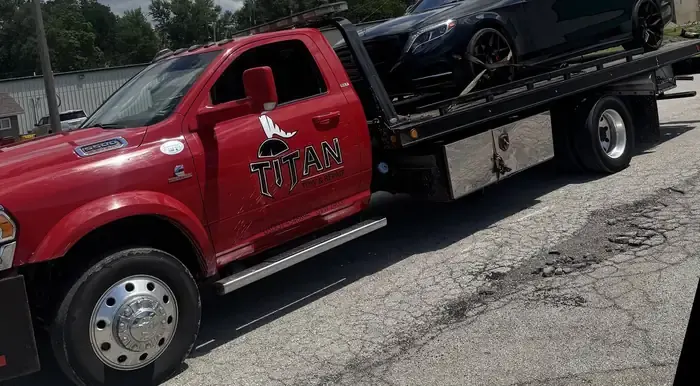
A rollback flatbed — often just called a rollback — has a deck that slides back and tilts to the ground. The vehicle is winched up onto it and rides with nothing touching the pavement. It is the carrying tool. Loading takes a few minutes longer than hooking a wheel lift, and for a great many modern vehicles it is the only correct answer.
A wrecker is the lifting and pulling tool. It lifts one end of a vehicle — on a light-duty truck, with a wheel lift that cradles the tires; on a heavy wrecker, with an underlift that goes under the front axle or the frame — and tows with the other two wheels rolling down the road. Because the boom and winch stay behind the truck, a wrecker is also what pulls a vehicle out of somewhere a deck cannot reach.
Both run out of our Liberty yard, which is why the question gets answered on the phone rather than on arrival. Light-duty towing covers the rollback side and heavy-duty towing the wrecker side.
Why weight class decides it before anything else does
For cars, the flatbed-or-wrecker question is about the drivetrain. For commercial vehicles it is settled earlier, by weight, and the two conversations should not be confused with each other.
A tractor-trailer can run at 80,000 pounds gross on the Interstate System under 23 CFR 658.17, with up to 20,000 pounds on a single axle and 34,000 on a tandem. Nothing about that goes on a rollback deck. A Class 8 tractor is a heavy wrecker job every time: the wrecker's underlift takes the steer axle or the frame at rated points, the driveline is disconnected so the drive wheels can roll safely, and air is supplied to release the spring brakes. How a semi actually gets towed walks through that procedure step by step.
A car is the opposite case. It is light enough that either truck can physically move it, so the decision comes down to what rolling the driven wheels would do to it. Between those two extremes sit pickups, vans, box trucks and hot shots, where the honest answer is that the truck's weight and the deck's capacity have to be checked before anything is promised.
What a rollback can and cannot carry
A rollback is defined by three numbers and one shape: the deck's length, its width, its rated capacity, and the angle the deck makes with the ground when it tilts. Every limitation below comes out of one of those.
- It can carry. Cars, crossovers, pickups, cargo and passenger vans, smaller RVs, non-rollers, wheels-locked and crash-damaged vehicles, and containers. The winch is what makes a vehicle with locked wheels or no key a routine load rather than a problem.
- It cannot carry a Class 8 tractor. Not a tractor, not a loaded trailer, not a bus. Those exceed both the deck and the rating, and they are wrecker work.
- Length and overhang matter. A long wheelbase can hang past the deck far enough that it is no longer secure, and a long vehicle plus the truck can also run into length limits.
- Approach angle beats capacity more often than weight does. A low front bumper, a splitter or an air dam meets the tilted deck before the tires do. That is what extended ramps and wood blocks exist for, and it is worth saying on the phone.
- Height is a real limit. On a deck, a tall vehicle gains several feet of height. Parking structures, drive-throughs and low bridges become part of the route planning rather than an afterthought.
- Access can rule it out. A rollback needs straight-line room behind it to tilt the deck and winch. Tight garages, underground levels and cramped lots often mean a wheel lift goes in, brings the vehicle out, and the deck loads it somewhere with room.
When it has to be a flatbed
- All-wheel drive and four-wheel drive. On many AWD systems, rolling one axle while the other is lifted turns the drivetrain against itself. Manufacturers commonly specify flatbed transport for this reason — your owner's manual is the authority for your vehicle.
- Electric vehicles. Most EV makers require flatbed transport. Driven wheels turning can push current back through the motor, and there is no neutral that fully disconnects the drivetrain the way there is in a gasoline car.
- Low front ends. Sports cars, lowered cars and some sedans will contact the ramp before they reach the deck. Mention it when you call so blocks and extended ramps come along.
- Transmission or drivetrain damage. If the problem is the gearbox, the differential or a wheel bearing, nothing should be rolling.
- Crash damage, or wheels that will not turn. A seized brake or a bent suspension arm makes a wheels-down tow a dragging operation.
- Anything that has to arrive exactly as it left. Classics, show cars and vehicles going to an appraisal ride better with nothing touching the road.
Drive-axle lifts, and when the driveline has to come out
On a car the rule of thumb is simple: lift the driven wheels and let the free-rolling ones turn. A front-wheel-drive car goes up by the front, a rear-wheel-drive car by the rear. Where that is not possible, dollies under the rolling wheels take them off the road instead, and on an all-wheel-drive vehicle a deck is still the cleaner answer.
On a heavy truck the same idea has teeth in it. A tractor's transmission is lubricated while the engine runs; tow it with the drive axles turning and the engine off and the gears are back-driven with no oil circulating, for every mile of the trip. So the operator breaks the connection mechanically — either pulling the axle shafts out of the drive hubs and capping the openings, or dropping the drive shaft and securing it out of the way. Minutes with hand tools, reinstalled at the destination.
That is also why some heavy tows go up by the rear rather than the front. Steer-end damage can force a rear lift, which changes the lift points and the lighting and takes longer to set up, but is still routine. A trailer with no tractor is its own case, covered in can a trailer be towed without its tractor.
What we run, and what we do not
Plainly stated, because it saves everyone a phone call. We run rollback flatbeds and heavy wreckers out of the Liberty yard, plus a mobile service truck. We do not run a rotator, and we do not haul equipment on a lowboy. A scene that needs a boom swinging off the side of the truck over a barrier or down an embankment is one we will tell you about early rather than discover on arrival — rotator or wrecker explains where that line sits, and most heavy work falls on the wrecker side of it.
What that leaves is a wide middle: cars and pickups on a deck, Class 8 tractors and loaded trailers behind a heavy wrecker, and the box trucks, hot shots, buses, containers and yard machinery in between, which get matched to whichever of the two can actually take them.
What you can say that decides it
You do not need to diagnose your own vehicle before you call. Read the badge on the back, say what it is doing, and dispatch works out which truck goes. These are the details that settle it fastest.
- Year, make and model. On a car that one answer usually settles the drivetrain question by itself.
- Front-wheel, rear-wheel, all-wheel drive, or electric. If you know it, say it. If you do not, say that instead of guessing.
- Whether it rolls, steers and comes out of park. Three separate questions, and each one changes the equipment.
- How low it sits, and how tall it is. Low decides the ramps. Tall decides the route.
- For a truck: the class, and loaded or empty. Pickup, box truck, hot shot with a gooseneck, or Class 8 tractor. A rough weight is better than none.
- Where it is sitting. A live shoulder, a soft verge, a tight garage and a dock each need different equipment before the tow even starts.
- Where it needs to end up. Your shop, a dealer, your yard or ours, and whether the destination can take the truck that brings it.
Related reading
Rotator or Wrecker: Which Heavy Tow Truck Does It Need? — Most heavy tows and recoveries do not need a rotator.
How to Choose a Heavy-Duty Towing Company — Choose a heavy-duty towing company on five things: whether their operators hold recovery certification such as WreckMaster, whether they carry on-hook and garage-keepers insurance, whether they own the equipment rather than brokering it out, whether a person who knows the trucks answers the phone at 3am, and whether their invoices carry the detail your office needs to reconcile the charge.
Semi Running Hot: Pull Over or Push On to the Next Exit? — A climbing gauge under heavy load on a grade can be normal; a gauge that keeps climbing after you shed load and speed is not.
What this covers
Light-duty towing
The same yard that runs the heavy wreckers runs the rollbacks, so a car gets the same answer at 3am that a semi does.
Light-duty towing detailsHeavy-duty towing
A loaded tractor-trailer is not a bigger car. It needs a rated wrecker, a rated operator and a plan before anything gets hooked. That is what we send.
Heavy-duty towing detailsIn a specific city: Heavy-duty towing in Kansas City, Missouri · Heavy-duty towing in Liberty, Missouri