How a broken-down bus or motorcoach actually gets towed
A bus is towed by a heavy wrecker, but not the way a semi is. Passengers come off first. The bus is lifted at points its manufacturer designed for towing, never by body panels, with care for its long, low overhangs. If its drive wheels stay on the ground, the driveline is disconnected to protect the transmission, and the air suspension is managed so the body clears the road.
Why a bus is not just a long truck
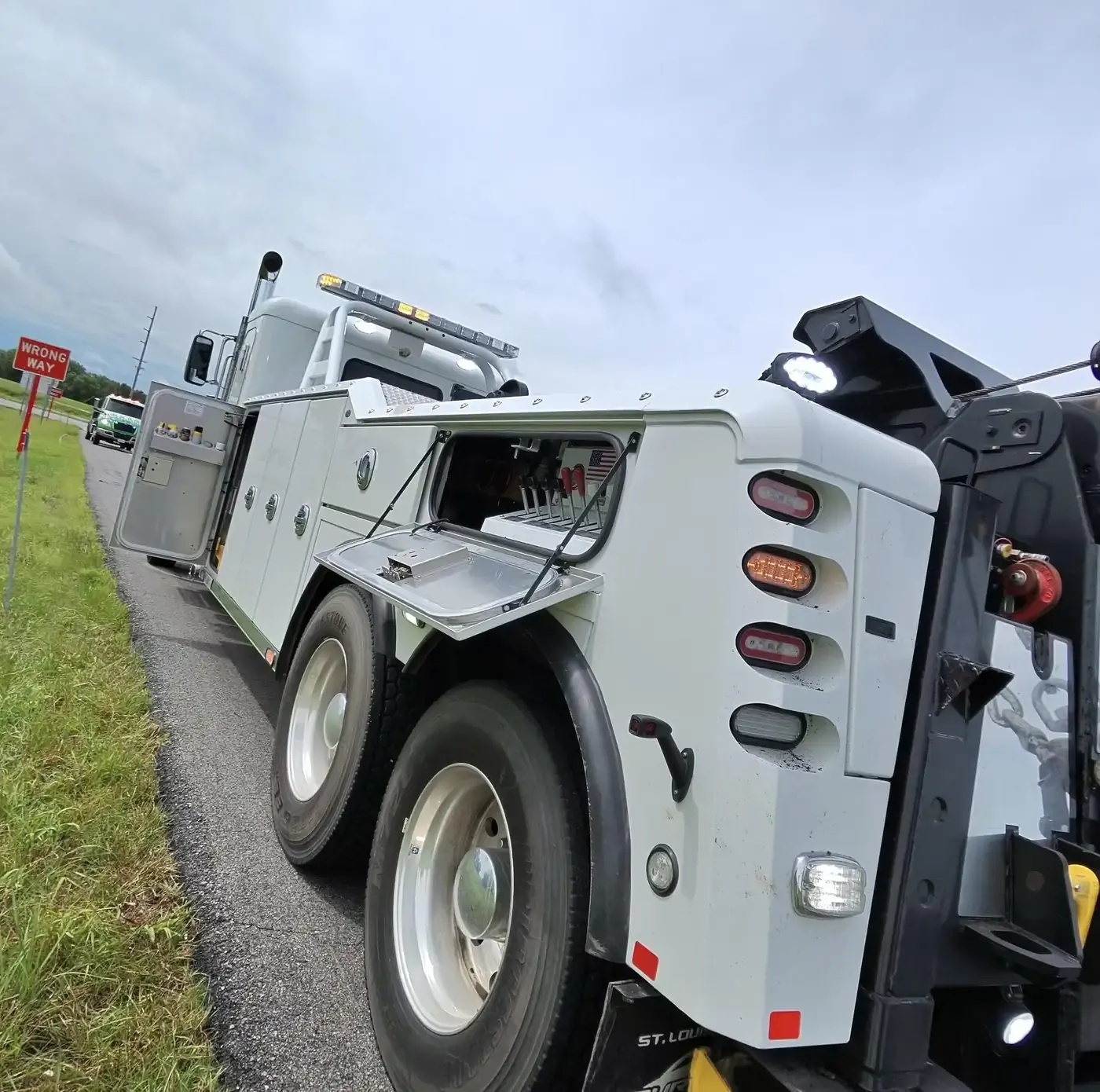
From a distance, towing a broken-down bus looks like towing any other heavy vehicle: a wrecker backs up, lifts one end, and drives away. Up close it is a different job. A motorcoach is long and heavy, but it is also built low, with the body hanging well beyond the axles at both ends, and much of its structure is designed to carry passengers rather than to be pulled on. A wrecker that treats it like a tractor-trailer can crush a bumper, tear an air line or scrape the underside on the first driveway it meets.
Buses also vary far more than trucks do. A school bus, a city transit bus, a church or airport shuttle and a highway motorcoach have different engine locations, different drive axles, different suspensions and different places where they can safely be lifted. The first job on any bus tow is knowing exactly which of those is sitting on the shoulder.
Passengers come first, every time
Nothing is hooked up to a bus with people on it. Passengers are moved to safety first — away from traffic, and ideally behind a barrier or well off the shoulder — and the operator arranges a replacement vehicle to take them on. On a charter or motorcoach trip that also means luggage: the bays underneath are usually emptied before the tow, both because the bags belong with their owners and because a loaded luggage bay changes how the coach rides on the wrecker.
If you are the driver or the operator, tell dispatch how many people are aboard and whether a replacement vehicle is already on its way. It changes the urgency of the call and how the scene is managed while everyone waits.
Two kinds of bus need extra thought before anything is connected. On a bus with a wheelchair lift or ramp, the lift has to be stowed and secured before the tow, and if it failed while deployed, it is secured in place so it cannot swing or drop during the move. Any passenger who uses a wheelchair is helped off first and kept somewhere safe and sheltered while the replacement vehicle is arranged. On a school bus, the school district's own procedures for a breakdown with students aboard come first — who stays with the students, who is notified and how they are collected — and nothing is hooked up until every student is safely off and accounted for.
Where a bus can and cannot be lifted
A heavy wrecker usually tows a bus with its underlift: a hydraulic arm that reaches under one end of the vehicle and lifts that axle clear of the road. What matters is exactly where it lifts. Buses and coaches have designated towing and lifting points built into their structure, and the lift is made there, using adapters that fit the vehicle, rather than against a bumper, a body panel or a component that was never meant to carry the weight of the bus.
The long overhang at each end is the other constraint. Lifting one axle raises the far end's overhang toward the sky and drops the near one toward the pavement, and a coach can scrape at either end on a steep ramp, a crowned road or a driveway entrance. A careful tow plans the route with that in mind.
The driveline, and why it gets disconnected
When a vehicle is towed with its drive wheels on the ground, those wheels turn the driveline and, through it, parts of the transmission. With the engine off, the transmission may not be lubricated the way it is when driving, and towing any distance like that can damage it badly. So when a bus is towed with its drive axle still on the road, the driveline is disconnected first — typically by removing the driveshaft or the axle shafts, depending on the vehicle — and secured so nothing can come loose on the way.
Which end is lifted affects this directly. Highway motorcoaches and many transit buses have their engines and drive axles at the rear; most school buses have the engine at the front and the drive axle at the rear. Lifting the drive axle clear avoids the driveline question, but it is not always the right end to lift, so it is decided for each bus rather than assumed.
Air suspension and clearance
Most modern buses and coaches ride on air suspension, and many can lower or kneel to make boarding easier. With the engine off and the air system empty, the suspension can settle to its lowest position, which takes away ground clearance exactly when it is needed. Before towing, the suspension is brought to a safe ride height — using the bus's own air if it can still be supplied, or air supplied from the wrecker — and the brake system is handled so the brakes are released on the wheels that stay on the road.
Some coaches also have a tag axle, an extra unpowered axle behind the drive axle, and some of those can be lifted. How the tag axle is set changes how the coach's weight is carried during the tow, so it is part of the plan rather than an afterthought.
What to tell dispatch about a bus
- The type of bus. School bus, transit bus, shuttle or highway motorcoach, and the make if you know it.
- Its length. Roughly how long it is, which decides the equipment and how it maneuvers.
- Where the engine is. Front or rear, which usually tells us where the drive axle is.
- What failed. Engine, transmission, air system, electrical, a tire or a crash, and whether the air suspension still holds the bus up.
- Who is aboard. Whether passengers are still on the bus and whether a replacement vehicle is coming.
- Where it is sitting. Mile marker and direction, or the exact location off the road, and whether it is in or near a live lane.
Where the bus goes, and who decides
A bus is usually towed to the operator's own garage or to a repair facility that works on that make, and the operator decides which. School districts, transit agencies and charter companies often have established repair arrangements, and the tow should follow them. Get the destination, the contact who will receive the bus, and any gate or after-hours instructions before the tow sets off.
Heavy towing for buses and coaches is part of the heavy-duty towing we run across Kansas City and northwest Missouri. For how the same principles apply to a tractor, see how a semi gets towed, and for why a heavy tow is not simply a bigger light-duty tow, read flatbed or wrecker: which tow truck.
Related reading
Can a Trailer Be Towed Without Its Tractor? — Yes.
How a Semi Actually Gets Towed, Start to Finish — Towing a semi starts with a walk-around, not a hook.
Does AAA Cover Semi Trucks or Box Truck Towing? — Usually not.
What this covers
Heavy-duty towing
A loaded tractor-trailer is not a bigger car. It needs a rated wrecker, a rated operator and a plan before anything gets hooked. That is what we send.
Heavy-duty towing detailsIn a specific city: Heavy-duty towing in Kansas City, Missouri · Heavy-duty towing in Liberty, Missouri · Heavy-duty towing in Kansas City, Kansas · Heavy-duty towing in St. Joseph, Missouri