
The drive belt just let go. What it was turning, and why you should stop soon.
Get off the road at the first safe place and shut down. Depending on the engine, the belt may drive the alternator, the air-conditioning compressor and, on belt-driven designs, the water pump and cooling fan, so charging stops and temperature can climb fast. A new belt can often be fitted at the roadside, but a failed tensioner or pulley may need parts ordered or a shop.
What the belt was driving
At the front of the engine, one or more drive belts run from the crankshaft pulley around the accessories, with a tensioner keeping the belt tight and idler pulleys guiding it. What those belts turn varies by engine and by how the truck was built, so the list below is what a belt commonly drives rather than a promise about yours. Your engine documentation or your shop can tell you exactly what runs off your belt.
- The alternator. With the belt gone, charging stops and the truck runs on its batteries until the voltage falls too low for the engine electronics. Our post on a semi alternator that is not charging covers that side of it.
- The water pump, on belt-driven designs. Where the pump runs off the belt, coolant stops circulating when the belt breaks, and engine temperature can rise quickly.
- The cooling fan, on belt-driven designs. A fan driven through the belt stops pulling air through the radiator, which shows first at low speed and at idle.
- The air-conditioning compressor. A cab that suddenly goes warm can be the first thing a driver notices, and it is a useful clue that the belt, not the air conditioning, has failed.
- Other accessories. Depending on the engine and the options fitted, other components may share the same drive, which is why the dash can light up with several unrelated-looking warnings at once.
Why stopping soon is the cheaper choice
A broken belt starts two clocks at once. The battery warning and a falling voltmeter mean the truck is living on stored power, and if the belt also drove the water pump or the fan, the temperature gauge will start to climb. Neither clock gives you a reliable number, and both end badly: a truck that stalls in a live lane with its lights dimming, or an engine run past its temperature limit.
Modern engines try to protect themselves. Freightliner's driver's manuals list high coolant temperature and low coolant level among the conditions that start a warning, a derate or a shutdown, depending on how the engine is set up. That protection can decide where the truck stops if you do not decide first. Our post on a semi running hot covers that pull-over call in detail.
Once you are stopped, turn on the hazard flashers and set out the warning triangles, which 49 CFR 392.22 requires for a truck stopped on the road or the shoulder. Our post on where the warning triangles go covers the placement.
Signs the belt is gone, or about to go
Some warning signs show up before a belt fails, and some only after it has gone. Both kinds are worth recognizing, because the earlier ones give you the chance to have the drive looked at in a shop bay instead of on a shoulder.
- A battery lamp and a falling voltmeter together. A sudden charging warning with no other explanation is a reason to look at the belt as soon as it is safe to stop.
- A climbing temperature gauge. Especially alongside a charging warning, on an engine whose water pump or fan runs off the belt.
- The air conditioning quitting at the same moment. Several belt-driven accessories failing together points at the one thing they share.
- A squeal that has come and gone. A squeal that suddenly stops can mean the belt has given up rather than recovered. Gates, the belt and tensioner maker, says a squealing belt is rarely caused by the belt alone, and that slipping and misalignment from tensioner wear are the predominant cause.
- Visible wear before failure. Glazing, fraying, cracks, damaged ribs, oil on the belt, or a pulley that sits crooked or wobbles are all reasons to have the drive inspected before the belt breaks on the road.
Why belts break: the usual causes
A broken belt can be the symptom rather than the cause. Fitting a new one without finding out why is how the same truck ends up back on the shoulder, so the whole drive gets inspected, not just the belt.
- A worn tensioner. The tensioner holds the belt at a consistent tension. Gates notes that a loss of tension creates noise and heat that lead to premature belt failure.
- Idler and pulley bearings. Freightliner's belt inspection procedure treats excessive play or wobble in a pulley as a sign of bearing failure, and Gates adds that worn pulleys can misalign and damage the rest of the system. A bearing that locks up can take the belt with it.
- Misalignment. Freightliner lists misalignment among the kinds of belt damage to inspect for, and a drive that is out of line puts uneven wear on the belt.
- Oil and coolant contamination. Freightliner's procedure warns that oil, grease or belt dressing can make a belt fall apart in layers, says to repair any oil or coolant leaks affecting the belts before replacing them, and says not to use belt dressing on any belt. Our post on a semi coolant leak covers tracing one.
- Debris in the pulleys. According to the same procedure, sand or gravel caught in a pulley, or a rough pulley surface, leaves jagged or streaked belt sidewalls.
- Age and operating conditions. Detroit's operator manual for its current heavy-duty engines warns that extreme heat or cold, dust, debris and road salt can significantly shorten belt life. It also says those engines use a belt material specific to the original equipment, and that an aftermarket belt may shorten maintenance intervals.
What you can safely check once the engine is off
Look, do not reach. Check the belt only with the truck stopped somewhere safe, the engine off and the key out, and never put your hands near belts or pulleys with the engine running. Engine parts stay hot after shutdown, so do not climb onto the engine or grab anything near the exhaust.
- Is the belt still there? Gone completely, hanging off, or still on some pulleys but not others.
- Anything wrapped or caught. Pieces of belt tangled around a pulley or lodged near the fan need to be cleared by the technician before the engine is run again.
- Wet spots. Oil or coolant on the belt, the pulleys or the area around them points to a leak that caused this failure or will cause the next one.
- The tensioner and pulleys. A tensioner arm resting at an odd angle, or a pulley that sits crooked, is worth a photo.
- The gauges you noted. What the temperature gauge and voltmeter read before you shut down. Do not open a hot cooling system to check the coolant.
- A photo of the belt path. A picture of the drive and any damage helps the technician bring the right belt and parts on the first trip.
Replacing the belt at the roadside
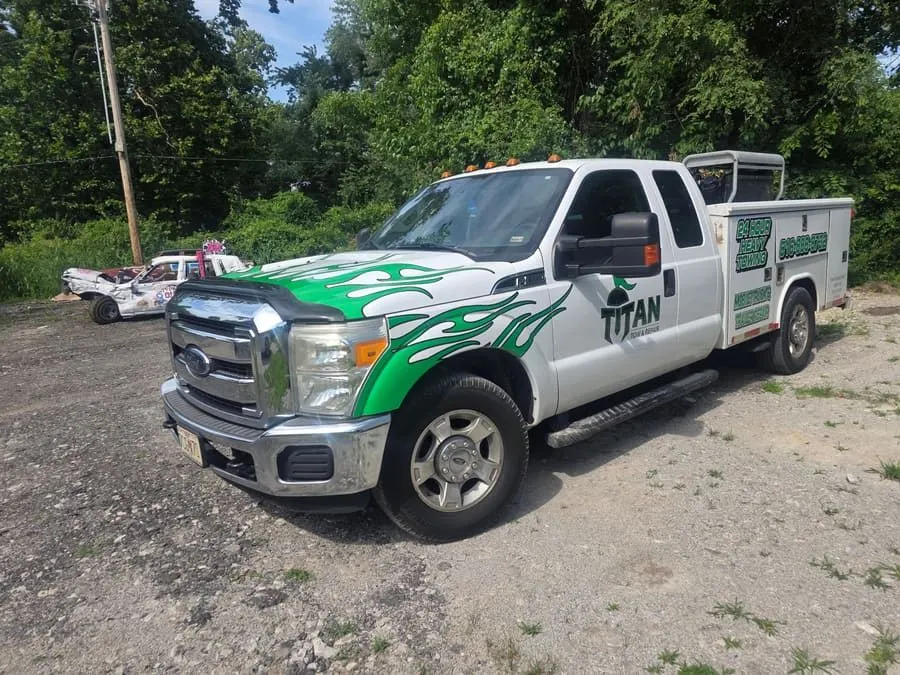
Belts are part of the cooling-system work our mobile truck repair service handles, and a broken drive belt can be replaced where the truck sits when the rest of the drive is sound. The technician confirms the correct belt and routing for your engine, looks over the tensioner, idlers and pulleys for play, wobble, noise and contamination, checks for any leak that soaked the old belt, and fits the new one. The engine is then run to confirm the belt tracks properly, the charging system is charging and the temperature behaves.
What we will not do is promise a tensioner or pulley at the roadside. If a tensioner, an idler or an accessory pulley failed and took the belt with it, that part has to be replaced before a new belt is worth fitting, and depending on the engine it may need to be ordered or the work may need a shop. Gates recommends replacing the tensioner and pulleys along with the belt when they are worn, which is sound advice and sometimes a shop decision rather than a shoulder one.
When a broken belt turns into a tow
Some belt failures end with a wrecker rather than a new belt. If the engine overheated badly before it was shut down, it needs a proper inspection before it runs again. If a locked-up accessory or a failed tensioner needs parts nobody carries on a service body, or the truck stopped somewhere it cannot safely be worked on, the answer is a tow to the shop or yard of your choice. Our post on how a semi gets towed explains what that involves.
Do not try to limp a truck with no belt to a shop, however close it looks, without talking to someone first. What is safe depends entirely on what that belt was driving on your engine.
Details that help us bring the right belt
- Engine make, model and year. Belts, routing and tensioners differ, and the right belt on the service truck saves a second trip.
- What stopped working. Charging, temperature, air conditioning or a combination, and which warning lamps came on.
- How far it ran after the failure. Whether the temperature climbed, and how high the gauge went before you shut down.
- What you can see. A belt that is missing, shredded or hanging, a crooked pulley, or oil or coolant on the drive. A photo helps.
- Where you are. Highway, direction and mile marker, or the name of the lot, and whether the truck is safely off the road.
Sources
Related reading
Water in Fuel Light and Clogged Fuel Filters on a Semi — The water-in-fuel light means the fuel/water separator has collected enough water to need draining, and on some engines, including Detroit's, leaving it leads to a derate.
Battery Light On: Semi Alternator Not Charging — A battery warning light with a falling voltmeter means the batteries are being drained instead of charged.
Semi Coolant Leak: Hose, Radiator or Water Pump? — Most semi coolant leaks come from hoses, clamps, the radiator or the water pump, and those are commonly repaired at the roadside.
What this covers
Mobile truck repair
Our service truck carries the parts and the tools. Faster for your driver, cheaper for your office, and the load keeps moving.
Mobile truck repair detailsIn a specific city: Mobile semi truck and heavy-duty truck repair in Kansas City, Missouri, with a diesel mechanic at the roadside · Mobile truck and trailer repair in Riverside, Missouri · Mobile truck and trailer repair in Liberty, Missouri: a diesel mechanic for emergency roadside breakdowns · Semi truck and heavy-duty truck repair in Kansas City, Kansas, by a mobile diesel mechanic who comes to the truck · Mobile semi truck and trailer repair in Saint Joseph, Missouri · Mobile truck repair and a diesel mechanic on call in Topeka, Kansas · Roadside semi truck and trailer repair in Lee’s Summit, MO, from a mobile diesel mechanic