
The battery light is on and the voltmeter is dropping. Is it the alternator?
A battery warning light with a falling voltmeter means the batteries are being drained instead of charged. The alternator is the usual suspect, but a slipping or broken belt, a loose or corroded cable, or a failed connection causes the same symptoms. The truck will run only until the batteries are too low to power the engine's electronics, so get somewhere safe and call before it stalls.
What the warning is really telling you
While the engine runs, the alternator is supposed to power everything electrical on the truck and keep the batteries topped up at the same time. When it stops doing that, the truck does not stop immediately. It carries on running on the batteries, which slowly drain as they supply the lights, the engine's electronic controls, the fans, the dash and anything else switched on. The battery warning light, or a voltmeter reading that keeps falling, is the truck telling you that the batteries are losing that race.
Most heavy trucks in North America run a 12-volt electrical system with several batteries connected together. With the engine off, fully charged batteries typically sit a little above 12.5 volts. With the engine running and the charging system working, the reading is normally higher, commonly somewhere in the range of about 13.5 to 14.5 volts depending on the system and temperature. A running engine showing a reading at or below the resting battery voltage, and falling, is not charging.
How long you have
There is no honest single answer, because it depends on how charged the batteries were, how healthy they are, the temperature and how much is switched on. What is certain is the ending. A modern diesel engine depends on its electronic control module, its fuel system electronics and its sensors, and when the voltage falls far enough those stop working properly and the engine stalls or refuses to restart. Before that point, you may see dimming lights, flickering or erratic gauges, and warning lights for other systems, including the ABS, as the voltage sags.
Treat the warning as a signal to get off the road in a controlled way while the truck still has power, not as something to drive through until the next town. A truck that stalls in a live lane at night with no lights is a far more dangerous problem than a charging fault on a shoulder. Turn off everything you do not need to reduce the load while you find a safe place to stop.
What usually causes it
- The drive belt. The alternator is driven by a belt from the engine. A belt that has broken, slipped off or is slipping will stop or weaken the charge, often along with squealing, and on many engines the same belt drives other components too.
- A loose or corroded cable. The heavy charging cable from the alternator to the batteries, the ground cables and the battery terminals all carry large currents. A connection that has loosened or corroded can stop the charge reaching the batteries even though the alternator is working.
- A failed alternator. Worn brushes, a failed internal voltage regulator, a failed diode or a worn bearing can each stop an alternator charging. A grinding or whining noise from the alternator points to the bearing.
- A blown fuse or fusible link. Some charging circuits are protected, and a failed protection device breaks the circuit.
- Batteries that have failed. A shorted or badly failed battery can drag down the system and make a working alternator look like a faulty one, and damaged batteries can be dangerous to charge.
What a driver can check safely
- Read the voltmeter twice. Note the reading with the engine running, and if it is safe to stop the engine, note the resting reading too. The difference tells a technician a lot.
- Look at the belt. With the engine off and the key out, check whether the belt is still on its pulleys, whether it is cracked, glazed or frayed, and whether it feels loose. Never reach near belts or pulleys with the engine running.
- Look at the battery connections. Check the terminals and cables for obvious looseness or white or green corrosion. Do not tug hard on cables near the batteries, and keep sparks and flames away, because batteries can give off hydrogen gas.
- Listen near the alternator. A grinding, whining or rattling noise that was not there before points at the alternator's bearing or mounting.
- Note what else is acting up. Dim lights, erratic gauges and other warning lights help confirm a low-voltage problem rather than a single failed component.
What gets fixed where the truck stands
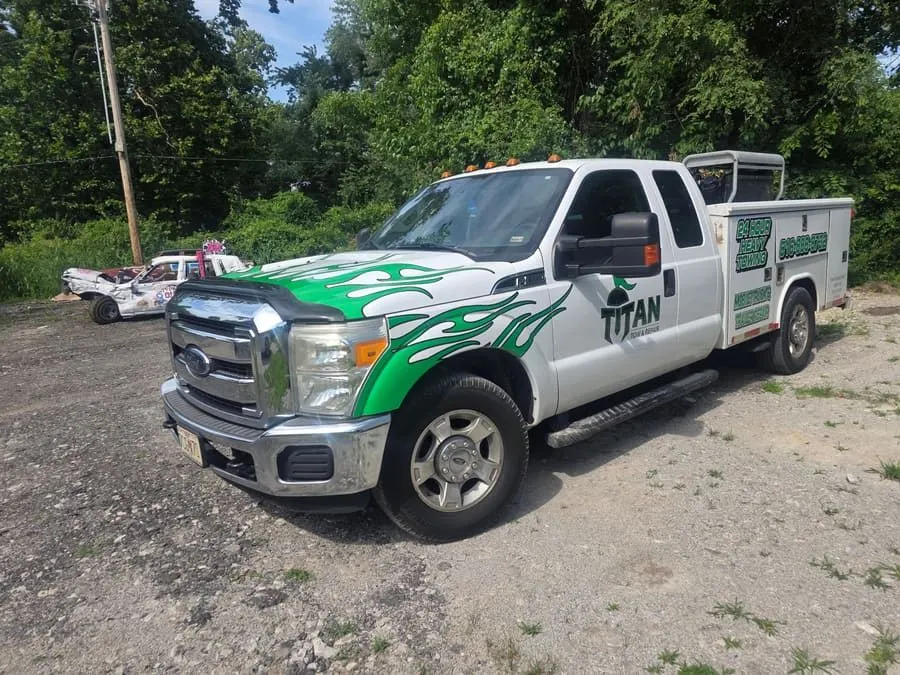
Charging faults are one of the most common roadside repairs there are. The service truck tests the batteries and the charging system to find out which part has actually failed, rather than guessing, then replaces a broken or worn belt, repairs or replaces loose and corroded cables and terminals, replaces a failed alternator, and replaces batteries that are no longer holding a charge. Testing matters, because a truck that gets a new alternator when its real fault was a corroded ground cable will be stranded again.
Once the repair is done, the charging voltage is checked with the engine running and the electrical loads switched on, to confirm the system is keeping up, not just working at idle with everything off. The mobile truck repair page lists the battery, charging and electrical faults we handle most often.
When the batteries are already flat
If the truck has already stalled or will not restart, the charging fault has become a no-start, and the order of work changes: the truck needs enough power to run again and the charging fault needs fixing, or it will simply drain the batteries again a few miles down the road. Jump-starting a truck with a known charging fault and driving off without repairing it is how drivers end up stranded twice in one day. Our post on a semi that will not start covers batteries, jump-starting and what to check first.
A low-voltage event can also leave warning lights and stored fault codes in other systems. Once the voltage is back to normal many of these clear, but any that remain are worth reading and dealing with rather than ignoring. Our post on the ABS light covers one of the most common.
When it becomes a tow
Most charging faults do not end in a tow. The exceptions are an alternator failure that has damaged its mounting or the engine accessory drive, a belt failure that has taken other engine-driven components with it, electrical damage from a short that has burned wiring, or a charging fault that turns out to be the symptom of a deeper engine or wiring problem. In those cases, and when a truck has stalled somewhere it cannot safely be worked on, we will tell you on the phone and get the truck towed to the shop of your choice.
Related reading
Semi Coolant Leak: Hose, Radiator or Water Pump? — Most semi coolant leaks come from hoses, clamps, the radiator or the water pump, and those are commonly repaired at the roadside.
ABS Light On: Semi Tractor or Trailer, and Is It Safe? — An ABS warning light means the anti-lock system has found a fault and may not prevent wheel lockup on the affected vehicle.
Truck Air Compressor Not Building Air: Causes and Fixes — When a truck will not build air, the compressor is often not the part that failed.
What this covers
Mobile truck repair
Our service truck carries the parts and the tools. Faster for your driver, cheaper for your office, and the load keeps moving.
Mobile truck repair detailsIn a specific city: Diesel mechanic and mobile semi truck repair in Kansas City, Missouri · Mobile truck and trailer repair in Riverside, Missouri · Mobile truck and trailer repair in Liberty, Missouri · Mobile semi truck and trailer repair in Saint Joseph, Missouri · Mobile truck repair and a diesel mechanic on call in Topeka, Kansas