
Your truck is losing coolant. Where it is going, and what can be fixed on the shoulder.
Most semi coolant leaks come from hoses, clamps, the radiator or the water pump, and those are commonly repaired at the roadside. A truck losing coolant with no visible leak and white exhaust smoke may have an internal leak such as an EGR cooler, which is shop work. Never open a hot cooling system: it is under pressure and can scald.
First, do not open it hot
A diesel engine's cooling system runs under pressure, which lets the coolant run hotter than its normal boiling point without boiling. Remove the radiator or surge tank cap while the system is hot and that pressure is released all at once, and the coolant can flash to steam and spray out. People are badly scalded this way every year. Let the engine cool, and if you have to check the level before it is fully cool, do it with the cap wrapped in a heavy cloth, turned slowly to the first stop so any remaining pressure vents before it comes off.
If the temperature gauge is climbing or a low-coolant warning is on, the first decision is not the leak at all; it is whether to keep driving. Our post on a semi running hot covers that decision. Many modern engines will also derate or shut themselves down to protect the engine when coolant is low or the temperature is too high, and that protection is worth respecting rather than overriding.
Read the signs before you look underneath
- A puddle or drips under the front of the truck. An external leak. The color of coolant varies with its type, so do not rely on color alone, but a sweet smell is a strong clue.
- Steam or spray from under the hood. An external leak onto hot parts, often a hose or a radiator seam. Stop and let it cool before looking.
- Coolant level dropping with no drips anywhere. Coolant going somewhere you cannot see: into the exhaust, into the oil, or being pushed out as vapor.
- White, sweet-smelling exhaust smoke. Coolant being burned or evaporated in the exhaust, commonly from a leaking EGR cooler on modern diesels, or more seriously a head gasket.
- Milky or creamy oil on the dipstick. Coolant mixing with the oil, which can point to an oil cooler failure or an internal engine problem. Do not keep running an engine with coolant in its oil.
Where external leaks usually come from
- Hoses and clamps. Radiator hoses, heater hoses and the smaller hoses to other components harden, crack and swell with age and heat. Clamps loosen as hoses shrink in cold weather. This is the most common source of all and the most straightforward fix.
- The radiator. Many truck radiators have plastic side tanks crimped onto a metal core, and those seams can crack or seep. The core itself can be damaged by road debris or corrosion.
- The surge or expansion tank. Plastic tanks crack, and their caps and fittings can leak, particularly when the cap's seal has aged.
- The water pump. Water pumps have a weep hole designed to show when the internal seal is failing. Coolant running from it, or wet streaks below the pump, mean the seal is going.
- Thermostat housings and gaskets. A seeping gasket at a housing or a fitting often shows as crusty residue where coolant has dried.
What you can check safely
Once the engine has cooled, a few minutes of looking narrows it down considerably. Look for wet spots and dried residue along each hose and at both ends of each hose where it meets a fitting. Look along the radiator's side tanks and core, around the surge tank, and below the water pump for streaks from its weep hole. Check the level in the surge tank against its marks so you know how much has been lost. Glance at the oil dipstick for any milky appearance.
Take a photo of anything wet or crusty, and note the coolant level and whether you have seen white smoke. Those details tell a technician on the phone a lot about which parts to bring.
Topping up in an emergency
If you have to add coolant to reach a safe place, use the same type of coolant that is already in the system if you have it. Heavy trucks use different coolant chemistries, and mixing them can reduce the protection they give against corrosion and freezing. If you have nothing else, clean water will get you off the road in a genuine emergency, but it dilutes freeze protection and corrosion protection, so the system should be checked and corrected afterwards, and in freezing weather it can be the difference between a leak and a cracked component.
Add coolant only when the system has cooled, and never pour cold coolant into a severely overheated engine. Clean up spills where you can: coolant is toxic, and its sweet taste attracts animals.
What gets fixed where the truck stands
Most external coolant leaks are roadside repairs. Hoses and clamps are replaced, fittings and surge tank caps are dealt with, and radiator and water pump problems are repaired or replaced on site where the truck and the part allow it. Once the leak is fixed, the system is refilled with the correct coolant, air is bled out so the engine does not run hot on a trapped air pocket, and the system is run up to temperature and checked for leaks under pressure before the truck moves.
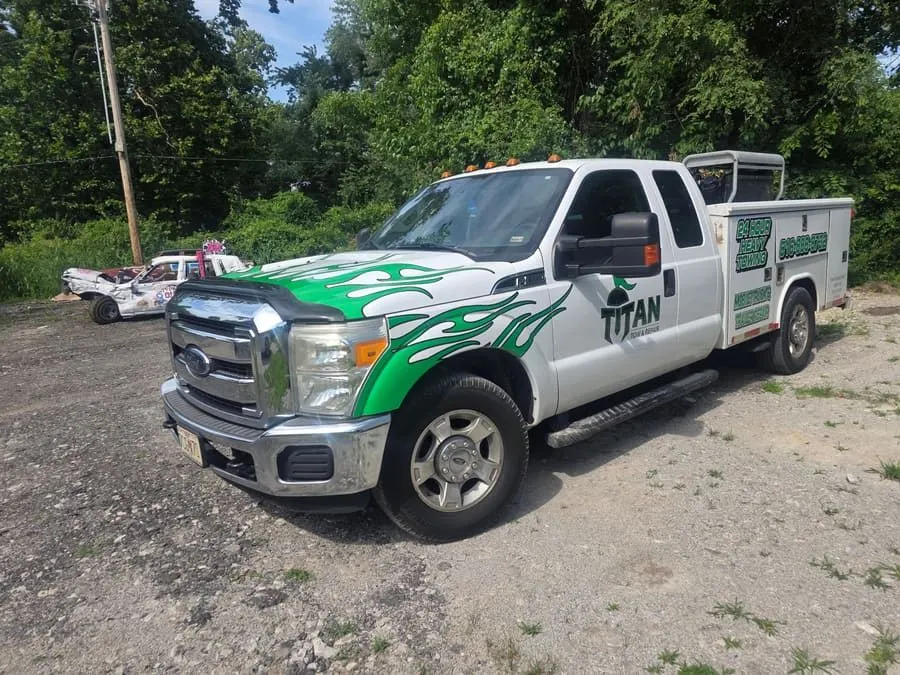
The service truck carries common hoses and clamps, and knowing the make, model and engine of the truck when you call makes it much more likely the right parts come on the first trip. The mobile truck repair page lists the cooling and engine faults we handle most often.
When it is shop work
Internal leaks are a different job. A leaking EGR cooler, an oil cooler that is mixing coolant and oil, a failed head gasket or leaking cylinder liners all require the engine to be taken apart to a degree that belongs in a shop. The same is true of an engine that has been run badly overheated, where the leak is only the first symptom of damage that needs proper inspection.
Where that is the likely answer, the useful thing is to know before the engine is run any further. Continuing to drive a truck that is burning coolant or has coolant in its oil can turn a repairable fault into a ruined engine. We will tell you on the phone if what you describe sounds like an internal leak, and if it is, the truck is towed to the shop of your choice rather than driven there.
Related reading
ABS Light On: Semi Tractor or Trailer, and Is It Safe? — An ABS warning light means the anti-lock system has found a fault and may not prevent wheel lockup on the affected vehicle.
Battery Light On: Semi Alternator Not Charging — A battery warning light with a falling voltmeter means the batteries are being drained instead of charged.
Truck Air Compressor Not Building Air: Causes and Fixes — When a truck will not build air, the compressor is often not the part that failed.
What this covers
Mobile truck repair
Our service truck carries the parts and the tools. Faster for your driver, cheaper for your office, and the load keeps moving.
Mobile truck repair detailsIn a specific city: Diesel mechanic and mobile semi truck repair in Kansas City, Missouri · Mobile truck and trailer repair in Riverside, Missouri · Mobile truck and trailer repair in Liberty, Missouri · Mobile semi truck and trailer repair in Saint Joseph, Missouri · Mobile truck repair and a diesel mechanic on call in Topeka, Kansas