
What does a heavy-duty tow actually cost in Kansas City?
Heavy-duty towing in Kansas City is quoted per job rather than from a flat price list, because the cost is driven by which class of truck has to roll, how hard the unit is to reach, whether it is loaded, whether recovery work is needed first, how far it runs and how long the scene takes. An honest operator gives you a conditional number on the phone.
Why nobody publishes a heavy-duty price list
Light-duty towing can be advertised as a hook fee plus a per-mile rate because the job barely varies — a car is a car, it sits on pavement, and it goes on a deck. Heavy duty does not work that way. The same call, described two different ways, can be one truck for an hour or three trucks for most of an afternoon.
What is honest instead of a rate card is the list of inputs combined differently on every job. Any company advertising one fixed price for heavy-duty recovery is either quoting the simplest possible version of the job or intends to revise the number once the driver sees the scene.
The class of truck sets the floor
Everything else is added on top of one decision: which unit leaves the yard. What a truck costs to put on the road is about its rating, its rigging and how many operators it takes to run, not about distance. Sending the wrong class twice costs more than sending the right one once, which is why we ask what you are driving and how it is sitting before quoting. These are the units that answer a commercial call, cheapest to most expensive to dispatch:
- A mobile service truck. The cheapest thing we can send, because it fixes the problem instead of moving it. Air leaks, brake chambers, batteries, lights, hoses and tires are often roadside work, and mobile truck repair that succeeds means no tow bill.
- A rollback flatbed. Right for cars, pickups, vans and smaller commercial units, and cheaper to put on the road than a heavy wrecker. Wrong for a loaded tractor-trailer.
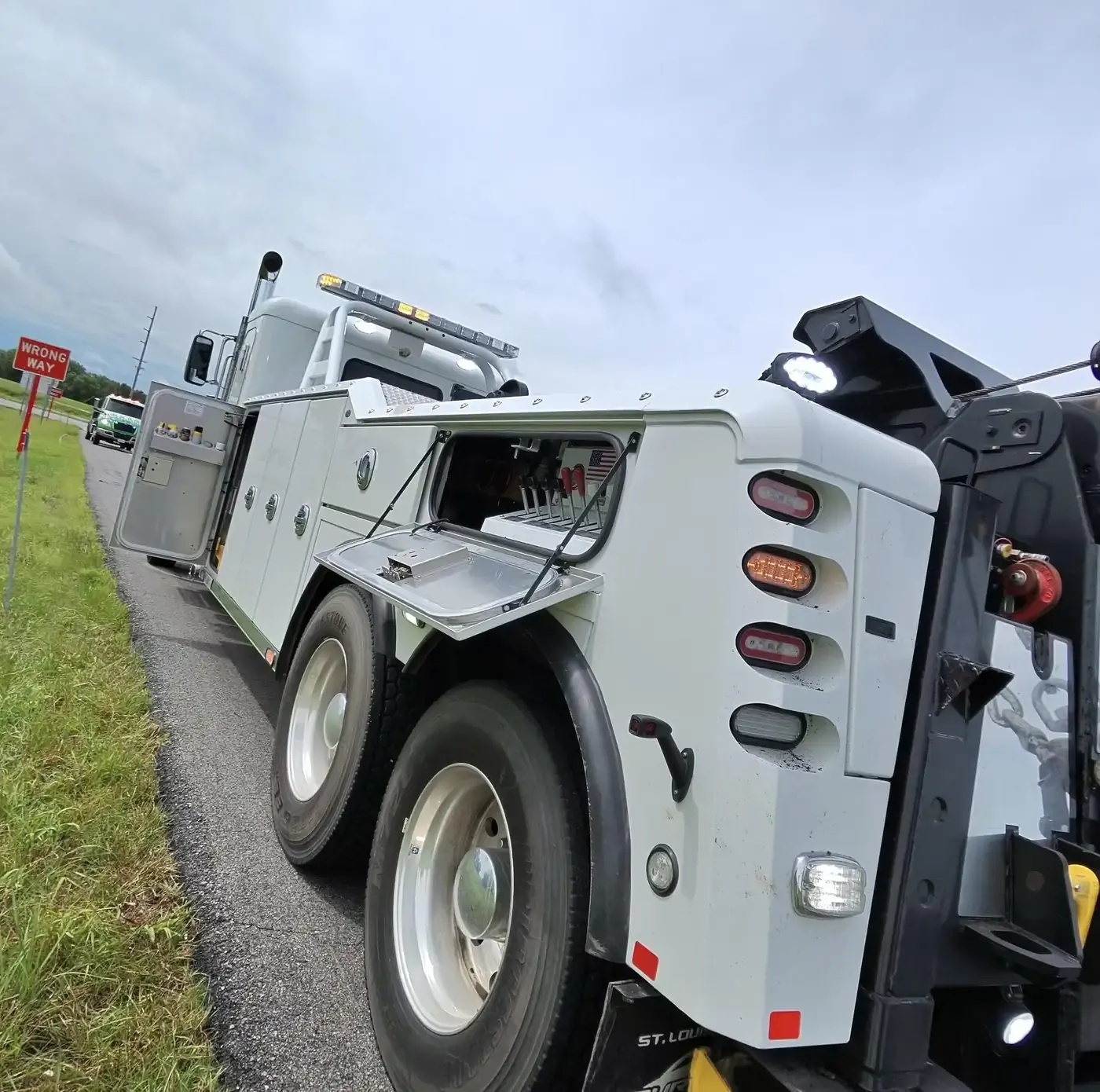
- A heavy wrecker. The rated boom and underlift a semi tractor, a loaded trailer, a bus or a piece of equipment needs. This is the class most heavy-duty calls require, and it sets the bracket for the job.
- A second heavy unit. Some jobs need two — one to lift or hold while the other pulls, or a separate truck for the trailer when tractor and trailer cannot travel coupled. Two trucks means two crews and a different cost structure.
- A rotator. Specialist equipment for lifts a conventional wrecker cannot make. We do not run one, and we will say when a job needs one rather than improvising. Our post on rotators versus conventional wreckers explains where that line falls.
How hard the unit is to reach
Access is the factor drivers underestimate most. A tractor-trailer upright on a wide shoulder with room ahead and behind is the simple version of a heavy tow: the wrecker backs in, hooks and leaves. Take away the room and the same tow becomes a longer job with far more setup in it. Describe the position honestly, because access is the input most likely to change a quote on arrival. These are the conditions that cost time:
- No room to set up. A narrow shoulder, a guardrail, a bridge deck or a work zone with barrier wall both sides leaves nowhere to position a wrecker safely.
- Soft or sloped ground. Grass, mud, gravel or a grade may mean positioning the wrecker somewhere awkward, or putting matting and cribbing under it.
- Tight yards and docks. A trailer wedged at a dock or a unit under a low canopy needs maneuvering room that has to be made, not found.
- Live traffic. Working beside moving lanes slows everything and may require lane closures before anything is hooked.
- Darkness and weather. Rain, ice and night work add setup time and lighting, and make everything on the shoulder more dangerous.
Loaded or empty, and whether recovery comes first
A loaded trailer is heavier, harder to rig and slower to move than an empty one. If the freight has shifted, the job changes shape: the load may need stabilizing, re-securing or transferring to another trailer before the unit moves at all.
The bigger fork is whether the unit needs recovering before it can be towed. A tow moves a unit already sitting on its wheels on pavement. Recovery is everything that has to happen first — winching, rigging, uprighting, separating a jackknife — and it is separate work with its own equipment and its own time on scene. If your truck is in a ditch, a median or a dock well, the quote has two halves in it and you should ask which is which. The detail is in our guide to what a winch-out or recovery costs, and the service itself is winch-out and recovery.
Distance, time on scene and how many people it takes
Distance works in both directions: the run out to you and the run on to wherever the unit is going. Our yard is in Liberty, so a job up I-35 toward Kearney is a shorter round trip than one out I-70 past Blue Springs, and a tow to your own shop is a different job from a tow to a dealer across the metro.
Time on scene is the input people expect least. Much of a heavy job happens standing still: assessing, rigging, disconnecting driveline, caging brakes, securing the load, waiting on an agency to release the scene. That time is real work and belongs on the invoice. What is not legitimate is ambiguity about when the clock starts.
Additional operators follow from all of the above. Two trucks means two crews; someone on traffic control while rigging is set is a third pair of hands. People get added because the plan cannot be executed safely with fewer, and the invoice should say what each one did.
Cleanup, storage and the costs that land afterward
Two categories of charge routinely surprise people because they arrive after the truck has been moved. Neither is improper; both need discussing beforehand.
The first is scene cleanup. A breakdown that dropped nothing leaves nothing to clean. A wreck, a broken air line, a ruptured fuel tank or a spilled load is different: debris has to come off the roadway and absorbent has to go down on fluids before lanes reopen, and the responding agency decides when the scene is clear. A large spill, or anything hazardous, becomes specialist environmental work beyond what a tow company does, billed by whoever performs it.
The second is storage. If the unit goes to a yard rather than straight to your shop, storage may start accruing, and the rules about when it starts and what releases the unit vary between operators. Ask at dispatch, not when you come to collect — and if you have a destination in mind, say so, because a direct tow to your own shop avoids the question entirely.
What an itemized invoice should show
You cannot check a number whose parts you cannot see. An invoice that is a single total and a date is not something you can reconcile, dispute or file with a claim, so ask for itemization before the work starts rather than after. That same detail is what makes a charge reconcilable later against a run, a driver and a load — the subject of our post on who pays when a truck breaks down.
- The unit and the vehicle. Your unit number, the tractor and trailer identification, and the driver's name.
- Where and when. Pickup location with highway and mile marker, the destination, and the times: dispatched, on scene, cleared.
- Which trucks attended. Each unit named individually, with what it did. A second truck listed with no explanation is the first thing to question.
- Tow separated from recovery. Winching, rigging and uprighting itemized apart from the tow that followed, because they are different work.
- Labor and operators. How many people, for how long, and on what basis the time is counted.
- Extras, named. Cleanup, absorbent, disposal, access fees, storage and any separately billed rigging — each on its own line, not bundled into a round number.
The questions to ask before you agree to anything
A fair quote is specific and conditional. It names the truck that is coming, states what the figure assumes, and says what would change it — and anything that does change is raised on scene, before the work happens, not on the invoice afterward. A flat number with no conditions, or a refusal to discuss price until the truck arrives, both leave you negotiating on a shoulder with no leverage.
Ask the last question first if the truck is undamaged, because the cheapest heavy-duty tow is the one you never needed. Air systems, brakes, batteries, starters, lights and tires are frequently fixable where the vehicle sits. If we can fix it there we will say so, even on a call that came in asking for heavy-duty towing.
- Which class of truck are you sending, and why that one?
- Is that ETA from now, or from when the driver leaves?
- What does the figure assume, and what would change it?
- Does time run from dispatch, from arrival, or from hook-up?
- Is rigging included, or billed separately by the piece?
- If a second truck is needed, will you tell me before it rolls?
- Is there storage at your yard, when does it start, and what releases the unit?
- Can this be repaired where it sits instead of towed?
Related reading
What Happens to Your Load When the Truck Breaks Down — When a truck breaks down, the load takes one of three paths: the whole combination is towed together, a rescue tractor takes the trailer on while the dead unit gets repaired, or the trailer stands somewhere secure until a decision is made.
Rotator or Wrecker: Which Heavy Tow Truck Does It Need? — Most heavy tows and recoveries do not need a rotator.
How a Semi Actually Gets Towed, Start to Finish — Towing a semi starts with a walk-around, not a hook.
What this covers
Heavy-duty towing
A loaded tractor-trailer is not a bigger car. It needs a rated wrecker, a rated operator and a plan before anything gets hooked. That is what we send.
Heavy-duty towing detailsWinch-outs & recovery
Bad rigging wrecks loads and hurts people. Recovery is the part of this job where training is the whole difference.
Winch-outs & recovery detailsIn a specific city: Heavy-duty towing in Kansas City, Missouri · Heavy-duty towing in Liberty, Missouri · Winch-outs and truck recovery in Kansas City, Missouri