
Your semi just broke down on the highway. Do these six things.
Get the truck off the traveled lanes if it still moves, put the four-way flashers on immediately, and place your warning devices within 10 minutes, as 49 CFR 392.22 requires. Then get back in the cab with your seat belt fastened — MoDOT says you are safest inside the vehicle. Fix your exact position before you dial.
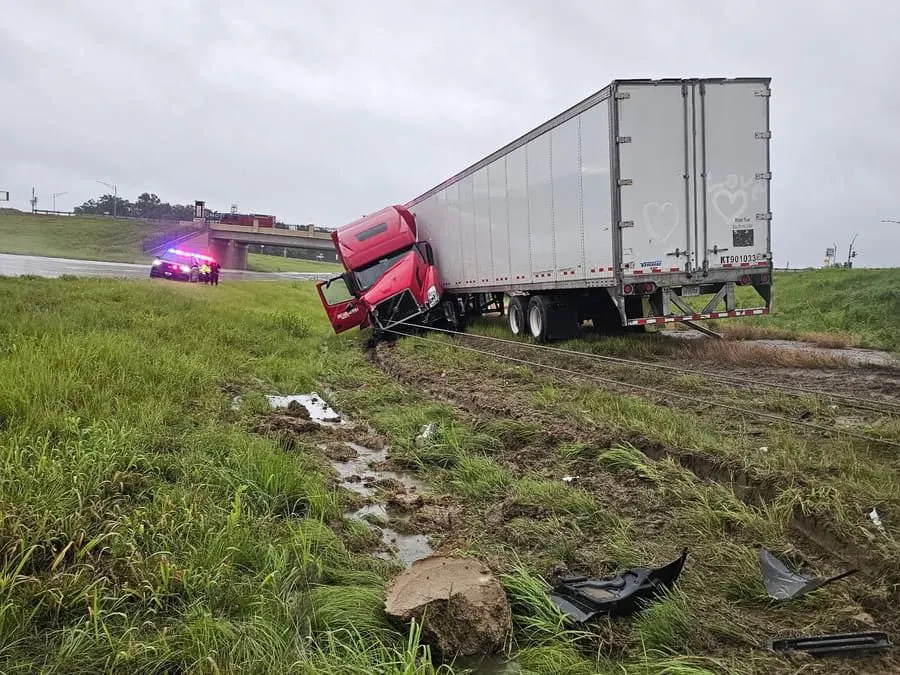
The order matters more than the speed
Almost everyone calls for help first and does the safety steps afterwards. That is backwards. The minutes between the truck stopping and help arriving are the most dangerous part of the event, and the phone call does nothing about that. The flashers, the warning devices and where you put your body do.
The federal rule sets the sequence for you. Under 49 CFR 392.22 the hazard warning flashers go on immediately when a commercial vehicle stops on the traveled portion of a highway or on the shoulder for any reason other than a necessary traffic stop, and they stay on until the warning devices are placed. The devices go out as soon as possible, and in any event within 10 minutes. Ten minutes is a ceiling, not a plan.
1. The first sixty seconds — get it off the road while it still moves
If the unit will still roll under its own power, spend that while you have it. A truck losing air, overheating or counting down a derate usually has some distance left, and the gap between a live lane and a wide shoulder is the gap between a service call and a recovery. MoDOT's Steer It and Clear It guidance says the same: move vehicles out of the travel lane to the nearest safe location when the vehicle is movable and there are no serious injuries.
Choose the stopping place rather than taking the first gap. An exit ramp, a wide right shoulder well past the rumble strip, a weigh station or a lot beats a narrow shoulder every time. Avoid the gore area at a ramp, where traffic is still picking a lane, and carry it past a hill crest or a bend if you can. Shoulder width through this metro is not consistent — I-70 through Independence, I-35 north of Liberty and I-29 toward the airport all narrow and widen — so judge the shoulder you can see.
If it will not move at all and you are in a live lane, call 911 before anyone else. Law enforcement can close that lane in a way a tow company cannot.
2. Flashers before anything else
The four-ways go on before you unbuckle, before you read the dash, before you reach for the phone. For the first thirty seconds they are the only warning the traffic behind you has.
Leave them running for the whole event. On a truck on a narrow shoulder at night they do more work than anything else on the vehicle.
3. Warning devices, placed the way the rule actually reads
Three bidirectional reflective triangles are the standard kit, and where they go depends on the road. On a divided or one-way highway all three go behind the truck toward approaching traffic: one within 10 feet of the rear on the traffic side, one at about 100 feet and one at about 200 feet. On a two-way undivided road, one goes 10 feet behind on the traffic side, one 100 feet behind and one 100 feet ahead, because traffic reaches you from both directions. Every interstate in this metro is divided, so the first pattern is the one most drivers stranded here need.
If the truck has stopped within 500 feet of a curve, a hill crest or anything else blocking the view, 392.22 moves the warning back: a device goes out toward the obstruction, between 100 and 500 feet from the truck. And if fuel or a flammable load is leaking, no flame-producing device goes near it — which is exactly why reflective triangles are the better thing to keep behind the seat.
Walking back along a shoulder is the most exposed thing you will do all day. Our guide to where to place warning triangles on a semi covers placement in full. If walking back is genuinely unsafe, protect yourself first, call 911, and place the devices when it can be done safely.
4. Where to wait: the cab first, the barrier second
This page used to say to get behind the guardrail and stay there. That is not what the state agencies tell stranded drivers, and the official guidance should lead. MoDOT's advice is plain: stay in your vehicle if you can with your seat belt fastened, because you are safest inside your vehicle, and if you must get out, exit or approach on the non-traffic side. The Kansas Highway Patrol gives the same stay-in-the-vehicle instruction to drivers stranded in a winter storm.
A belted cab is a structure — a high seating position and several tons of truck between you and anything that drifts onto the shoulder. So once the flashers are on and the devices are placed, the default is back in the cab, belt fastened, doors closed.
Getting away from the truck is sometimes right, and the situations are specific: the truck is burning, smoking from a wheel end or the engine, leaking fuel, sitting in a lane you cannot clear, or carrying a load that has visibly shifted. Then the truck is the hazard and distance is worth the exposure. Move away from traffic rather than along the shoulder, and get behind a barrier only if you can reach one without crossing a lane.
5. What to assess before you call
Two minutes of fact-gathering changes which truck gets dispatched and how long you sit. Everything on this list is done from the seat or from the non-traffic side of the unit. None of it involves going underneath the truck, opening the hood on the traffic side, or standing between your trailer and a live lane.
- Air. Does the system still build and hold pressure? Watch the gauges with the engine running and listen for a leak audible from the seat. Our page on air leaks at the roadside covers which ones are a fix and which are a tow.
- The dash. Write down every lamp and every code word for word, with any countdown of remaining miles or hours. On a modern truck the codes usually decide the answer before anyone sets off.
- Gauges before shutdown. What coolant temperature, oil pressure and voltage were doing in the last minute before it stopped — nobody can recover that later.
- Tires and wheel ends. A flat inside dual, smoke or a hot smell from a hub, a shredded cap — looked at from the non-traffic side only. If a tire is down, the blowout page covers what happens next.
- The trailer. Loaded or empty, what the freight is, whether the seal is intact, whether the lights work, and whether anything inside sounds like it has moved.
- Your footprint. Fully on the shoulder, partly in a lane, or blocking one. That decides whether this is a service call, a tow or a police-managed scene.
6. Fix your position, then make the call
Location matters more than anything else you control. Note the highway number, the direction you were traveling, and the nearest mile marker or the last exit you passed. In this metro, say which side of the state line you are on, because the same interstate runs through both. "I-29 northbound, just past mile marker 14" gets a truck moving; "somewhere north of the airport" costs you the time it takes someone to work out what you meant.
Then describe the truck honestly: what you drive, whether the trailer is loaded and with what, whether it still builds air, rolls and steers, and what failed. Understating the problem to get a lighter truck sent only means waiting twice. Say if you are in a live lane, if anything is leaking, or if the load has moved. Our heavy-duty towing page covers what a heavy wrecker needs before it rolls.
Ask the question most drivers do not: can this be repaired where it sits? Air leaks, brake chambers, glad hands, batteries, starters, alternators, hoses, belts and trailer lighting are routine mobile truck repair work, and a roadside fix turns a lost day into a couple of hours. What does not happen on a shoulder is anything needing the truck lifted, engine internals or a transmission — and we would rather say so on the phone than after two hours beside a live lane.
While you wait, and when someone arrives
Leave the warning devices out until the service truck or the wrecker is on scene, set up and running its own lights. The gap between your triangles coming in and the recovery lights going on has nothing warning traffic at all, so they are the last thing collected, not the first.
If a trooper, a MoDOT or KDOT crew or a motorist assist unit arrives first, do what they tell you — they are managing traffic you cannot see. If law enforcement orders a tow, say who your carrier uses before the truck is loaded rather than after. Stay out of the space between the truck and traffic for the whole event, including while the wrecker rigs. Our guide to how a semi actually gets towed covers what happens from there.
Related reading
Semi Running Hot: Pull Over or Push On to the Next Exit? — A climbing gauge under heavy load on a grade can be normal; a gauge that keeps climbing after you shed load and speed is not.
Truck in Derate or Limp Mode: What It Means, What to Do — A derate is the engine computer cutting power because an emissions or engine reading is out of range — most often DEF quality or level, a failed regen, or a sensor.
DEF Light or Regen Stuck: What to Do Before the Derate — A DEF or regen warning is a countdown, not a breakdown.
What this covers
Mobile truck repair
Our service truck carries the parts and the tools. Faster for your driver, cheaper for your office, and the load keeps moving.
Mobile truck repair detailsHeavy-duty towing
A loaded tractor-trailer is not a bigger car. It needs a rated wrecker, a rated operator and a plan before anything gets hooked. That is what we send.
Heavy-duty towing detailsIn a specific city: Heavy-duty towing in Kansas City, Missouri · Mobile semi truck repair in Kansas City, Missouri · Heavy-duty towing in Liberty, Missouri · Mobile truck and trailer repair in Riverside, Missouri