
Air leak on a semi: what gets fixed at the roadside and what does not
Most air system faults on a semi are roadside-repairable: leaking glad hands, blown air lines, failed brake chambers, stuck slack adjusters and leaking fittings can all be replaced on the shoulder by a mobile service truck. Compressor failures, governor faults buried in the engine bay and anything requiring the unit to be lifted need a shop.
Why this question is worth asking
An air leak is one of the most common faults that strands a truck, and one of the most over-towed. "It will not build air" sounds terminal, and an operator who owns only tow trucks has one answer available to give you.
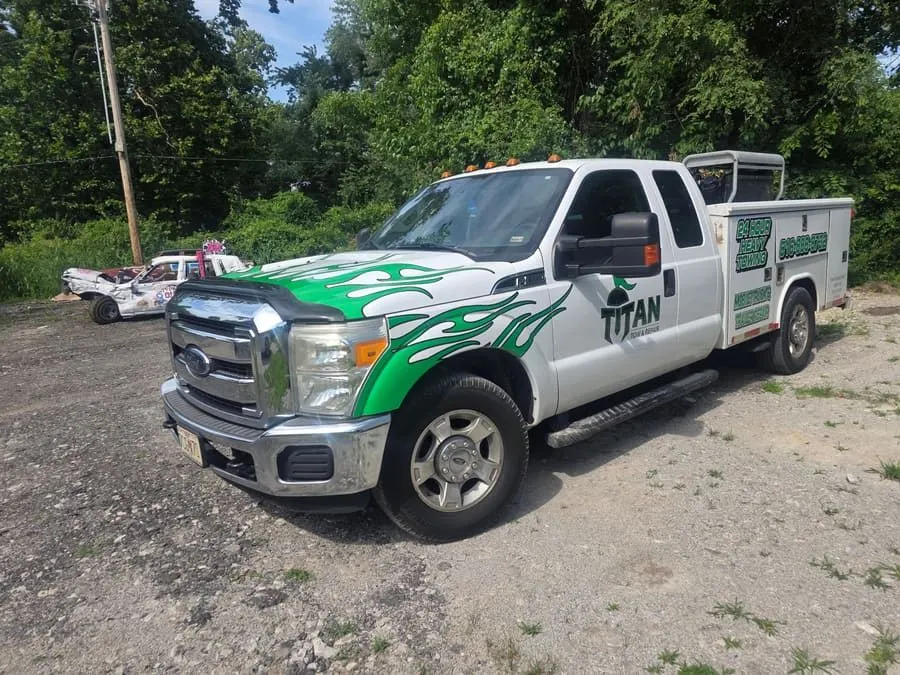
A roadside fix means no tow bill and a driver rolling again the same day. It runs the other way too: a few air faults are genuinely not roadside work, and hearing that on the phone beats finding it out after two hours on a shoulder. Our mobile truck repair service exists for the first case, the wreckers on the same phone number for the second.
Air is what holds the brakes off
The compressor feeds a governor that cycles it on and off, and the air passes through the air dryer on its way to the tanks. Bendix, which builds a large share of the dryers on the road, describes the dryer plainly: it sits between the compressor and the reservoirs and takes water, oil and solid contaminants out before they reach the valves.
From the supply tank the air splits into primary and secondary service reservoirs, each protected by a check valve so a failure on one side cannot drain the other. 49 CFR 393.50 requires that protection, and requires every reservoir to carry a condensate drain valve a person can operate by hand.
The last piece decides your day. The parking and emergency brakes on both tractor and trailer are spring brakes — a heavy spring holds them applied, and air pressure is the only thing holding them off. Lose the air and the spring wins. That is a designed safety feature, and it is why a truck with a serious leak eventually parks itself wherever it happens to be standing.
What the gauges are telling you
An air-braked truck hands you most of the diagnosis on the dash, if you know what the numbers mean. These figures come from the air brake section of the Missouri Commercial Driver License Manual and from the federal rules.
- 120 to 140 psi is governor cut-out. A healthy system climbs to cut-out and the compressor stops, then cuts back in around 100 psi. A system that never reaches cut-out is either losing air faster than the compressor makes it or not making it at all.
- 85 to 100 psi inside 45 seconds. On a dual air system at operating rpm, pressure should build through that range in roughly that time. Much slower is a supply problem rather than a simple leak.
- 55 psi is the low-air warning. 49 CFR 393.51 requires a continuous warning, audible or visible from the driving position, whenever service reservoir pressure sits at 55 psi and below, or half the governor cut-out pressure, whichever is less. The buzzer is not an early warning. It is the margin nearly gone.
- 20 to 45 psi is where the springs take over. The parking control and the tractor protection valve pop out somewhere in that band and the brakes apply themselves. Wherever the truck sits then is where it stays.
- Leak-down, brakes released. Fully charged, engine off, parking brake released: the loss should be under 2 psi in a minute for a single vehicle and under 3 psi for a combination.
- Leak-down, brakes applied. Hold the foot brake down a full minute. More than 3 psi for a single vehicle, or 4 psi for a combination, is more air loss than the system is allowed, and the instruction that follows it is to find the leak and fix it before driving.
Where the leaks actually are, most likely first
- Glad hands and their seals. The couplings between tractor and trailer, and the seals inside them, are the single most common source. A hardened or displaced seal leaks loudly and costs almost nothing to put right.
- Air lines, fittings and connectors. Lines wear through where they cross a bracket; push-to-connect fittings, elbows and tees back off with vibration. Both are quiet enough that a leak-down test finds them before your ears do.
- Brake chambers. A ruptured service diaphragm leaks continuously at the chamber and usually changes character when the brake is applied.
- Valves. Relay, quick-release, tractor protection and spring brake control valves leak internally as they age, often venting from an exhaust port rather than anywhere you would think to look.
- The air dryer purge valve. A dryer that purges constantly instead of cycling is dumping the compressor's output on the ground, and presents exactly like a leak.
- Reservoir drains, then the compressor. A drain valve left cracked open empties a tank overnight. A compressor that is not pumping is last by likelihood and first by consequence.
Finding it without getting hurt
Get the unit off the traveled lane if it will still move, chock the wheels, put the hazard flashers on and set the triangles out — 49 CFR 392.22 gives you ten minutes, and our guide to where the warning triangles go covers placement. Then shut the engine off, because a running compressor keeps refilling the system and masks both the sound and the gauges.
- Start at the couplings. Glad hands, both hoses and the seals inside them, checked from beside the catwalk rather than from underneath anything.
- Walk the quiet side. Listen along the frame rails on the side away from traffic, and look where lines cross brackets.
- Use soapy water if you carry it. A spray bottle finds the small fitting leak that is too quiet to hear beside a highway.
- Do not go underneath on a shoulder. Not on a shoulder, not in a median, not with traffic passing. Nothing under there is worth it.
- Do not cage a spring brake to get moving. Releasing one by hand has a correct procedure and several dangerous ones, and a chamber under spring load is not something to improvise with at the side of a road.
What the service truck fixes where it sits
- Glad hand seals and couplers. The most common cause of a trailer that will not charge, and the quickest thing here to put right.
- Air lines. A chafed or blown line between tractor and trailer, or along the frame, gets cut back and replaced in place.
- Brake chambers. A ruptured diaphragm is a replace-in-place job on most units where access allows.
- Slack adjusters. Seized or out-of-adjustment adjusters can usually be freed or swapped roadside; a brake that has already run hot is a different call, covered in our post on a dragging trailer brake and a hot hub.
- Fittings, valves and trailer plumbing generally. Push-to-connect fittings, relay valves and quick-release valves are carried as stock items, and most trailer leaks live in the plumbing rather than in anything structural.
What has to go to a shop
- Air compressor failure. Buried, heavy, and needing the truck cool and stationary far longer than a shoulder allows.
- Air dryer replacement. Sometimes roadside, often not, depending on how it is mounted and what has to come off to reach it.
- Governor faults in the engine bay. Frequently diagnosable at the roadside and frequently not repairable there.
- Cracked reservoirs and frame-mounted tanks. Replacement is shop work, and a cracked tank is not something to nurse along.
- Anything needing the unit lifted. If it needs a hoist, it needs a shop. We do not carry one and will say so.
A truck that will not hold air is not going anywhere
49 CFR 393.45 requires braking system connections to be installed so the attachment is free of leaks, constrictions or other conditions that would adversely affect the performance of the brake system, and 393.51 requires that low-air warning to work. A leak found at a roadside inspection is a defect against the vehicle, not a maintenance note; our post on DOT out-of-service faults covers what happens next.
49 CFR 396.7 goes further: a vehicle must not be operated in a condition likely to cause an accident or a breakdown, and one discovered to be unsafe while being operated may be continued only as far as the nearest place where repairs can safely be made. That is the rule behind the advice every experienced driver gives — do not drive it somewhere better because the air is dropping fast. The brakes will apply themselves at a pressure you do not choose. If your problem is the opposite one, our post on semi brakes that will not release deals with that.
Four answers decide which truck comes out: does it build air at all, how fast does it drop, can you hear where it is leaking, and is it on the tractor or the trailer. A system that holds but bleeds down overnight is almost certainly roadside work. One that will not climb to governor cut-out points at the compressor. A leak audible at the coupling is very likely a glad hand seal. Fleets can settle billing once through a fleet towing account rather than at the roadside.
Related reading
Semi Won't Start: Jump Start, Batteries or Starter? — Listen to what the truck does when you turn the key.
Semi Broke Down on the Highway? Do These Six Things — Get the truck off the traveled lanes if it still moves, put the four-way flashers on immediately, and place your warning devices within 10 minutes, as 49 CFR 392.
Gelled Fuel and Frozen Air Lines: Winter Truck Breakdowns — When a truck dies in a Missouri cold snap it is usually one of two things: diesel gelled in the filters, or moisture frozen in the air system.
What this covers
Mobile truck repair
Our service truck carries the parts and the tools. Faster for your driver, cheaper for your office, and the load keeps moving.
Mobile truck repair detailsFleet & commercial towing
Fleets do not need a hero, they need a truck that turns up and paperwork that reconciles. We do both.
Fleet & commercial towing detailsIn a specific city: Mobile semi truck repair in Kansas City, Missouri · Mobile truck and trailer repair in Riverside, Missouri