DEF light on, regen will not finish. Here is what to do before the truck derates.
A DEF or regen warning is a countdown, not a breakdown. The aftertreatment system is telling you it will cut power on a schedule if the fault stands. Some causes — low or contaminated DEF, a sensor, a loose connector — are roadside fixes. A loaded DPF or a failed doser is shop work. Reading the code is what decides which.
Two different warnings, one clock
The aftertreatment system on a modern diesel raises two families of warning, and drivers tend to lump them together. The first is about DEF: the tank is low, the fluid in it is not what the system expects, or the SCR side has a fault. The second is about the particulate filter: soot is building faster than the truck can burn it off, and a regeneration either cannot start or keeps failing to finish.
What they share is the clock. Neither is the truck breaking down. Both are the engine computer announcing that it will reduce power in stages if the fault stays. Manufacturers publish exactly what each lamp state means; the specifics below come from Cummins and Detroit driver guidance; your engine make and model year decide which applies.
What the DEF lamp is telling you, stage by stage
Cummins sets out four stages of DEF-related warning in its engine lamp identification guide, and reading them in order tells you how much room is left.
- Solid DEF lamp. DEF level is low. Refill with the correct fluid — Cummins recommends a DEF meeting the ISO 22241 specification.
- Solid DEF lamp with the check engine lamp. A lower DEF level, the wrong type of DEF, or an SCR system issue. Cummins says the driver will experience a mild loss of engine power.
- Flashing DEF lamp with a solid check engine lamp. DEF critically low, incorrect DEF type, or an SCR fault standing for more than five hours. A severe loss of power follows.
- Stop engine lamp with a flashing DEF lamp and solid check engine lamp. DEF critically low and the fuel tank refilled without refilling DEF, or the engine idled for an hour or shut down. The vehicle is limited to 5 mph.
- Detroit, the same idea in different lamps. Its driver card reads the low DEF light solid as DEF very low, flashing as the tank empty with speed limited to 55 mph, and flashing in the empty-and-ignored state as 5 mph until DEF is detected in the tank. Improper fluid also cuts performance.
What the regen lamps mean, which is something else
The DPF side has its own ladder. Cummins describes the DPF lamp as meaning the filter requires regeneration; flashing, that power may be reduced automatically; flashing with the check engine lamp, that regeneration is needed immediately and power is cut further. A red stop engine lamp together with the DPF lamp means a regeneration has not completed successfully in a timely manner, and Cummins is blunt: the vehicle must not be operated, and service must be arranged immediately.
Detroit reads the same way in its own terms — DPF lamp solid means a parked regen may be needed, flashing means one is required as soon as possible, or bringing the vehicle to highway speeds to enable an automatic regeneration.
The high exhaust system temperature lamp is the one drivers misread. It is not a fault. Cummins describes HEST as indicating high exhaust temperatures may exist because of regeneration, with the instruction to keep the exhaust outlet away from any combustible surface or material. Detroit adds that a flashing HEST means a parked regen is running and the system is not yet up to temperature.
Why a regen will not complete
Five reasons cover most of it, worth working through in order before anyone is dispatched.
- The duty cycle never allows one. Short trips, heavy idling and stop-start local work never get the exhaust hot enough. Cummins' driver action is to bring the vehicle to highway speed for at least 20 minutes at the earliest opportunity, and Detroit offers the same alternative.
- The inhibit switch is on. Cummins lists this first: make sure the DPF switch is not in the inhibit position. Some fleets leave it set. If it is on, the truck cannot regen no matter what else is right.
- A fault is blocking it. A sensor, a doser, a leaking exhaust joint or an SCR fault can stop the computer ever authorizing a regen. The lamps do not tell you which; the fault codes do.
- The parked regen keeps getting interrupted. Detroit's card is specific: a parked regeneration stops if the key is turned off, the clutch is depressed, the truck is put into gear, or the parking brake is released.
- The filter is past the point of no return. Beyond a certain soot load the computer refuses, because burning that much off at once would damage the filter. Nothing done on a shoulder will start one then.
Running a parked regen the way the manual says
Cummins' procedure is to park and set up a safe exhaust area, confirming nothing is on or near the exhaust surfaces; set the parking brake and place the transmission in park or neutral; make sure the fast-idle and PTO switches are off; then push the DPF switch to the on position. Exhaust surfaces stay hotter than normal for three to five minutes after it finishes.
Give it time. Cummins says to allow up to an hour and to monitor the vehicle and the area around it throughout. Detroit's heavy-duty operators manual puts a parked regen at about 30 to 45 minutes on current engines and treats it as complete when the engine returns to idle and the DPF lamp stays off.
Where you park for it is a safety decision. A hot exhaust pointed at dry grass, spilled fuel or a pallet stack is exactly what both manufacturers are warning about. A truck stop, a yard or a wide lot beats a shoulder. If you are stopped on an interstate shoulder while working through this, the sequence in our guide to what to do when a semi breaks down on the highway comes first.
Five minutes of checks before you call anyone
- DEF level. Read the gauge, then look in the tank if you can reach it. A gauge reading full over an empty tank is a sensor fault, and that is a different repair.
- What went in the DEF tank. Diesel, water or windshield fluid in the DEF tank is a common quality fault, and it happens at busy fuel islands. If the last fill might have been wrong, say so — that changes a top-up into a drain.
- The regen inhibit switch. Check its position before anything else — it is the cheapest possible answer.
- Whether a parked regen ever ran to the end. If it has been aborted three times by a clutch pedal, that is the story rather than a broken truck.
- The exact text on the dash. Every lamp, the code and the message word for word, with the remaining miles or hours. Every conversation after this one runs on those numbers.
What gets fixed at the roadside, and what is shop work
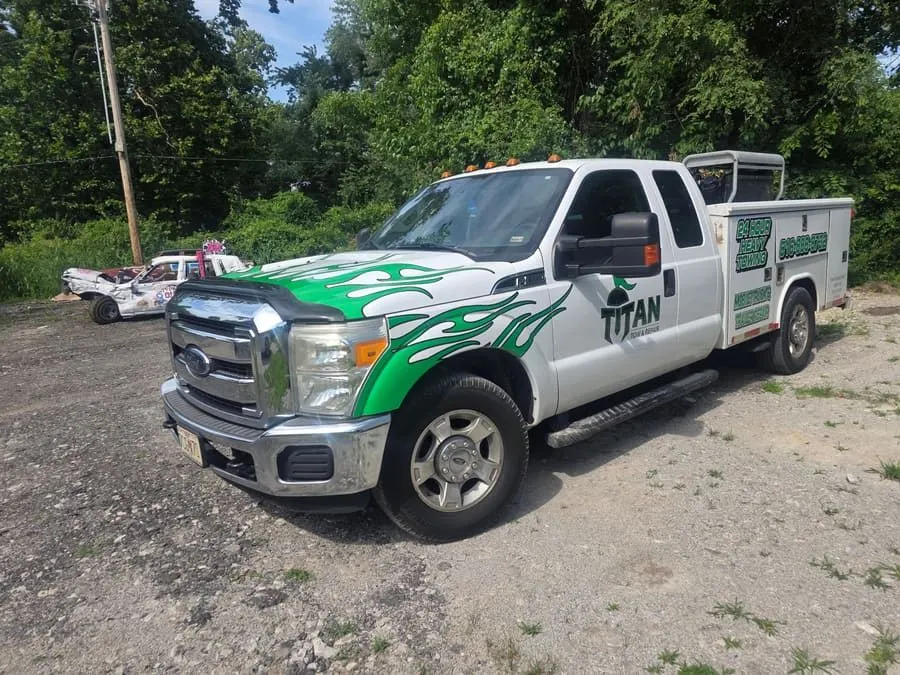
The service truck reads fault codes on the spot, and a real share of DEF and regen calls resolve there. Low DEF is a top-up with the correct fluid. A failed sensor, heater or connector can often be replaced where the truck stands. If the computer is willing to run a parked regen, we can confirm the conditions are met and let it finish, and once a genuine fault is repaired the code can be cleared so the derate schedule resets. That is ordinary mobile truck repair.
The word doing the work there is willing. A DPF loaded past the regen threshold has to come off the truck to be cleaned or replaced, and we do not do that at the roadside. Neither is a failed DEF doser or injector, a cracked SCR catalyst, or a DEF tank contaminated badly enough to need a full drain and flush.
What is useful at the roadside is the diagnosis and the plan. The code tells you which one you have; the countdown tells you how far you can still get. The decision is usually clear: drive to the shop while the truck will still do it, or take the tow now, while where the truck stops is still your choice.
The derate is coming. Choose where you stop.
The worst version of this call is the one where the countdown ran out in a live lane. A 5 mph derate does not care where it happens, and a truck creeping along the shoulder of I-70 is a hazard to everyone passing. If the miles left are short and the fix is a shop fix, pick the stopping place while you can. A tow from a safe spot is routine; a tow from a live lane is a recovery, and it costs more in every way.
If you are already derated, say so when you call. You will get a straight answer about whether the service truck or the wrecker is the right one, and if it is the wrecker, the truck goes to the shop you choose, not the nearest one to where it stopped. Our page on derate and limp mode covers what to do once the power is already gone.
Sources
- Cummins Engine Lamp Identification Guide (Bulletin 4971518): lamp descriptions, Four Stages of DEF-Related Warnings, How to Perform a Parked Regeneration
- Detroit DD Heavy Duty Platform Operators Manual (DDC-SVC-MAN-0189), Sections 9.05, 9.11 and 9.12 (Parked Regeneration), 11.01 (Diesel Exhaust Fluid Level Warning Lamps) and instrument panel lamp tables
Related reading
Can You Drive a Semi With a Blown Airbag? Loaded vs Empty — A loaded semi should not be driven on a blown air bag, and no truck should move with the axle down on the frame or a tire touching anything.
Gelled Fuel and Frozen Air Lines: Winter Truck Breakdowns — When a truck dies in a Missouri cold snap it is usually one of two things: diesel gelled in the filters, or moisture frozen in the air system.
Semi Running Hot: Pull Over or Push On to the Next Exit? — A climbing gauge under heavy load on a grade can be normal; a gauge that keeps climbing after you shed load and speed is not.
What this covers
Mobile truck repair
Our service truck carries the parts and the tools. Faster for your driver, cheaper for your office, and the load keeps moving.
Mobile truck repair detailsHeavy-duty towing
A loaded tractor-trailer is not a bigger car. It needs a rated wrecker, a rated operator and a plan before anything gets hooked. That is what we send.
Heavy-duty towing detailsIn a specific city: 24 hour semi truck towing and heavy-duty wrecker service in Kansas City, Missouri: big rigs, tractor-trailers and semi trailers · Semi truck repair in Kansas City, Missouri: a mobile diesel mechanic at the roadside, 24/7 · Heavy-duty towing and wrecker service in Liberty, Missouri · Mobile truck and trailer repair in Riverside, Missouri · Mobile truck and trailer repair in Liberty, Missouri: a diesel mechanic for emergency roadside breakdowns · Wrecker service: heavy-duty, semi, semi trailer and commercial truck towing in Kansas City, Kansas · Semi truck repair in Kansas City, Kansas, by a mobile diesel mechanic who comes to the truck, 24/7 · Heavy wrecker service and semi towing in Saint Joseph, Missouri · 24/7 semi and heavy-duty towing in Oak Grove, Missouri · Heavy-duty and semi towing in Topeka, Kansas · Mobile semi truck and trailer repair in Saint Joseph, Missouri · Mobile truck repair and a diesel mechanic on call in Topeka, Kansas · Heavy-duty wrecker service in Lee’s Summit, MO: semi truck towing, medium-duty towing and accident recovery · Roadside semi truck and trailer repair in Lee’s Summit, MO, from a mobile diesel mechanic
Towing near you: Towing and tow trucks in Kansas City, MO · Tow truck service in Kansas City, KS · Towing in Liberty, MO · Towing in Lee’s Summit, MO