Your car died inside a parking garage. Here is how it comes out.
A disabled car inside a low-clearance parking garage is usually brought out by a wheel-lift truck that can fit under the ceiling, then loaded onto a flatbed outside where there is room. What decides the plan is the posted clearance, the level the car is on, the ramps and gates, management's permission, whether the car rolls and steers, its drivetrain, and whether the keys are there.
Why many garages will not take a rollback
A parking structure is built around ordinary cars. Its ceiling height, ramp slopes, turning radii and gate lanes are all sized for a passenger vehicle driving itself in and out. A tow truck is taller, longer and less maneuverable than the cars the garage was designed for, and a rollback flatbed has more demands still.
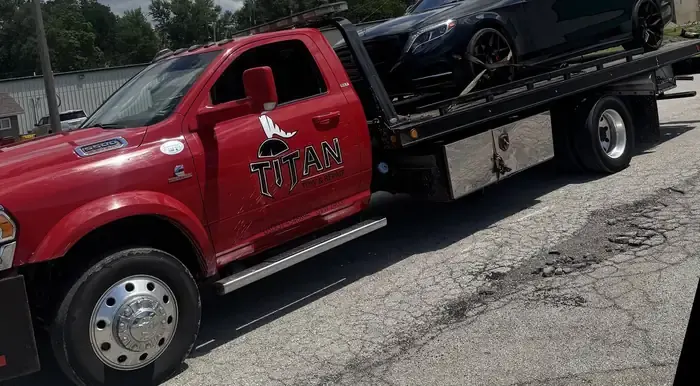
A rollback carries the car on a deck that slides back and tilts down to the ground. To load, the truck needs head room above the tilted deck, length behind it to lay the deck down, and a straight line to winch the car up. Low beams, sprinkler pipes, lights, signs and ductwork hanging below the ceiling reduce the usable height further. Tight spiral ramps and low entry bars at the gate can stop a truck before it reaches the car at all.
Many structures have a clearance bar at the entrance for exactly this reason. It is a hard limit, and a tow operator treats it as one.
How a wheel lift gets the car out
When a rollback cannot get in, a truck with a wheel lift often can. A wheel lift is a hydraulic arm that reaches under one end of the car and cradles the tires, raising that axle just enough to clear the ground. Because it lifts the car only a little and does not need a tilting deck, it can work where a flatbed cannot.
The wheel lift's job in a garage is short: bring the car out to open ground at street level or in an outdoor lot, where there is space to load it properly. Our light-duty towing service uses it for exactly that, for garages a rollback cannot enter, with the car then carried on the flatbed to wherever it is going.
The drivetrain still matters for those few hundred feet. An all-wheel-drive car should not roll on one axle even briefly down a ramp, so it comes out with dollies under the wheels that would otherwise touch the ground, for the reasons in why AWD cars go on a flatbed. An electric vehicle needs the same care, covered in how to tow an electric vehicle.
Before you call: what to check in the garage
A few minutes of looking around saves a wasted trip. You do not need to measure anything or move the car; just gather what is already posted or obvious, and stay out of the driving lanes while you do it.
- The posted clearance. Read the height on the sign or bar at the entrance you would use to reach the car. If there are several entrances with different heights, note each one.
- The level and space. Which floor the car is on, the space or row number, and whether that level is above ground, below ground or on the roof.
- The route. Whether the ramps are straight or spiral, whether there are low points on the way down that seem lower than the entrance, and whether the car's level has its own lower clearance sign.
- Gates and tickets. Whether there is a gate arm, a ticket machine, a pay station or a staffed booth, and whether you have the entry ticket or pass.
- Who manages it. The name of the attendant, the security desk or the property management company, and a phone number if one is posted.
Permission from the attendant or management
A parking garage is private property, and a tow truck working inside one needs the owner's permission, not just yours. Some structures have rules about service vehicles, hours when trucks may enter, or a requirement that security escort any tow. Some will open a gate arm or lift a height restriction for a scheduled tow; others will not allow a tow truck in at all.
The simplest path is to speak to the attendant or management before you call, tell them the car is disabled and a tow is coming, and ask whether there are any rules the driver needs to follow. If the garage is unstaffed, look for the posted management contact. Let dispatch know what they said, including any name and phone number, so the driver can reach them on arrival.
If you are in a residential or employer garage, the building's front desk or facilities team usually handles this. If you rented a car and it died in a garage, the rental company may have its own procedure for disabled vehicles.
Does it roll, steer and come out of park?
These three questions change the job more than anything else. A car that rolls freely and steers can be lifted and guided around ramps and pillars with little fuss. A car that is locked in park, has a seized brake or a flat tire it cannot turn on, or has its steering wheel locked, needs more equipment and more room.
Many modern cars have an electronic parking brake and an electronic shifter that need battery power to release. A car with a completely dead battery may therefore be stuck in park with its rear wheels locked. Tell dispatch whether the dashboard lights come on at all and whether you can shift into neutral.
Sometimes the car does not need to leave. A dead battery or a flat tire is often what stranded it, and roadside help such as a jump start or a tire change, where the conditions allow it, can get the car driving out on its own. Describe what happened when it stopped, and dispatch can say whether a roadside visit is worth trying first.
Keys, drivetrain and the car itself
The last set of details is about the car. Each one decides a specific piece of equipment or a step in the job.
- Keys or fob. Have them with you. Without a key, many cars will not unlock the steering or shift out of park, and the car cannot be put in neutral for towing.
- Year, make and model. This answers most drivetrain questions and tells the driver where the towing points and tie-downs are.
- Drivetrain. Front-, rear- or all-wheel drive, or electric. AWD and EVs need dollies to come out on a wheel lift.
- Ride height. A lowered car, or one with a low front spoiler, needs extra care on garage ramps as well as when it is loaded.
- What went wrong. Dead battery, flat tire, warning light, noise, leak, or crash damage. A car leaking fluid in a garage should be mentioned, and if there is smoke or a burning smell, leave the car and call 911.
- Destination. Your mechanic, a dealer or your home, with any hours or drop-off instructions.
When the garage simply cannot be reached
Occasionally a car is parked somewhere no tow truck can get to: a basement level below a clearance too low for any truck, a space reached only by a ramp too tight to use, or a structure whose management will not allow a truck in. That is not a common outcome, but it is better to know about it on the phone than after a truck has driven across town.
In those cases the options depend on the fault. A car that can be started, even briefly with a jump, may be able to drive to a level a truck can reach. A car that rolls and steers can sometimes be moved to an accessible spot with management's agreement, but never push a car down a ramp by hand, where it can get away from you. A car that cannot move at all may need to wait until a garage-appropriate solution is arranged with the property owner or a mechanic who can work on it in place.
The older flatbed or wrecker post explains how the two trucks differ in general. For a garage tow, what decides it is what you can see at the entrance, so read the sign, talk to the attendant, and give dispatch the whole picture before a truck is sent.
Related reading
How to Tow an Electric Vehicle Without Damaging It — Most electric vehicles should be towed on a flatbed with all four wheels off the ground, because turning the driven wheels turns the motor.
Why AWD Cars Need a Flatbed Tow, Not a Wheel Lift — AWD cars go on a flatbed because their front and rear axles are linked through a center differential, a coupling or a transfer case.
Kansas City Towing Laws: Towed From a Private Lot — In Missouri, RSMo 304.
What this covers
Light-duty towing
The same yard that runs the heavy wrecker runs the rollbacks, so a car gets the same answer at 3am that a semi does.
Light-duty towing detailsTowing near you: Towing and tow trucks in Kansas City, MO · Tow truck service in Kansas City, KS · Towing in Liberty, MO · Towing in Lee’s Summit, MO