Why your all-wheel-drive car should ride on the deck
AWD cars go on a flatbed because their front and rear axles are linked through a center differential, a coupling or a transfer case. Towing with one axle lifted and the other rolling forces that link to slip for the whole trip, which builds heat and can damage it. Manufacturers such as Subaru and Hyundai tell owners not to tow AWD models with one axle on the ground.
What all-wheel drive actually connects
A front-wheel-drive car sends power only to the front wheels, so the rear axle is just two wheels on bearings. Lift the front, tow it on the rear, and nothing in the drivetrain turns. That simplicity is why a front-wheel-drive car can usually go on a wrecker's wheel lift without drama.
An all-wheel-drive car is built the other way. Its purpose is to send power to both axles, so somewhere between the engine and the wheels there is a component that ties the front axle and the rear axle together. How tightly they are tied, and by what, varies from one system to the next, but on almost every AWD car there is a mechanical path running from the front wheels, through the middle of the car, to the rear wheels.
That path is the whole story of why AWD cars go on a flatbed. Our older post on flatbed or wrecker: which tow truck covers the difference between the two trucks. This one explains what is happening inside the car.
Center differentials, couplings and transfer cases
There are three common ways to connect the axles. The names show up in owner's manuals and on window stickers, so they are worth knowing.
- Center differential. Full-time AWD systems often use a differential between the front and rear axles, the same kind of gearset that lets the left and right wheels turn at different speeds in a corner. It lets the axles turn at slightly different speeds, but it is designed for the small differences of normal driving, not for one axle standing still while the other spins down the highway.
- Coupling. Many crossovers and cars use an on-demand system: the car drives mostly through one axle and engages the other through a clutch pack or viscous coupling when it senses slip. Towing with one axle turning and the other stopped looks to that coupling like constant, severe slip.
- Transfer case. Traditional four-wheel-drive trucks and SUVs use a transfer case bolted behind the transmission, with driveshafts running to each axle. Some are part-time and lock the axles together when engaged; many have a neutral position designed for towing, which we cover below.
What towing with two wheels down does
Picture an AWD crossover on a wheel lift with its front wheels in the air and its rear wheels rolling. The rear wheels turn the rear axle, the rear axle turns the driveshaft, and the driveshaft tries to turn the center differential or the coupling. The front half of the drivetrain is standing still. The component in the middle is being asked to absorb the entire difference, continuously, for as long as the tow lasts.
A center differential in that situation spins its internal gears at a speed and for a duration it was not designed for. A clutch-type coupling slips and heats up. Some drivetrains also turn parts of the transmission, which may not be lubricated with the engine off. The damage is not always immediate or obvious, which is part of what makes it expensive: a car can arrive at the shop seeming fine and develop a drivetrain fault later.
Towing with all four wheels on the ground behind another vehicle is a different case again, and some AWD and 4WD vehicles are approved for it only under specific conditions set by the manufacturer. A tow truck lifting one end is not one of those conditions on most AWD cars.
What the owner's manuals say
You do not have to take a tow operator's word for any of this. The towing section of your owner's manual is the authority for your vehicle, and for AWD models it is usually direct.
Subaru's owner's manuals tell owners never to tow AWD models with the front wheels raised and the rear wheels on the ground, or the other way around, and point to the center differential as the reason. The same manuals describe a flatbed truck as the best way to transport the vehicle, and set only narrow, low-speed limits on moving an automatic model with all four wheels on the ground.
Hyundai's owner's manuals say that AWD vehicles must be towed with a wheel lift and dollies, or on flatbed equipment, with all the wheels off the ground, and that the use of wheel dollies or a flatbed is recommended. Other manufacturers word it differently, but the principle recurs: on an AWD vehicle, either every wheel turns together or none does.
Where dollies fit in
A flatbed is the simplest answer, because the car rides on the deck with nothing turning. It is not the only correct one. Wheel dollies are small wheeled platforms placed under the axle that would otherwise roll on the road, so a wheel-lift truck can carry one axle in the air and the other on dollies, and every wheel on the car stays still.
Dollies are also how a car that cannot roll gets onto a deck in the first place. A car with a seized brake, a locked transmission or a damaged wheel can be winched onto a rollback on skates or dollies so its own wheels never have to turn. Hyundai's manuals list dollies alongside the flatbed for exactly this reason.
Where a flatbed cannot reach, such as inside a low parking structure, a wheel lift with dollies may be the way the car comes out to open ground before it is loaded properly.
4WD trucks and the neutral transfer case
Four-wheel-drive pickups and SUVs with a two-speed transfer case often have a neutral position, marked N on the lever or selected by a switch procedure. In neutral, the transfer case disconnects both driveshafts from the transmission, which is what lets some of these vehicles be flat-towed behind a motorhome with all four wheels on the road.
The procedure is specific and it is in the manual. Jeep's owner's manuals, for example, lay out a step-by-step sequence for shifting the transfer case into N for recreational towing, including where the transmission must be left and applying the parking brake. The same manuals warn that using a front or rear wheel lift for recreational towing can cause internal damage to the transfer case. That is a warning worth reading carefully: a neutral transfer case is designed for towing four wheels down, not as a license to lift one end. Our post on how an RV or motorhome gets towed covers the car-behind-the-coach situation as a separate part of the job.
Not every 4WD vehicle has a neutral position, and a transfer case with a fault may not shift into it at all. If the drivetrain is the reason the vehicle broke down, assume nothing in it can be trusted and put it on the deck.
Telling dispatch it is all-wheel drive
You do not need to know which of these systems your car uses. What helps is making sure the question gets asked, because the badge on the tailgate does not always say AWD, and many crossovers are sold in both front-drive and all-wheel-drive versions that look identical.
- Year, make, model and trim. Often enough on its own to answer the drivetrain question.
- AWD, 4WD, front- or rear-wheel drive. Say it if you know it, and say you are not sure if you are not. The window sticker, the registration or the owner's manual can confirm it.
- Whether it rolls, steers and shifts out of park. A car stuck in park or with a locked wheel needs skates or dollies to load.
- What went wrong. If the fault is in the transmission, the transfer case or a differential, nothing should be turning.
- Where it is parked. A driveway, a lot, a shoulder or a garage with a low ceiling each change the plan. On a shoulder, keep the hazard flashers on and wait well away from traffic.
Flatbed towing for AWD cars around Kansas City
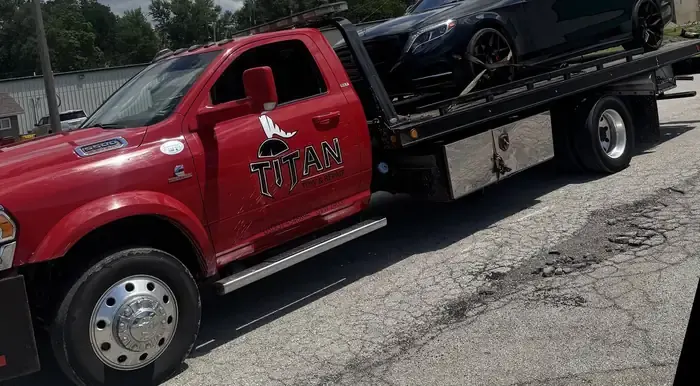
We run rollback flatbeds for cars, crossovers, pickups and vans on the same 24-hour dispatch as the heavy wrecker and the heavy-duty tow unit, out of the yard in Liberty. All-wheel-drive and four-wheel-drive vehicles ride on the deck, and cars that will not roll are winched on with skates or dollies. The light-duty towing page covers the rest of what that side of the operation handles, and the service area page shows where we work on both sides of the state line.
If you are not sure what your car is, tell us the make and model and we will work out the drivetrain before the truck leaves. Sending the right truck the first time is our job, and it beats paying for a drivetrain repair later.
Related reading
How to Tow an Electric Vehicle Without Damaging It — Most electric vehicles should be towed on a flatbed with all four wheels off the ground, because turning the driven wheels turns the motor.
Kansas City Towing Laws: Towed From a Private Lot — In Missouri, RSMo 304.
Flatbed or Wrecker? Which One Your Vehicle Needs — A flatbed carries the whole vehicle with all four wheels off the road; a wrecker lifts one axle and tows with the other two wheels rolling.
What this covers
Light-duty towing
The same yard that runs the heavy wrecker runs the rollbacks, so a car gets the same answer at 3am that a semi does.
Light-duty towing detailsTowing near you: Towing and tow trucks in Kansas City, MO · Tow truck service in Kansas City, KS · Towing in Liberty, MO · Towing in Lee’s Summit, MO