Towing an EV: the flatbed, transport mode and a damaged battery
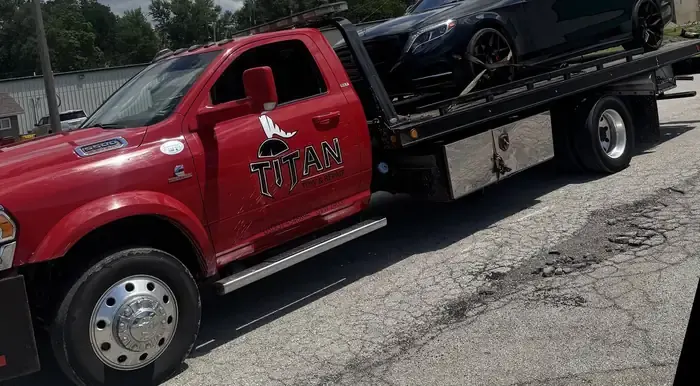
Most electric vehicles should be towed on a flatbed with all four wheels off the ground, because turning the driven wheels turns the motor. The car is winched on in transport mode or on dollies, lifted and tied down only at the manufacturer's points, and a crash-damaged EV is kept outdoors, away from buildings and other vehicles, because its battery can catch fire hours later.
Why an EV rides on the deck
In a gasoline car with an automatic transmission, shifting to neutral separates the wheels from the engine. An electric vehicle has no such separation in most designs. The motor is geared directly to the driven wheels, so if those wheels turn, the motor turns. With the car off, that can overheat components and damage the drive unit, and a spinning motor can also generate electricity.
That is why manufacturers are firm about it. Tesla's owner's manuals for the Model 3 and Model Y say never to tow the car with its tires on the ground, even for a short distance, and to transport it with all four tires off the ground, recommending a flatbed truck or comparable transport vehicle. Ford's Mustang Mach-E owner's manual says the vehicle must be recreationally towed with all four wheels off the ground, warning that the vehicle or electric drive motor could otherwise be damaged.
Not every maker says exactly the same thing. Hyundai's IONIQ 5 manual allows a rear-wheel-drive version to be towed with its driven rear wheels lifted and the front wheels on the road, but requires all-wheel-drive versions to have all wheels off the ground, and recommends wheel dollies or a flatbed for all of them. The older flatbed or wrecker post already notes that most EV makers call for a flatbed. The manual for your exact model is the final word.
All-wheel-drive EVs are the strictest case
Many electric cars and SUVs have a motor on each axle. That removes the mechanical center differential covered in why AWD cars go on a flatbed, but it does not make a two-wheels-down tow acceptable. With a motor at each end, whichever axle is left on the road turns a motor. There is no end of the car that can safely roll.
For a dual-motor EV, the practical options are a flatbed, or a wheel lift with dollies under the other axle so that every wheel is off the pavement. Knowing whether the car is single- or dual-motor before the truck is dispatched decides which of those makes sense.
Transport mode, and what a dead 12-volt battery changes
Getting an EV onto a flatbed still involves the wheels turning briefly while it is winched up the deck. Manufacturers deal with that in two ways, and the operator needs to know which one applies.
- Transport or tow mode. Many EVs have a setting, usually on the touchscreen, that holds the car in neutral with the parking brake released so it can be rolled or winched a very short distance. Tesla calls it Transport Mode and says it prevents damage only for a limited time, at low speed, over a very short distance, such as pulling the car onto a flatbed.
- Dollies or tire skates. When transport mode is unavailable, the manufacturer's alternative is to load the car without its wheels turning. Tesla's instructions call for self-loading dollies or tire skates if Transport Mode cannot be enabled or the touchscreen is not accessible.
- The 12-volt battery. An EV's big high-voltage battery does not run the screens, door releases, shifter or parking brake. A separate low-voltage battery does, and when it is flat the car may be completely unresponsive even with a full charge. Tesla notes that a car with no low-voltage power needs an external power supply to open the hood or use the touchscreen, and that Transport Mode may cancel if low-voltage power is lost.
- An electronic parking brake. On many EVs the parking brake is released electrically. With no power, the rear wheels may be locked, which is another reason skates or dollies come out.
Weight, lift points and tie-downs
An electric vehicle is typically heavier than a gasoline car of similar size, because the battery pack is heavy. That matters for the deck, the winch and the tie-downs, and it is why the model name is one of the first things a dispatcher asks.
Where the car is lifted and secured matters just as much. On most EVs the high-voltage battery pack fills much of the underside, between the axles. A jack pad, a winch hook or a tie-down placed against the pack instead of a designated point risks damaging the very component that makes the car dangerous when it is damaged. Manufacturers publish lift points and towing instructions for this reason, and Hyundai's IONIQ 5 manual warns against lifting the vehicle by the tow fitting or by body and chassis parts.
Many EVs also use a screw-in towing eye, stored in the trunk or front trunk, that threads into a socket behind a bumper cover. It is meant for pulling the car onto a deck, not for lifting it. If you know where yours is, tell the operator.
A damaged high-voltage battery changes everything
A crash that reaches the battery pack turns an EV tow into a hazard that can outlast the scene. Lithium-ion cells that are crushed or punctured can go into thermal runaway, a self-heating reaction that can produce toxic gases and fire. It does not always happen right away. NHTSA's interim guidance for towing and recovery operators and storage facilities warns of the potential for delayed fire with damaged lithium-ion batteries.
The National Transportation Safety Board investigated electric vehicle battery fires and found that all three crash-damaged batteries in its study reignited after firefighters had extinguished the vehicle fires, one of them while the car was being loaded onto a tow truck. The NTSB traced the risk to stranded energy: the charge left in a damaged battery's undamaged cells, which responders have no practical way to measure or drain at the scene. It names tow operators as second responders who face that risk.
So a damaged EV is treated differently from the moment it is found. If the car has been in a fire, the fire department decides when it is safe to move. If it has not, the crew still watches for the warning signs NHTSA lists: smoke, sparks, flames, leaking fluids, increased heat, or gurgling, popping or hissing from the battery area. Any of those means stepping back and calling 911.
Where a damaged EV should and should not go
The destination for a crash-damaged EV is not the same as for a gasoline car, and a few rules come directly from the federal guidance.
- Not inside a building. NHTSA's interim guidance says not to store a severely damaged vehicle with a lithium-ion battery inside a structure or within 50 feet of any structure, vehicle or combustibles.
- Not into a home garage. A damaged EV dropped in an attached garage puts the house next to a battery that may still ignite. One NTSB case involved an SUV that crashed into a house's garage, where its damaged battery kept reigniting after firefighters put the fire out.
- Not onto a charger. Do not plug in a damaged EV, whatever the dash says about the state of charge. Leave that decision to the manufacturer or an authorized service center.
- The manufacturer is told early. NHTSA's guidance says to notify an authorized service center or the vehicle manufacturer as soon as possible, because they may have additional steps to secure and discharge the battery.
- The storage yard knows what is coming. The NTSB noted that keeping that clear space may be impractical at tow and storage yards, so the destination has to be agreed before the car leaves the scene.
What we do, and what we leave to others
We carry electric vehicles on rollback flatbeds as part of our light-duty towing, following the manufacturer's towing instructions for the model: deck transport, transport mode or skates and dollies, and the designated towing and tie-down points. We do not hold EV-specific certifications, and we do not assess, discharge or repair high-voltage batteries. On a crash-damaged EV, the fire department controls the scene and the manufacturer's emergency response guidance governs the battery.
When you call about an EV, tell us the make, model and year, whether it is single- or dual-motor, whether the screen and 12-volt system still work, whether it has been in a crash, and whether there has been any smoke, smell or noise from underneath. If there has, get everyone away from the car and call 911 before you call a tow. If you have questions about coverage for a damaged EV, your insurer is the one to ask; we cannot advise on a policy.
Related reading
Why AWD Cars Need a Flatbed Tow, Not a Wheel Lift — AWD cars go on a flatbed because their front and rear axles are linked through a center differential, a coupling or a transfer case.
Kansas City Towing Laws: Towed From a Private Lot — In Missouri, RSMo 304.
Flatbed or Wrecker? Which One Your Vehicle Needs — A flatbed carries the whole vehicle with all four wheels off the road; a wrecker lifts one axle and tows with the other two wheels rolling.
What this covers
Light-duty towing
The same yard that runs the heavy wrecker runs the rollbacks, so a car gets the same answer at 3am that a semi does.
Light-duty towing detailsTowing near you: Towing and tow trucks in Kansas City, MO · Tow truck service in Kansas City, KS · Towing in Liberty, MO · Towing in Lee’s Summit, MO