
Setting up a fleet towing account, and the decisions to make before the first call
Set up a fleet towing account before a truck goes down. Give the towing company your billing contact and vehicle list once, agree the invoice format and any PO or reference numbers, and name who can authorize work and who answers after hours. After that, a dispatch is one call with a unit number, a location and a destination shop.
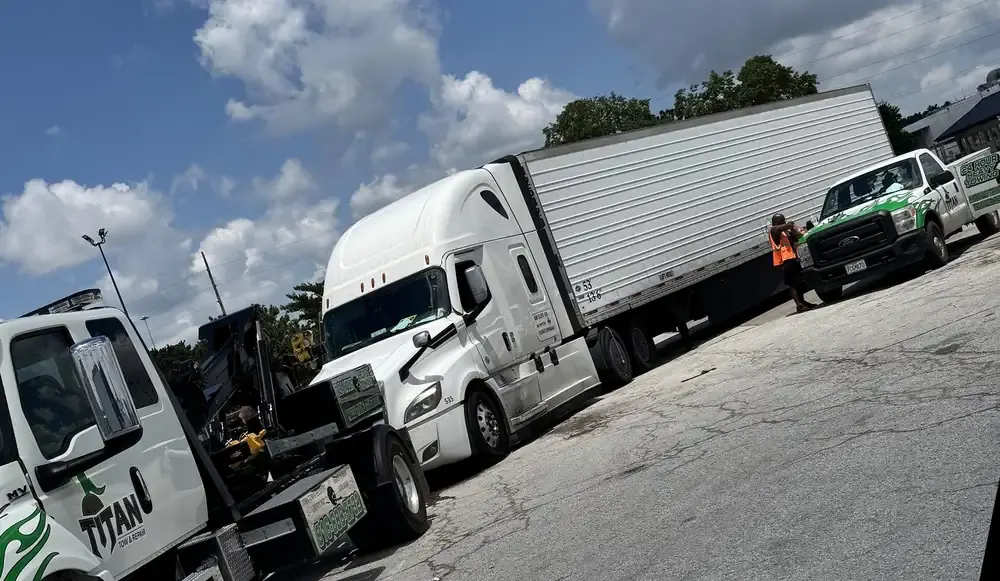
What an account changes on the day a truck goes down
Without an account, every breakdown starts with a payment conversation. The towing company needs to know who is paying and who has authority to approve the job, and the only person on the phone is a driver standing beside a dead truck who usually knows neither. That conversation costs time, and it is the wrong person having it.
With an account, those questions were answered weeks ago. The driver or dispatcher gives a unit number, a location and a destination, the truck rolls, and the invoice goes to the office that expects it. Choosing which company to trust with that is a separate job, covered in our guide on how to choose a heavy-duty towing company. This post assumes you have chosen, and covers what to settle when you open the account.
What we take from you once, at setup
Opening a fleet towing account with us starts with a phone call. The details below are given once and kept on file, so nobody has to repeat them from the shoulder.
- A billing contact. The person or department invoices go to, with the address or email your accounts team actually watches.
- Your vehicle list. Unit numbers and the details that decide which of our trucks comes out. More on what to include below.
- The invoice format. If your office, your carrier or your insurer needs a particular layout or reference on the paperwork, it is agreed at setup and goes on every invoice after that.
- Your destinations. The shops, yards or dealers your units normally go to, so a tow goes straight there rather than through our yard.
- Your insurer, if you want claims billed. Whether we can bill an insurer directly depends on the carrier and the policy, so we confirm it with them rather than assume.
- Any paperwork you need from us. Certificates of insurance are available on request for fleet accounts, and many fleets keep one on file for their own vendor records.
Decide who can authorize work
This is the decision fleets most often skip, and the one that causes the most friction later. A towing company can only act on an approval from someone with authority to give it, so write down who that is before it matters.
The goal is a short, clear list your drivers and your towing company both know. Our post on who pays when a truck breaks down explains why the driver should not be the one negotiating on the shoulder.
- Named approvers. The people who can approve a tow, a roadside repair or a recovery, by name and role, with a backup for each.
- What a driver may approve alone. Many fleets let a driver request a tow to the usual shop on the account but require the office to approve anything beyond that, such as recovery work or an unplanned destination.
- When the office must be reached first. Recovery after a crash, a loaded trailer that may need transferring, or a unit that needs to go somewhere other than your normal shop.
- Repair or tow. Whether a driver can accept a roadside repair on the spot, or whether that decision sits with maintenance. A clear rule here saves a tow the truck may not need.
Purchase orders, references and what goes on the invoice
Our fleet invoices carry the unit, the driver, the location, the time, the destination and the nature of the work. That is normally what an office needs to match a charge to a run. What only you can decide is how your own system files it, and that is worth settling at setup instead of fixing invoice by invoice.
- Is a PO number required? If so, decide who issues it and whether it can be supplied after the tow for a night or weekend call, so an urgent job is never held up waiting for a number.
- Other reference fields. Cost center, terminal, customer job number, trip or load number. Tell us which ones your accounts team uses.
- One invoice per event. A tow, a recovery and a roadside repair on the same breakdown can be itemized so each part can be coded or claimed separately.
- Where copies go. Accounts, maintenance, safety, or all three. A safety department building a claim file wants the same invoice accounts is paying.
Preferred shops by area, and where units can wait
A fleet that runs the whole metro rarely wants every unit towed to one place. A truck that fails on the Kansas side may be better off at a different shop from one that fails north of the river, and a unit under warranty may need a specific dealer. Decide that now, write it down by area, and give the list to your towing company.
Most fleets prefer units towed straight to their own shop, and we do that as standard, because a direct move is quicker and cheaper than going through a yard first. Sometimes there is nowhere to take the unit yet: the shop is closed, the decision on repairing it has not been made, or it is a weekend. Our Liberty yard can hold a unit until then, and it can be collected at any hour. For each area your trucks run, write down the following.
- A primary shop for each area you run, with its address, hours and the name of the service contact.
- A backup for each, for when the primary is full or closed.
- Dealer or warranty destinations, for units where the repair location affects the warranty.
- Gate and drop instructions, including where to leave keys and paperwork when a shop is closed.
After-hours contacts and what happens if nobody answers
Breakdowns do not wait for office hours, and an account whose only contact works days is half an account. We answer around the clock, so the gap to close is on your side.
- A night and weekend contact, with a phone number that is actually answered, and a second name if the first does not pick up.
- A standing instruction for when nobody can be reached, such as tow to the usual shop or hold at our yard until morning.
- Holiday cover, since the regular on-call rotation often changes around holidays.
- Who to tell about a crash, if your safety department or insurer wants to be notified before a recovery starts.
The vehicle details worth listing
The vehicle list is not just for billing. The right details let dispatch send the right truck the first time, which matters more across a mixed fleet of cars, vans, box trucks and tractors.
- Unit number, exactly as it is painted or stickered on the vehicle, so the tow operator hooks the right one in a yard full of identical trucks.
- Year, make and model, VIN and plate. These identify the unit on the invoice and on any claim.
- Body type and size. Car, cargo van, box truck, straight truck, tractor, and the body length for box and straight trucks.
- Drivetrain and brakes. All-wheel drive, electric or hybrid, and air or hydraulic brakes, all of which change how a vehicle is towed.
- Upfits. Liftgates, ladder racks, reefer bodies or tool boxes that affect clearance, weight or loading.
- Warranty or lease notes. Anything that restricts where the unit can be repaired.
A driver instruction card for every cab
The last step is putting the account in the driver's hand. A card kept with the registration, or a note in your fleet app, turns a stressful call into a checklist. Keep it short enough to read on a dark shoulder.
- Get safe first. Hazard flashers on, off the travel lanes if the vehicle will still move, and warning triangles out as 49 CFR 392.22 requires for commercial vehicles.
- The towing company's number and your account name.
- What to say. Unit number, exact location with highway, direction and mile marker or cross street, whether you are in a live lane, what failed, and whether you are loaded.
- Who to call next. Your dispatcher or the after-hours contact, in that order.
- What not to do. Do not pay with a personal card or approve work outside the rules the office has set. Refer those questions to the office.
- What to collect. Photos of the vehicle and the scene if it is safe, and the name of the operator and where the unit is going.
Sources
Related reading
Who Pays When a Semi Breaks Down: Driver, Carrier, Insurer? — Who pays for a truck breakdown depends on the arrangement, not the breakdown.
How to Choose a Heavy-Duty Towing Company — Choose a heavy-duty towing company on five things: whether their operators hold recovery certification such as WreckMaster, whether they carry on-hook and garage-keepers insurance, whether they own the equipment rather than brokering it out, whether a person who knows the trucks answers the phone at 3am, and whether their invoices carry the detail your office needs to reconcile the charge.
Does Commercial Truck Insurance Cover Towing? — It depends on why the truck needed towing and what the policy includes.
What this covers
Fleet & commercial towing
Fleets do not need a hero, they need a truck that turns up and paperwork that reconciles. We do both.
Fleet & commercial towing details