Box truck towing: what tows it, and what can be fixed where it sits
A broken-down box truck or straight truck is towed by whichever truck is rated for its loaded weight and length. A smaller box truck may ride a flatbed, while a full-size straight truck usually goes behind a wrecker, with its brakes and drivetrain protected for the trip. Air brakes, a liftgate and a full load all change the plan, and many failures are fixed without a tow.
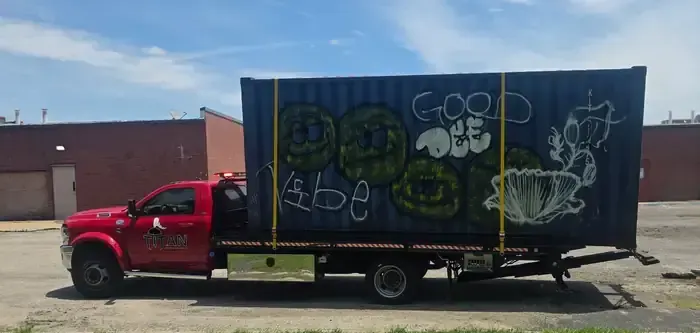
Where a box truck sits between a car and a semi
Box trucks and straight trucks fall in the middle of the weight scale, and that is exactly why they confuse the tow call. The Federal Highway Administration's weight classes, which run from Class 1 to Class 8 by gross vehicle weight rating (GVWR), put Classes 3 to 6, from 10,001 to 26,000 pounds, in the medium-duty band. Class 7 runs from 26,001 to 33,000 pounds, and Class 8 is anything heavier. A cutaway box van can sit near the bottom of that range; a 26-foot straight truck is often rated at the top of it, and some straight trucks are rated heavier still.
The GVWR is printed on the manufacturer's certification label, usually on the driver's door edge or door frame. It is the single most useful number to read to dispatch, because it tells the towing company roughly what the truck can weigh loaded before anyone has seen it. A truck that looks like a large van and a truck that looks like a small semi can both be called a box truck, and they do not get the same tow truck.
Flatbed or wrecker: the details that decide it
There is no single right truck for every box truck. The choice comes down to a handful of details, and the general trade-offs between a deck and a boom are explained in our post on flatbed or wrecker.
- Loaded weight. A rollback's deck and winch have a rated capacity. A lighter box van can ride on one; a heavier straight truck, especially with freight aboard, is wrecker work.
- Length and overhang. A long body behind the rear axle affects whether the truck fits on a deck at all, and how much the front end lifts when the back is picked up, or the reverse.
- Air or hydraulic brakes. Heavier straight trucks commonly have air brakes with spring parking brakes, which lock the wheels when there is no air. Those have to be dealt with before the truck can roll behind a wrecker.
- A liftgate. A liftgate hangs low at the rear. It limits how the truck can be lifted from behind, can drag on a ramp or a deck angle, and has to be stowed and secured for the trip.
- How far it is going. A short move and a long run across the metro can call for different preparation of the drivetrain, covered in the next section.
- Where it is sitting. A loading dock, a tight alley, a parking structure and a highway shoulder each limit which equipment can get to the truck and set up safely.
Protecting the drivetrain and brakes on a longer tow
When a box truck is towed with its drive wheels on the ground, those wheels turn the axle, the driveshaft and part of the transmission even though the engine is off. With the engine not running, the transmission may not be lubricated the way it is when driving. Vehicle manufacturers commonly specify disconnecting the driveshaft, or lifting the drive axle off the road, before a tow of any real distance, and the owner's or body builder's documentation for your truck is the authority on what applies to it.
Air brakes add a step. Spring parking brakes are held off by air pressure, so a truck with no air, or a leak that has dumped it, will not roll freely. The operator either supplies air to the truck's brake system from the wrecker or mechanically cages the spring brakes, then confirms the brakes are released before moving. Trucks with hydraulic brakes have their own considerations, including a driveline parking brake on some models. None of this is something to improvise at the roadside, and it is part of why the right truck and operator matter more than the nearest one.
When the box is full
A loaded box truck can usually be towed with its freight aboard, provided the load is secured and the truck's weight is within what the tow truck is rated for. The load shifts the weight balance, and lifting the front of a truck that is heavy at the back changes the forces on the rear axle, the frame and the wrecker. That is why dispatch asks whether the truck is loaded and roughly with what.
Some situations change the answer. If freight has shifted or broken loose inside the box, if the body is damaged, or if the loaded weight is beyond what the tow truck can safely lift, the load may need to come off first. Arranging the transfer of freight is normally the fleet's or the shipper's job rather than the towing company's, and it is better to know that on the phone than on scene. Temperature-controlled bodies also bring their own clock, since the refrigeration unit may stop when the truck does.
Rental trucks: the rental company usually comes first
If the box truck is a rental or a lease, check the agreement or call the rental company before calling anyone else. Most rental companies run their own roadside assistance process, and many agreements expect you to use it. A tow arranged outside that process may not be reimbursed, and the company may want the truck taken to a particular location.
If the rental company tells you to arrange your own tow or repair, ask for a reference number and the name of the person who authorized it, and ask where the truck should go. Keep a copy of every invoice. Agreements differ, so the rental company is the only reliable answer about what is covered, and nothing here is legal or contract advice.
Faults that often get fixed without a tow
Box trucks strand drivers for many of the same reasons tractors do, and plenty of those faults are repairable where the truck sits. Our mobile truck repair service works on medium-duty trucks as well as Class 8, and the common roadside fixes include the following.
- Batteries, starters and alternators. A no-start or a truck that died while running is often a charging or cranking fault.
- Air leaks and brake faults. Split air lines, leaking fittings, brake chambers and slack adjusters on air-braked trucks.
- Cooling problems. Burst hoses, broken belts and coolant leaks behind an overheating warning.
- Tires. Roadside replacement of a failed tire and the wheel-end damage a blowout leaves behind.
- Derates and sensor faults. DEF and sensor problems that put a diesel into reduced power, read from the fault codes on the spot.
- Lights and wiring. Faults that leave the truck able to run but not legal to drive.
What still ends in a tow
The service truck has honest limits. Engine internals, transmissions and any repair that needs the truck on a lift go to a shop. So does a fault that needs a part nobody carries on a service body, or a repair that would take longer than the location is safe to work in. Liftgate hydraulics and body repairs are specialist work for a liftgate or body shop, not something we fix at the roadside.
When the answer is a tow, the heavy-duty towing and flatbed side runs out of the same Liberty yard, so the call does not start over. For a delivery fleet with several trucks, having an account in place first makes that call shorter; see setting up a fleet towing account. Medium-duty units that pull a trailer, such as a dually with a gooseneck, are a slightly different problem, covered in who tows a broken-down hot shot.
Before you call: the details that pick the truck
Get safe before anything else: hazard flashers on, off the travel lanes if the truck will still move, and warning devices out if the vehicle requires them. Then have these ready for fleet towing dispatch.
- Year, make, model and body length, and the GVWR from the door label if you can read it safely.
- Loaded or empty, roughly what the cargo is, and whether it has shifted.
- Air or hydraulic brakes, and whether the truck still has air.
- Liftgate or not, and whether it is stowed.
- What happened. Warning lights, noises, smoke or leaks, and whether it stopped suddenly or lost power gradually.
- Where it is and where it should go. Exact location, whether you are in a live lane, and the destination shop or yard.
- Unit number and owner. Your fleet name and unit, or the rental company and agreement number.
Related reading
Who Pays When a Semi Breaks Down: Driver, Carrier, Insurer? — Who pays for a truck breakdown depends on the arrangement, not the breakdown.
How to Choose a Heavy-Duty Towing Company — Choose a heavy-duty towing company on five things: whether their operators hold recovery certification such as WreckMaster, whether they carry on-hook and garage-keepers insurance, whether they own the equipment rather than brokering it out, whether a person who knows the trucks answers the phone at 3am, and whether their invoices carry the detail your office needs to reconcile the charge.
How to Set Up a Fleet Towing Account: What to Settle First — Set up a fleet towing account before a truck goes down.
What this covers
Fleet & commercial towing
Fleets do not need a hero, they need a truck that turns up and paperwork that reconciles. We do both.
Fleet & commercial towing detailsHeavy-duty towing
A loaded tractor-trailer is not a bigger car. It needs a rated wrecker, a rated operator and a plan before anything gets hooked. That is what we send.
Heavy-duty towing detailsIn a specific city: Wrecker service: heavy-duty, big rig, semi and semi trailer towing in Kansas City, Missouri · Heavy-duty towing and wrecker service in Liberty, Missouri · Wrecker service: heavy-duty, semi, semi trailer and commercial truck towing in Kansas City, Kansas · Heavy wrecker service and semi towing in Saint Joseph, Missouri · 24/7 semi and heavy-duty towing in Oak Grove, Missouri · Heavy-duty and semi towing in Topeka, Kansas · Heavy-duty wrecker service in Lee’s Summit, MO: semi truck towing, medium-duty towing and accident recovery
Towing near you: Towing and tow trucks in Kansas City, MO · Tow truck service in Kansas City, KS · Towing in Liberty, MO · Towing in Lee’s Summit, MO