
Trailer lights out or acting strange? Start at the seven-way.
Most trailer light failures start at the connection between tractor and trailer: a corroded or loose seven-way plug, a worn pigtail cord, or a bad ground. If several lights fail or behave strangely at once, suspect the ground or the plug. If a single lamp is out, suspect that lamp or its wire. Plugs, pigtails, lamps and harness repairs are routine roadside work.
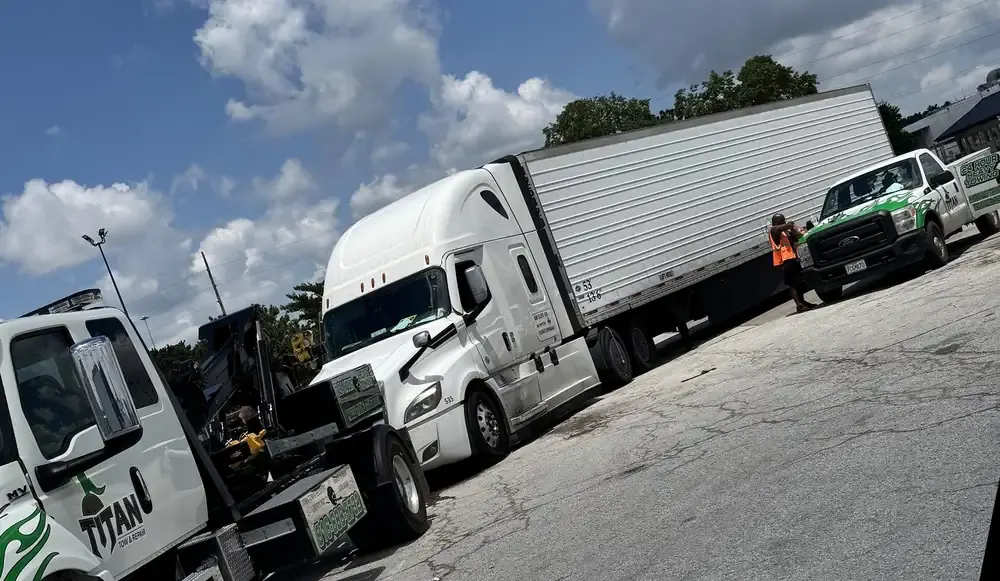
Why trailer lights fail more than anything else on the trailer
Every light on a trailer depends on one electrical connection that lives outdoors, flexes every time the rig turns, and spends its life being soaked, salted and shaken. The coiled pigtail cord between the tractor and the trailer bends thousands of times a day. The plug and the socket collect water, road salt and grime. The harness underneath the trailer runs past crossmembers where it can rub through. It is not surprising that lighting faults are among the most common trailer problems there are.
The good news is that lighting faults are also among the easiest to trace, because the pattern of which lights are out tells you most of what you need to know. Before anyone starts replacing lamps, it is worth reading that pattern.
What each pin in the seven-way connector does
Most North American tractor-trailers use a standard seven-way connector, and most follow the same color coding for the wires behind each pin. Trailers do get rewired over their lives, so treat this as the usual layout rather than a guarantee, and confirm it on the trailer in front of you before relying on it.
- White — ground. The shared return path for every lighting circuit on the trailer.
- Black — clearance, side marker and identification lamps.
- Yellow — left turn signal and hazard flashers.
- Red — stop lamps.
- Green — right turn signal and hazard flashers.
- Brown — tail and license plate lamps.
- Blue, the center pin — auxiliary, commonly used to supply constant power to the trailer's anti-lock brake system.
Read the pattern of what is out
- Everything on the trailer is dead. Start at the connection: a plug that is not fully seated, a broken pigtail, or a fault on the tractor side such as a blown fuse or a damaged socket.
- Several lights are dim, flicker, or light up when they should not. Markers that glow faintly when the turn signal flashes, or brake lights that pulse with the blinkers, are the classic signs of a bad ground. Current that cannot return through the white wire finds its way back through other circuits instead.
- One function is out everywhere. If every stop lamp is out but the tails work, the fault is on that one circuit: its pin in the plug, its wire in the pigtail, or its connection in the trailer's junction box.
- A single lamp is out. The lamp itself or the short wire and connector feeding it. On modern sealed LED lamps, a failed lamp is replaced as a unit.
- The lights come and go when the cord moves. A wire broken inside the pigtail's insulation, or a loose or corroded terminal in the plug, is almost always the cause.
Checks a driver can do in a few minutes
- Walk around with the lights on. Turn on the headlights and the hazard flashers and walk the trailer, noting exactly which lamps work, which do not, and which look dim. Check the stop lamps too, with someone applying the brakes if you can.
- Unplug and look. Pull the plug out of the trailer socket and inspect both sides. Green or white crust on the pins, pins that are bent or spread apart, and melted or cracked plastic are all causes on their own.
- Reseat it properly. Push the plug fully home and make sure the socket's spring cover latches over it. A plug that is only partly seated can make some circuits and not others.
- Do the wiggle test. With the lights on, flex the pigtail along its length and near each end. Lights that flicker as the cord moves point to a broken wire inside it.
- Split tractor from trailer. If another trailer or a plug tester is available, check whether the tractor's socket supplies every circuit. That tells you immediately which half has the fault.
What gets fixed where the trailer stands
Almost every trailer lighting fault is a roadside repair. The service truck replaces seven-way plugs and sockets, pigtail cords, lamps and lamp connectors, repairs broken or corroded ground connections, and repairs damaged sections of harness with sealed connections that are made to stay dry. Junction box corrosion, where the pigtail's circuits split off to the rest of the trailer, is cleaned or repaired on site as well.
There is an honest limit. A trailer whose wiring harness has rotted or chafed through along much of its length is better rewired properly in a shop than patched in a dozen places at the roadside, because each patch is a new place for water to get in. If that is what we find, we will fix what gets the trailer safely on its way and tell you plainly that the harness needs replacing. The trailer repair page covers the rest of the faults the service truck handles.
Why it is worth fixing before the next trip
Trailer lights are not a cosmetic problem. At night and in rain, marker and tail lamps are how other drivers judge the length and position of a trailer, and stop and turn lamps are how they know what it is about to do. A trailer with dark lamps is a hazard, and lighting defects are among the first things an officer or an inspector notices. Our post on DOT out-of-service faults covers how inspections treat brake and lighting problems.
There is also a less obvious reason. On many trailers the blue center pin supplies power to the anti-lock brake system. When that circuit fails, the trailer's ABS warning lamp usually comes on, and the trailer's anti-lock function is lost even though the brakes themselves still work. A lighting fault at the plug can therefore be a braking system fault too.
Making the repair last
The difference between a lighting repair that lasts years and one that fails in a month is mostly about water. Connections are made with sealed, heat-shrink connectors rather than twisted wires and tape. Clean terminals get a coating of dielectric grease before the plug goes back in. The pigtail is supported so its weight is not hanging off the terminals, and harness runs are clipped away from edges where they could rub through.
None of that takes long, and all of it is cheaper than a second road call for the same fault. If your trailer keeps losing lights in the same place, say so when you call, because a repeat failure usually means the root cause — a rub point, a water path or a failing ground — has not yet been found.
Related reading
Trailer Brake Dragging or a Hot Hub: Roadside Fix or Tow? — A dragging trailer brake heats one hub, and a hot hub can end in a wheel-off or a fire.
DOT Out of Service: Faults That Freeze a Running Truck — An out-of-service order means the vehicle legally cannot move until the listed fault is repaired, even if it runs perfectly.
Reefer Down: Protecting the Load When the Unit Stops Cooling — When a reefer stops cooling, the load is the emergency, not the trailer.
What this covers
Trailer repair
Most trailer faults do not stop a trailer moving. They stop it being legal to move, which is worse — the load sits while the paperwork says it cannot go anywhere.
Trailer repair details