
What does a mobile diesel mechanic actually fix where the truck sits?
A mobile diesel mechanic is a technician who drives to your truck with the diagnostic gear, the tools and the common parts, instead of the truck being towed to a shop. At the roadside that covers air and brake faults, batteries and charging, cooling, DEF and sensor problems, fault-code diagnostics, suspension, trailers and tires. Engine internals, transmissions and anything needing a lift stay shop work.
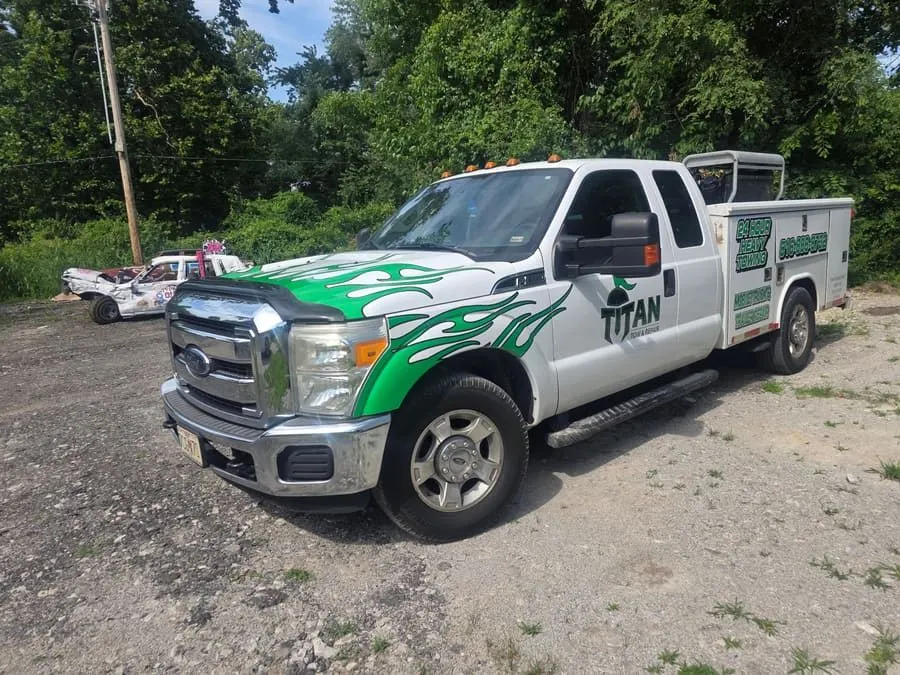
What a mobile diesel mechanic actually is
A mobile diesel mechanic is not a different trade from a truck mechanic. It is the same work, moved. The technician brings the scan tool, the hand tools and a service body stocked with the parts that fail most often, and works on the vehicle where it stands — on a shoulder, at a dock, in a yard, at a scale or a truck stop lot.
That makes it a third option, separate from the two most drivers think of first. A shop has the lifts and the parts counter, and the truck has to get there; a tow is what moves it when it cannot, at a cost on top of the repair. A mobile call skips both when the fault finishes at the roadside, and a large share of what strands a truck is exactly that. What it is not is a full shop on wheels. Our mobile truck repair page lists what the service truck handles.
What gets fixed where the truck stands
The list below is what our service truck works from across the Kansas City metro and northwest Missouri: the work that genuinely finishes at the roadside rather than starting there and ending somewhere else.
- Air systems and brakes. Air leaks, brake chambers, slack adjusters and glad hands. A truck that will not build or hold air is the classic mobile call: the failure is usually a line, a fitting or a chamber.
- Batteries and charging. Testing and replacing batteries, alternators and starters. A no-start is worth diagnosing first: a flat battery, a bad ground and a failed starter all sound alike from the seat.
- Cooling systems. Radiators, hoses, belts, leaks and overheating. Some are a hose and coolant; some are a tow, depending on whether the engine kept running after the temperature climbed.
- Diesel engine faults. Hard starts, no-starts, derates, and DEF and sensor problems — the faults that stop a modern truck with nothing mechanical broken.
- Fault-code diagnostics. Codes read on the spot instead of guessed at. On a recent truck they usually decide the answer, including whether the job is roadside work at all.
- Suspension and steering. Air bags, shocks and worn steering components, often what separates a truck unsafe to move from one that can be driven in.
- Trailer repairs. Lights, wiring, landing gear, doors and air lines, covered on our trailer repair page. Most trailer faults do not stop a trailer rolling; they stop it being legal to roll.
- Tires. Steer, drive and trailer positions replaced where the vehicle stands, plus the wheel-end hardware a failure takes with it — see mobile tire service.
The jobs that are shop work, and why
A service truck has no lift, no press and no parts department behind it, and the jobs below need one or more of the three. Hearing that on the phone is cheaper than finding out after two hours on a shoulder.
- Engine internals. Anything that needs the engine opened — head work, injectors buried in the valley, bearings, or an internal coolant loss.
- Transmissions and clutches. Both are heavy, both sit under the truck, and both need it properly supported first.
- Anything that needs a lift. If the repair only starts once the truck is off the ground, it is not a roadside job. Working under a truck on a shoulder is not negotiable.
- Wheel alignment. Alignment needs shop equipment and a level floor. A truck that wanders or pulls can be diagnosed at the roadside, not aligned there.
- Refrigeration units. A reefer plant that will not hold temperature is a sealed system and specialist work. We repair the trailer it is bolted to, not the unit.
- Structural welding. Frame, crossmember and rear-frame damage is shop fabrication work.
- DOT annual inspections. We do not perform them. A roadside repair can make a truck legal to move again, which is a different thing.
Codes first, parts second
The most useful thing a driver can do before the service truck rolls is read the dash carefully. The lamps, the messages and whether the engine has stepped down in power narrow the job from a category to a fault, which decides what parts get loaded.
A derate is the clearest example. When an aftertreatment or DEF fault puts a truck into limp mode, nothing mechanical has necessarily failed — the engine is being held down deliberately, and the repair is often a sensor, a wiring fault or a regen that needs to complete. Our post on a truck in derate or limp mode covers it.
They also bear on whether you should be driving at all. 49 CFR 396.7 says a vehicle must not be operated in a condition likely to cause an accident or a breakdown, and that one discovered unsafe on the highway may continue only to the nearest place where repairs can safely be made, and only where that is less hazardous than leaving it there.
Nights, weekends and the hours a shop is shut
Two of the things people type alongside "mobile diesel mechanic" are "24 hour" and "open now", and they are the same question: is anybody coming out at 2am on a Sunday? Our service truck runs the same round-the-clock dispatch as the wreckers, nights, weekends and holidays included, and a person answers the phone.
That matters more for repair than for towing, because the alternative is measured in shifts rather than hours. An air leak or a trailer light fixed overnight puts the load back on the road before a shop unlocks its gate, and the emptier roads usually make the work safer than the same job in traffic.
Nobody can honestly print a response time: it depends on where the truck already is, the weather and what else is down, so you get a real figure on the phone instead.
How a road call is priced
Mobile repair is quoted per job rather than off a rate card, and the reason is in the diagnostics: the same symptom can be several faults with very different parts and labor. What you pay for is the call-out, the time on scene, and the parts fitted. Any company worth calling explains which apply before it rolls.
The comparison that matters is not the repair against a shop's hourly rate. It is the repair against the whole of the other route — the tow, the shop's own diagnosis and labor, and the days the truck and its load wait for a bay. We took that apart in what mobile truck repair costs in Kansas City, including the honest exception: when the fault is genuinely shop work, a mobile call that ends in a tow costs more than calling the tow first.
What to have ready when you call
The parts on the service truck when it leaves are chosen from what you say on the phone, which is how a vague call turns into two trips.
- What the truck is. Make, model, year and engine. That decides which parts fit, before anyone drives anywhere.
- What the dash says, word for word. Lamps, messages and the actual fault codes if you can pull them. An exact code often decides the job; a paraphrase does not.
- What it is doing, and when it started. Cranks but will not start, will not build air, running hot, lost power on a grade, pulling to one side — and what changed just before it.
- Whether it still moves. A truck that can be driven off the shoulder into a safe lot is a different job from one stuck in a live lane.
- Exactly where it is. Highway and mile marker with your direction of travel, or the building and dock number. In this metro, which side of the Missouri-Kansas line you are on matters too.
- Who authorizes the work. On a fleet truck, the name, the purchase order and where the invoice goes, so nothing waits on an office to open.
- What has already been tried. A battery already swapped or a filter already changed is diagnosis time you should not pay for twice.
When the honest answer is a tow
A mobile call is not always the right call, and the useful version of this service says so before taking your money. The shop list above is the boundary: when the repair needs the truck lifted, a part nobody carries on a service body, or the engine or gearbox opened, the only question left is how the truck gets there.
Location can decide it on its own, whatever the fault is. A unit with no room to work safely outside a live lane gets moved first and repaired second. Under 49 CFR 392.22 the hazard warning flashers go on immediately when a commercial vehicle stops on the traveled portion of a highway, and the warning devices go out as soon as possible and within ten minutes at the latest.
Because the wrecker and the service truck come out of the same yard in Liberty, that decision costs you no second phone call. When the diagnosis says shop, the heavy-duty towing is already ours, and the truck goes to your shop, your yard or ours.
Related reading
Semi Brakes Won't Release: What to Check First — Spring brakes are held off by air, so brakes that will not release almost always mean air is not reaching them.
Semi Running Hot: Pull Over or Push On to the Next Exit? — A climbing gauge under heavy load on a grade can be normal; a gauge that keeps climbing after you shed load and speed is not.
Semi Won't Start: Jump Start, Batteries or Starter? — Listen to what the truck does when you turn the key.
What this covers
Mobile truck repair
Our service truck carries the parts and the tools. Faster for your driver, cheaper for your office, and the load keeps moving.
Mobile truck repair detailsIn a specific city: Mobile semi truck repair in Kansas City, Missouri · Mobile truck and trailer repair in Riverside, Missouri · Mobile truck and trailer repair in Liberty, Missouri