
How long does a roadside truck tire change actually take?
The tire change itself is usually the shortest part of a roadside tire call. What decides the total time is how long it takes to reach you, where on the truck the tire is, whether the right size is already on the service truck, the condition of the studs and nuts, and doing the safety setup and the torque properly. An inside dual or a damaged wheel end takes longer.
Where the time actually goes
When a driver asks how long a roadside tire change takes, they are usually picturing the moment the wheel comes off and the new tire goes on. That part is often quick. The total time from the phone call to the truck rolling again is made up of several steps, and knowing what they are makes it much easier to judge whether a call is going well.
- Reaching the truck. The service truck has to drive to wherever you are, and distance, traffic and weather decide how long that takes.
- Setting up safely. On a shoulder, the service truck is positioned to protect the work area, warning lights go on and the area is made as safe as it can be before anyone kneels beside a live lane.
- Lifting and removing the wheel. The truck is raised on firm footing and the wheel comes off. On a dual position, the outer wheel may have to come off first.
- Mounting and inflating. The replacement tire is mounted, inflated safely and checked.
- Torquing and checking. The wheel nuts are tightened to the correct torque in the correct sequence, pressures are checked on the tire and its partner, and the work area is cleared.
Position matters: steer, drive, trailer, inside or outside
Where the damaged tire sits on the truck changes the job. A steer tire is a single wheel and is usually straightforward to reach, but it is also the most urgent: a truck cannot safely go anywhere on a damaged steer tire. An outside dual on a drive or trailer axle is the quickest of the dual positions, because it comes straight off.
An inside dual takes longer, because the outer wheel has to be removed first to reach it and then refitted afterwards. Trailer tandems add their own considerations, particularly on a loaded trailer where lifting the right axle on firm ground matters. Tell dispatch the exact position — which axle, which side, inside or outside — and the service truck arrives knowing what the job involves.
Whether the right tire is already on the truck
The biggest single variable in a roadside tire call is whether the right tire is already on board. Our service truck carries tires in the common commercial sizes, so for most calls the replacement comes on the first trip and the job is done in one visit. When a truck runs an uncommon size, a wide-base single, or a low-profile tire that is not carried, the replacement has to be sourced, and that adds time that has nothing to do with the work itself.
The fix is simple: read the size off the sidewall of the damaged tire, or its partner, before you call, and give it to dispatch along with the position. It is printed as a string such as 11R22.5 or 295/75R22.5, and it decides whether the tire is already on the way or has to be found first.
Studs, nuts and wheel ends can turn a quick change into a longer one
Some tire calls turn out to be wheel-end calls. Wheel nuts that have seized onto their studs, studs that are stretched, cross-threaded or broken, and damage to the hub from running on a flat all take time to deal with properly, and none of them should be ignored just to get the new tire on. A wheel held on by a damaged stud is a wheel that can come off later.
Studs, nuts and the hardware a tire failure takes with it are replaced at the roadside as part of the job. But if the hub or the bearing has run hot — the grease is burned, the hub is discolored, or the wheel end is too hot to touch — that is no longer a tire change. A cooked bearing needs the wheel end taken apart in a shop, and the axle is lifted and towed there rather than asked to carry the truck any further. Our post on a dragging brake or hot hub explains how to tell the difference.
Why the torque step is not optional
Tightening wheel nuts is where a rushed roadside job does its damage. Nuts that are too loose let the wheel move against the hub, wearing the stud holes and eventually shearing studs; nuts that are too tight stretch the studs and can crack the wheel. Both end the same way, with a wheel that is not properly secured. The nuts are brought to the specified torque with a calibrated tool, in a crossing pattern so the wheel seats evenly against the hub.
Wheel and hub manufacturers commonly recommend re-checking wheel nut torque after the first 50 to 100 miles following a wheel installation, because the joint can settle as it seats. That is not a sign the job was done wrong; it is part of doing it right. Make a note of it, or have your shop check it at the next stop.
Safety is part of the job, not an extra
Changing a truck tire beside a live lane is dangerous work, and the setup time is what keeps it from going wrong. The jack goes on firm ground, not soft shoulder. A loaded truck is lifted at the right point and supported properly before anyone reaches under it.
A tire that has been run flat or badly underinflated is treated with particular caution. Its casing can be damaged in ways that are not visible, and a weakened casing can fail violently when it is inflated again. That is why a tire that has run flat is replaced rather than aired back up, and why tires are inflated with the technician positioned out of the path of a possible failure. If a roadside tire change ever seems to be skipping these steps to save a few minutes, it is saving them in the wrong place.
How to make your call faster
- The position. Steer, drive or trailer; which axle; which side; inside or outside dual.
- The size. Read off the sidewall, for example 11R22.5 or 295/75R22.5.
- The location. Mile marker and direction of travel, or a building and dock door.
- Where the truck is sitting. Shoulder, exit ramp, parking lot or yard, and whether it is in or near a live lane.
- Loaded or empty. It changes how the truck is lifted and supported.
- Anything else wrong. A hot hub, a damaged fender, brake lines hit by tire debris or a broken stud change what the service truck needs to bring.
Our side of it
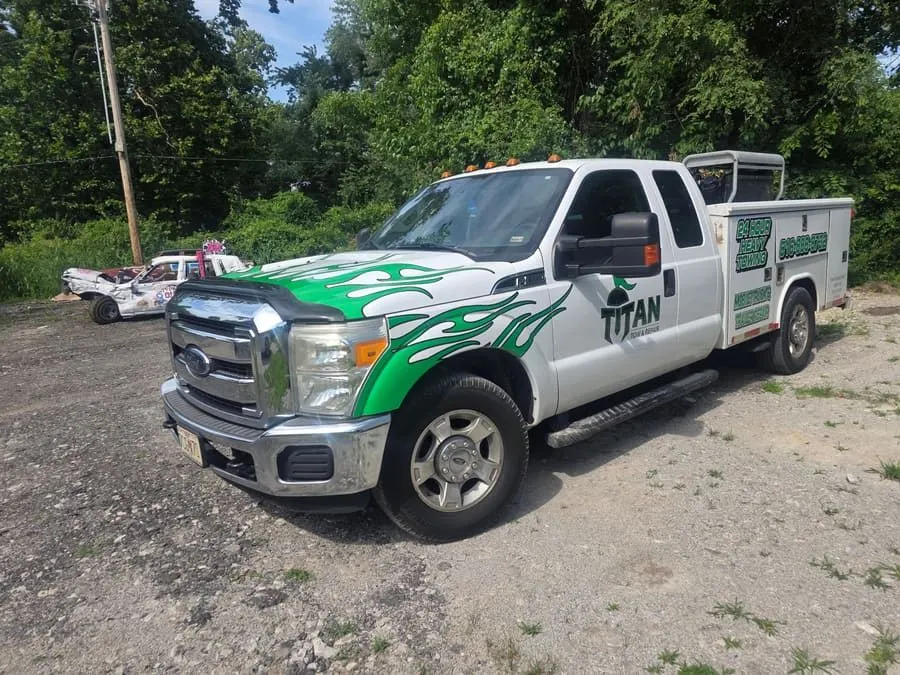
From our Liberty yard the service truck covers the Kansas City metro and the main corridors around the clock, with commercial tires in the common sizes already on board. Steer, drive and trailer positions, inside and outside duals, and the wheel-end work that comes with a blowout are all handled where the truck stands. The mobile tire service page lists what we do, and what we do not.
If the tire has just failed and you are still deciding what to do, read what to do after a truck tire blowout first. It covers the minutes between the bang and the phone call, which are the minutes that matter most.
Related reading
Truck Tire Blowout on the Highway: Do These Five Things — Do not brake hard and do not fight the wheel with sudden corrections.
What this covers
Mobile tire service
A blown tire is the most common thing that stops a truck, and the one most often fixed on the shoulder. We bring the tire to you rather than the truck to a shop.
Mobile tire service details